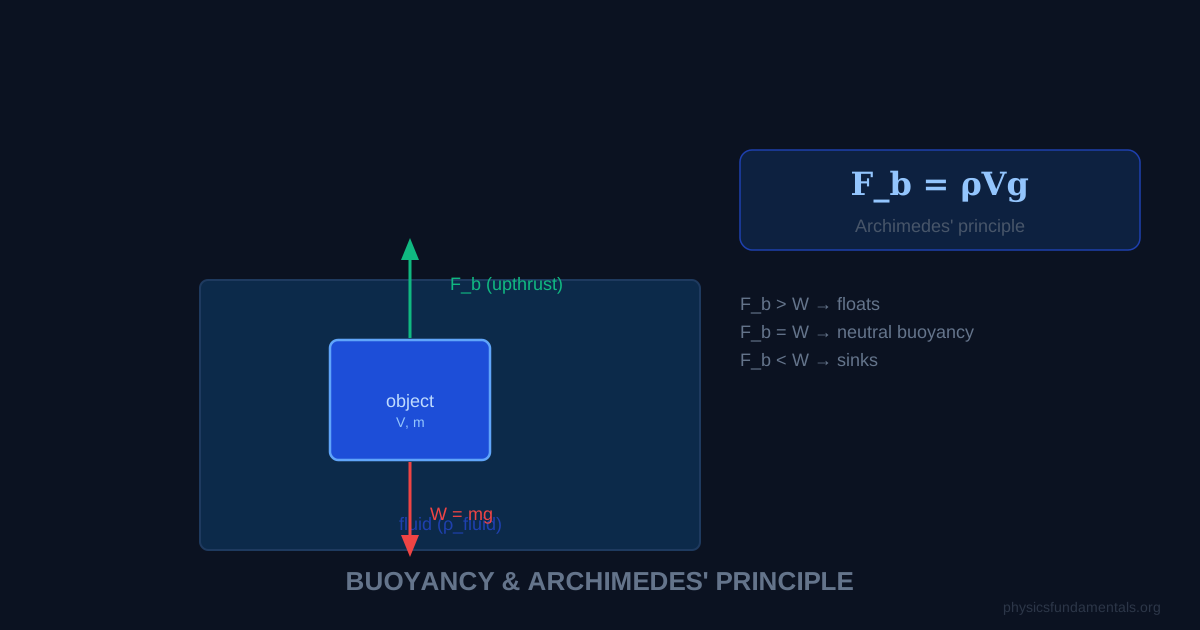
Archimedes' principle states that the buoyant force on an object equals the weight of fluid it displaces. The formula is F_b = ρ_fluid × V_displaced × g, where ρ_fluid is the fluid density, V_displaced is the volume of fluid displaced, and g is gravitational field strength (9.81 m/s²). An object floats when this buoyant force equals or exceeds its own weight; it sinks when its weight exceeds the buoyant force.
The principle was discovered by Archimedes of Syracuse around 250 BC, reportedly when he stepped into a bath and noticed the water level rise. He realised that the volume of water displaced equalled the volume of his body — and that this gave him a way to measure volumes of irregular objects without geometry. The story of him running through the streets shouting "Eureka!" is probably embellished, but the physics is exactly right.
- The buoyant force formula F_b = ρVg and where it comes from
- Why objects float, sink, or hover neutrally — the conditions explained
- 4 worked examples including ships, submarines, and density measurement
- How to use Archimedes' principle to find the density of irregular objects
- Real applications: hot air balloons, ships, submarines, hydrometers
Archimedes' Principle — Statement and Formula
Any object fully or partially submerged in a fluid experiences an upward buoyant force equal to the weight of fluid displaced by the object.
Where:
- F_b = buoyant force (upthrust), in newtons (N)
- ρ_fluid = density of the fluid, in kg/m³ (water: 1000 kg/m³; seawater: ~1025 kg/m³)
- V_displaced = volume of fluid displaced by the object, in m³
- g = gravitational field strength = 9.81 m/s²
Use our Buoyancy Calculator to find the buoyant force, displaced volume, or required density for any scenario.
Where the formula comes from
Pressure in a fluid increases with depth: P = ρgh. The pressure on the bottom face of a submerged object is greater than on the top face (because the bottom face is deeper). This pressure difference creates a net upward force — the buoyant force.
For a rectangular object of height h, cross-sectional area A, submerged to depth d at its top face:
- Pressure on bottom face: P_bottom = ρ_fluid × g × (d + h)
- Pressure on top face: P_top = ρ_fluid × g × d
- Net upward force: F_b = (P_bottom − P_top) × A = ρ_fluid × g × h × A = ρ_fluid × g × V
This derivation works for any shape — the result always comes out to ρ_fluid × V_displaced × g, which is exactly the weight of the displaced fluid.
Float, Sink, or Hover — The Three Conditions
An object's behaviour in a fluid is determined by comparing its average density to the fluid's density:
- ρ_object < ρ_fluid → floats. The object displaces fluid equal to its own weight before being fully submerged. Wood (ρ ≈ 600 kg/m³) floats on water (ρ = 1000 kg/m³).
- ρ_object = ρ_fluid → neutral buoyancy. The object hovers at any depth without rising or sinking. Submarines adjust ballast to achieve this. Fish use a swim bladder for the same purpose.
- ρ_object > ρ_fluid → sinks. Steel (ρ ≈ 7800 kg/m³) sinks in water. Even so, the buoyant force still acts upward — the object just weighs more than the fluid it displaces.
For a floating object, the fraction submerged equals the ratio of densities:
An iceberg (ρ ≈ 917 kg/m³) in seawater (ρ ≈ 1025 kg/m³) has 917/1025 ≈ 89% of its volume below the surface. The famous "90% underwater" figure is approximately correct.
4 Worked Examples
Example 1 — Buoyant force on a submerged block
Problem: A solid steel cube of side 0.1 m is fully submerged in water. Calculate the buoyant force. (ρ_water = 1000 kg/m³, g = 9.81 m/s²)
Solution:
V = 0.1³ = 0.001 m³
F_b = ρVg = 1000 × 0.001 × 9.81
F_b = 9.81 N
The steel cube has a weight of ρ_steel × V × g = 7800 × 0.001 × 9.81 = 76.5 N. The net downward force is 76.5 − 9.81 = 66.7 N — it sinks, but feels much lighter underwater.
Example 2 — Will a log float?
Problem: A pine log has density 520 kg/m³ and volume 0.08 m³. Will it float in fresh water (ρ = 1000 kg/m³)? If so, what fraction is submerged?
Solution:
Since ρ_log (520) < ρ_water (1000), it floats.
Fraction submerged = ρ_log / ρ_water = 520/1000 = 0.52 = 52%
Weight of log = 520 × 0.08 × 9.81 = 407.9 N
Check: buoyant force = 1000 × (0.52 × 0.08) × 9.81 = 407.9 N ✓
Example 3 — Measuring density with Archimedes' principle
Problem: A rock weighs 28 N in air. When fully submerged in water, it appears to weigh 21 N. Find the density of the rock.
Solution:
Buoyant force = apparent weight loss = 28 − 21 = 7 N
F_b = ρ_water × V × g → V = F_b / (ρ_water × g) = 7 / (1000 × 9.81) = 7.14 × 10⁻⁴ m³
Mass of rock = W/g = 28/9.81 = 2.854 kg
ρ_rock = m/V = 2.854 / (7.14 × 10⁻⁴) = 3997 kg/m³ ≈ 4000 kg/m³
This is the classic method Archimedes used to check whether a crown was pure gold.
Example 4 — Hot air balloon
Problem: A hot air balloon has a total volume of 2500 m³. The density of hot air inside is 0.95 kg/m³. Ambient (cool) air density is 1.22 kg/m³. The balloon envelope and basket have a combined mass of 500 kg. What is the maximum payload the balloon can lift?
Solution:
Buoyant force = ρ_cool × V × g = 1.22 × 2500 × 9.81 = 29,920.5 N
Weight of hot air = ρ_hot × V × g = 0.95 × 2500 × 9.81 = 23,298.75 N
Weight of envelope + basket = 500 × 9.81 = 4905 N
Net upward force = 29,920.5 − 23,298.75 − 4905 = 1716.75 N
Maximum payload mass = 1716.75 / 9.81 = 175 kg
Apparent Weight
When an object is submerged in a fluid, its apparent weight is less than its true weight by the buoyant force:
This is why objects feel lighter underwater. A 10 kg rock (true weight 98.1 N) fully submerged in water displaces about 0.0037 m³ (assuming density ≈ 2700 kg/m³), giving F_b = 1000 × 0.0037 × 9.81 = 36.3 N. Its apparent weight is 98.1 − 36.3 = 61.8 N — about 37% lighter.
Applications of Archimedes' Principle
Ships are made of steel (ρ ≈ 7800 kg/m³), yet they float because the hull is hollow. The average density of the ship — steel plus all the air inside — is less than water. A ship floats because its total weight equals the weight of water displaced by its hull below the waterline.
Submarines adjust buoyancy by filling or emptying ballast tanks with seawater. Empty tanks: submarine is less dense than water, rises. Full tanks: submarine is denser than water, sinks. Partial fill: neutral buoyancy, hovers at depth.
Hydrometers measure fluid density directly using Archimedes' principle. A calibrated weighted float sinks deeper in less dense liquids and less deep in denser ones. Used for testing battery acid, alcohol content, and milk quality.
Balloons and airships work on exactly the same principle as floating objects, but in air. A helium balloon (ρ_He ≈ 0.164 kg/m³) is much less dense than air (ρ_air ≈ 1.22 kg/m³), so the buoyant force exceeds the weight of the helium and balloon, and it rises.
Apparent Weight and Weighing in Fluids
The apparent weight of a submerged object is its true weight minus the buoyant force:
This is exactly what a spring balance reads when you weigh an object underwater. The reduction in apparent weight is the buoyant force — and this gives a direct experimental method for measuring the density of an irregular solid: weigh it in air (W_air) and in water (W_water), then:
This is Archimedes' original method for testing the purity of the king's crown. If the crown weighed 30 N in air and 22.5 N in water: ρ = 1000 × 30/(30−22.5) = 1000 × 30/7.5 = 4000 kg/m³. Pure gold is 19,300 kg/m³ — the crown was heavily alloyed with cheaper metal.
Pressure Derivation of Buoyancy
The buoyant force arises purely from the pressure difference between the bottom and top faces of a submerged object. For a rectangular block of height h and cross-sectional area A, with its top face at depth d:
- Pressure on top face: P_top = ρ_fluid × g × d (downward force = P_top × A)
- Pressure on bottom face: P_bottom = ρ_fluid × g × (d + h) (upward force = P_bottom × A)
- Net upward force: F_b = (P_bottom − P_top) × A = ρ_fluid × g × h × A = ρ_fluid × g × V
This derivation shows that buoyancy is purely a pressure phenomenon — it doesn't depend on what the object is made of, only on the volume of fluid displaced and the fluid's density. A hollow steel sphere and a solid steel sphere of the same outer volume experience identical buoyant forces, even though their masses differ enormously.
Floating Objects — Fraction Submerged
For a floating object, the buoyant force exactly equals its weight:
This ratio — the fraction submerged — depends only on the ratio of densities:
- Oak wood (ρ = 700 kg/m³) in water: 700/1000 = 70% submerged
- Ice (ρ = 917 kg/m³) in seawater (ρ = 1025 kg/m³): 917/1025 = 89.5% submerged — consistent with the "iceberg" observation
- Cork (ρ = 240 kg/m³) in water: 24% submerged — only a quarter underwater
Buoyancy in Gases — Balloons and Airships
Archimedes' principle applies to gases as well as liquids. A helium balloon (ρ_He = 0.164 kg/m³) displaces air (ρ_air = 1.22 kg/m³). The buoyant force per cubic metre:
A 1 m³ helium balloon can lift 10.36 − weight of balloon envelope ≈ 10 N of payload (about 1 kg). Large weather balloons (V ≈ 1 m³ at launch, expanding to ~10 m³ at altitude as pressure drops) can carry 1–2 kg of instruments to 30 km altitude. The Hindenburg airship (V = 200,000 m³, filled with hydrogen) had a lift capacity of about 230 tonnes, of which roughly 100 tonnes was available as useful payload after the structure's own weight.
Worked Example 5 — Balloon payload
Problem: A spherical helium balloon has diameter 2 m. The envelope mass is 0.5 kg. What maximum payload mass can it lift? (ρ_He = 0.164 kg/m³, ρ_air = 1.22 kg/m³, g = 9.81 m/s²)
Solution:
V = (4/3)π(1)³ = 4.189 m³
Buoyant force = ρ_air × V × g = 1.22 × 4.189 × 9.81 = 50.11 N
Weight of helium = ρ_He × V × g = 0.164 × 4.189 × 9.81 = 6.74 N
Weight of envelope = 0.5 × 9.81 = 4.91 N
Net upward force = 50.11 − 6.74 − 4.91 = 38.46 N
Maximum payload mass = 38.46/9.81 = 3.92 kg
Stability of Floating Objects
A floating object is stable if its metacentre lies above its centre of gravity. The metacentre is the point through which the buoyant force acts when the object is slightly tilted. If it's above the CoG, tilting creates a restoring couple that rights the vessel. If it's below the CoG, tilting creates a capsizing couple. This is why ships are designed with heavy ballast low in the hull and wide beams at the waterline — both raise the metacentric height, improving stability. The tragic sinking of the Swedish warship Vasa in 1628 resulted from an insufficient metacentric height: the vessel was too top-heavy and capsized in a gust of wind within minutes of launching.
Common Exam Mistakes
Mistake 1 — Using object density instead of fluid density. The buoyant force depends on the fluid's density and the displaced volume, not the object's density. F_b = ρ_fluid × V_displaced × g. The object's density only matters for determining whether it floats (comparison with fluid density) or for finding the displaced volume if the object is partially submerged.
Mistake 2 — Using total object volume when partially submerged. For a floating object, V_displaced is only the submerged portion, not the total volume. Use V_submerged = (ρ_object/ρ_fluid) × V_total.
Mistake 3 — Forgetting buoyancy when objects are fully submerged. Even a heavy sinker on a fishing line experiences an upward buoyant force. The net downward force pulling the fishing line is W_true − F_b, not W_true.
The distinction between apparent weight and buoyant force is tested regularly at A-Level. The buoyant force is the upward force from the fluid; the apparent weight is what a balance reads; the true weight is mg. They are related by: true weight = apparent weight + buoyant force. This relationship can be rearranged to find any one of the three if you know the other two — and knowing ρ_fluid and either V or ρ_object gives you F_b directly.
Frequently Asked Questions
What is Archimedes' principle?
Why do ships made of steel float?
What is the buoyant force formula?
What is neutral buoyancy?
Does buoyancy depend on depth?
Share this article
Written by
Physics Fundamentals Editorial Team
Written and reviewed by our team of physics educators. Content is aligned with A-Level, GCSE, AP Physics, and undergraduate curricula.
About Physics Fundamentals →