In 1905, Einstein won his Nobel Prize — not for relativity, but for explaining why shining light on a metal ejects electrons. The phenomenon was strange: dim blue light ejected electrons immediately, while intense red light ejected none at all, no matter how bright. Classical wave physics had no explanation. Einstein did: light comes in discrete packets of energy (photons), and each packet either has enough energy to free an electron or it doesn't. Intensity doesn't help if the individual photons are too weak.
That insight — that light is quantised — was the moment quantum mechanics became unavoidable. The photoelectric effect is not just an interesting historical footnote; it's the clearest single experiment that proves light has particle properties, and it's the basis of solar cells, photodetectors, night-vision cameras, and the sensors in every digital camera you've ever used.
- Why classical wave theory fails to explain the photoelectric effect — specifically and precisely
- Einstein's photon explanation: hf = φ + KEₘₐₓ — what each term means
- Work function, threshold frequency, and stopping potential — defined and calculated
- Real applications: solar cells, photomultiplier tubes, and digital camera sensors
What Is the Photoelectric Effect?
The photoelectric effect is the emission of electrons from a metal surface when electromagnetic radiation of sufficient frequency is shone on it. The emitted electrons are called photoelectrons.
Discovered experimentally by Heinrich Hertz in 1887 and investigated thoroughly by Philipp Lenard in the 1900s, the effect had features that classical wave physics could not explain:
- Electrons are only emitted above a certain threshold frequency f₀ — below this, no emission occurs no matter how intense the light.
- Above the threshold, emission is instantaneous — no time delay as energy builds up.
- The maximum kinetic energy of emitted electrons depends on frequency only, not intensity.
- Increasing light intensity increases the number of electrons emitted, not their speed.
Classical wave theory predicted the opposite: any frequency should eventually cause emission (given enough intensity), with brighter light producing faster electrons. The experimental results were completely at odds with this.
Einstein's Explanation: Light as Photons
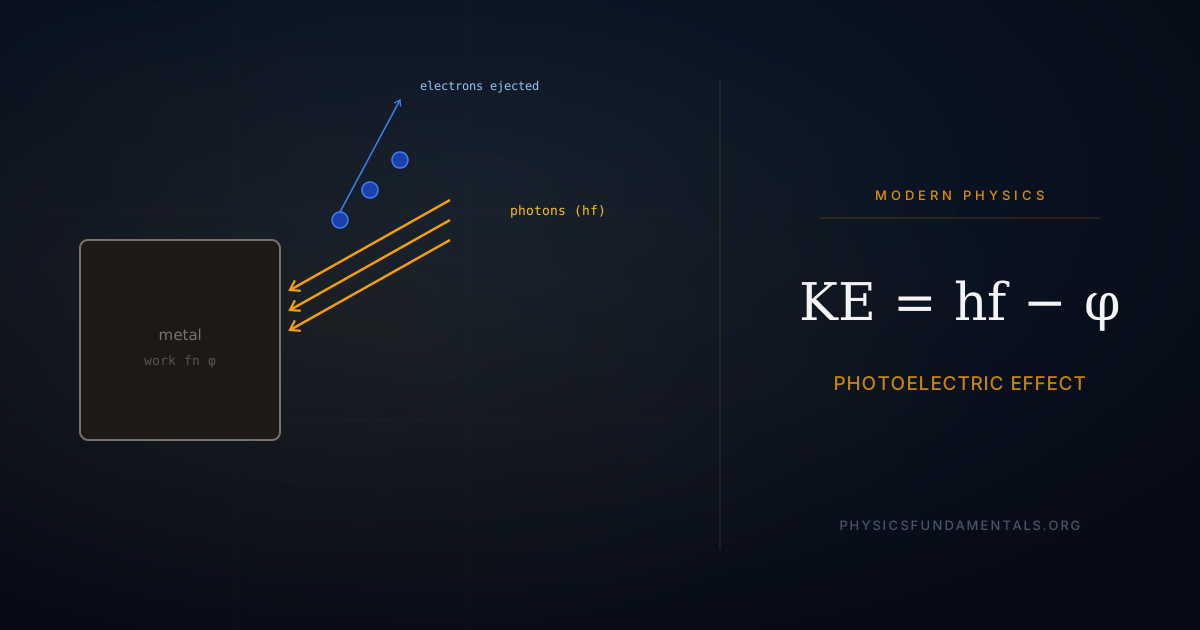
Einstein's 1905 solution was radical: light is composed of discrete packets of energy called photons. Each photon carries energy:
where h = 6.626 × 10⁻³⁴ J·s is Planck's constant (introduced by Planck in 1900 for a different problem) and f is the frequency. A photon either has enough energy to eject an electron or it doesn't — there's no accumulation of energy from multiple photons.
When a photon strikes a metal surface, it transfers all its energy to a single electron. Some energy goes into freeing the electron from the metal (the work function φ), and the rest becomes kinetic energy:
This is Einstein's photoelectric equation. It predicts every observed feature of the photoelectric effect.
The Work Function φ
The work function φ is the minimum energy required to remove an electron from the metal surface — the energy cost of escaping the material. It is measured in joules or electron-volts (1 eV = 1.6 × 10⁻¹⁹ J).
| Metal | Work function φ (eV) | Threshold frequency f₀ | Light needed |
|---|---|---|---|
| Caesium (Cs) | 2.1 eV | 5.07 × 10¹⁴ Hz | Visible (green) |
| Sodium (Na) | 2.36 eV | 5.71 × 10¹⁴ Hz | Visible (yellow-UV) |
| Zinc (Zn) | 4.3 eV | 1.04 × 10¹⁵ Hz | Ultraviolet |
| Aluminium (Al) | 4.28 eV | 1.03 × 10¹⁵ Hz | Ultraviolet |
| Gold (Au) | 5.1 eV | 1.23 × 10¹⁵ Hz | Deep UV |
Metals with low work functions (like caesium) are used in photomultiplier tubes and photoelectric sensors because even visible light can trigger emission. Metals with high work functions require UV or shorter wavelengths.
What Happens When a Photon Hits a Metal Surface?
When a photon of frequency f strikes a metal surface, one of three things happens depending on the photon energy E = hf relative to the work function φ:
Case 1: hf < φ — The photon energy is less than the work function. The photon is absorbed but no electron is emitted. The energy goes into heating the metal. This happens regardless of how many photons arrive (i.e., regardless of light intensity). No amount of dim red light will eject electrons from zinc.
Case 2: hf = φ — The photon energy exactly equals the work function. An electron is just barely freed from the surface with zero kinetic energy (KE_max = 0). This corresponds to the threshold frequency: f₀ = φ/h.
Case 3: hf > φ — The photon has more than enough energy to free an electron. The excess energy becomes kinetic energy: KE_max = hf − φ. The electron is emitted with kinetic energy up to this maximum. (Some electrons are deeper in the metal and lose more energy escaping, so not all emitted electrons have KE_max — it's the maximum kinetic energy that satisfies Einstein's equation.)
Worked Example 1: Finding KE_max
UV light of wavelength 200 nm shines on a zinc surface (φ = 4.3 eV = 6.88 × 10⁻¹⁹ J). Find the maximum KE of emitted electrons.
Photon energy: E = hc/λ = (6.626 × 10⁻³⁴ × 3 × 10⁸) / (200 × 10⁻⁹)
KE_max = hf − φ = 6.21 − 4.3 = 1.91 eV = 3.06 × 10⁻¹⁹ J
Worked Example 2: Finding Threshold Frequency
Sodium has work function φ = 2.36 eV = 3.78 × 10⁻¹⁹ J. Find its threshold frequency and the longest wavelength that will cause emission.
Green light or shorter wavelengths will cause photoelectric emission from sodium. Red light (f < f₀) will not, regardless of intensity.
Worked Example 3: Finding the Work Function from a Graph
A plot of KE_max vs frequency gives a straight line with gradient h = 6.63 × 10⁻³⁴ J·s and x-intercept at f₀ = 6.0 × 10¹⁴ Hz. Find the work function.
This is the standard experimental method: the gradient of KE_max vs f gives h (Planck's constant), and the x-intercept gives f₀ (threshold frequency), from which φ = hf₀. Millikan used this approach to measure h with high precision, confirming Einstein's equation.
Worked Example 4: Photocurrent and Intensity
A metal surface illuminated by 400 nm light produces a photocurrent of 2.5 μA. The light intensity is then doubled while keeping the wavelength the same. Find: (a) the new photocurrent, (b) the new maximum kinetic energy of emitted electrons.
(a) Doubling intensity doubles the photon flux, so twice as many photoelectrons are emitted per second — photocurrent doubles to 5.0 μA. (b) KE_max = hf − φ = hc/λ − φ depends only on photon energy (fixed by λ = 400 nm) and work function (fixed by the material) — intensity doesn't affect photon energy, so KE_max is unchanged. This is the cleanest way to see why intensity and frequency play completely different roles in the photoelectric effect.
Stopping Potential
In the standard photoelectric experiment, a potential difference (the stopping potential V_s) is applied to prevent photoelectrons from reaching the collector. At the stopping potential, even the fastest electrons (with KE_max) are stopped:
Measuring V_s gives KE_max directly without measuring electron speeds. Millikan's precise measurements of V_s vs f confirmed Einstein's equation and measured h to within 0.5% of its modern value — a remarkable verification of the photon model.
Significance and Applications
Confirmation of quantisation: The photoelectric effect was the first direct evidence that electromagnetic radiation is quantised — that energy comes in discrete packets (photons). This was the experimental foundation of quantum mechanics.
The Photoelectric Effect and Wave-Particle Duality
The photoelectric effect proves that light has particle-like properties (discrete photons with energy E = hf). But Young's double-slit experiment proves light has wave-like properties (interference). Both are true — this is wave-particle duality. Light is not "really" a wave or "really" a particle; it is something quantum mechanical that exhibits both properties depending on the experimental context.
Einstein's explanation required treating light as particles for the photoelectric effect. Yet no particle model can explain diffraction and interference — those require waves. Both descriptions are incomplete; together they give a fuller picture that quantum electrodynamics (QED) reconciles mathematically.
Applications and Modern Technology
CCD image sensors: every digital camera, telescope, and phone uses the photoelectric effect. CCD (charge-coupled device) and CMOS sensor pixels are silicon photodetectors — photons with E = hf above silicon's bandgap (~1.1 eV) generate electron-hole pairs, which are read out as an image signal. Higher-energy photons (blue light) generate the same one electron per photon as lower-energy photons (red light) — the number of electrons determines brightness. This is why cameras can photograph single photon events in astronomical imaging.
Solar panels: silicon solar cells work by the photoelectric effect in semiconductors. Photons above the bandgap create electron-hole pairs that are separated by an internal electric field, driving current. The energy of photons above the bandgap threshold is converted; photons below it are absorbed as heat. This is why photovoltaic efficiency is limited — photons far above the bandgap waste the excess energy as heat, while photons below the bandgap are useless. Multi-junction solar cells use several semiconductor layers with different bandgaps to capture more of the spectrum.
Photomultiplier tubes: used in particle physics detectors, night vision cameras, and medical PET scanners. A single photon ejects one electron from the photocathode (photoelectric effect). That electron is accelerated through ~100 V and strikes a dynode, releasing 4–8 secondary electrons. Cascading through 10–12 dynodes gives total gain of 10⁶–10⁸ — one photon becomes a measurable current pulse. This allows detection of individual photons, enabling extraordinarily sensitive measurements in physics, astronomy, and medicine.
Photoelectric smoke detectors: a light source illuminates a chamber where normally no light reaches the detector. Smoke particles scatter light into the detector, triggering the alarm. (This is a different principle from ionisation smoke detectors, which use alpha radiation to ionise air and detect smoke by interrupting the resulting ion current.)
X-Ray Photoelectron Spectroscopy (XPS)
XPS uses the photoelectric effect for surface chemical analysis. A monochromatic X-ray beam (typically Al Kα at 1,486 eV) irradiates a sample surface. Inner-shell electrons are ejected with kinetic energy KE = hf − φ − E_binding, where E_binding is the electron's binding energy in the atom. Measuring KE gives E_binding, which identifies the element and chemical state. XPS can detect elements in the top 1–10 nm of a surface at concentrations as low as 0.1 atomic percent. Used in semiconductor quality control, catalyst characterisation, and materials science research.
Historical Significance
The photoelectric effect played a pivotal role in the development of quantum mechanics. By 1905, classical physics was in crisis: blackbody radiation (Planck's 1900 solution required energy quantisation), the Michelson-Morley experiment (no ether), and the photoelectric effect (classical wave theory fails) all demanded new physics. Einstein's 1905 paper on the photoelectric effect was the first to take Planck's quantisation seriously as a physical reality rather than a mathematical trick — light actually comes in discrete packets (photons), not as a continuous wave. This was the birth of quantum theory applied to light, and it paved the way for de Broglie's matter waves (1924), Schrödinger's equation (1926), and all of modern quantum mechanics.
Common Exam Mistakes
Confusing photon energy and intensity. Energy of each emitted electron depends on photon frequency (hf − φ), not light intensity. Intensity determines the number of photons per second, hence the number of electrons emitted per second (current), but not their individual kinetic energies. Using wavelength in the wrong formula. E = hf = hc/λ — if wavelength is given, convert to frequency via f = c/λ before calculating energy. Forgetting work function units. Work functions are often quoted in eV; convert to joules before using with h in SI units: 1 eV = 1.6 × 10⁻¹⁹ J. Useful shortcut: since eV₀ = KE_max, dividing both sides by e shows that the stopping potential in volts numerically equals KE_max in eV — saving a unit conversion step in stopping-potential problems.
Frequently Asked Questions
What is the photoelectric effect?
What is the work function in the photoelectric effect?
Why does intensity not affect the kinetic energy of photoelectrons?
What is the threshold frequency in the photoelectric effect?
How did Einstein explain the photoelectric effect?
What is the stopping potential in the photoelectric effect?
Share this article
Written by
Physics Fundamentals Editorial Team
Written and reviewed by our team of physics educators. Content is aligned with A-Level, GCSE, AP Physics, and undergraduate curricula.
About Physics Fundamentals →