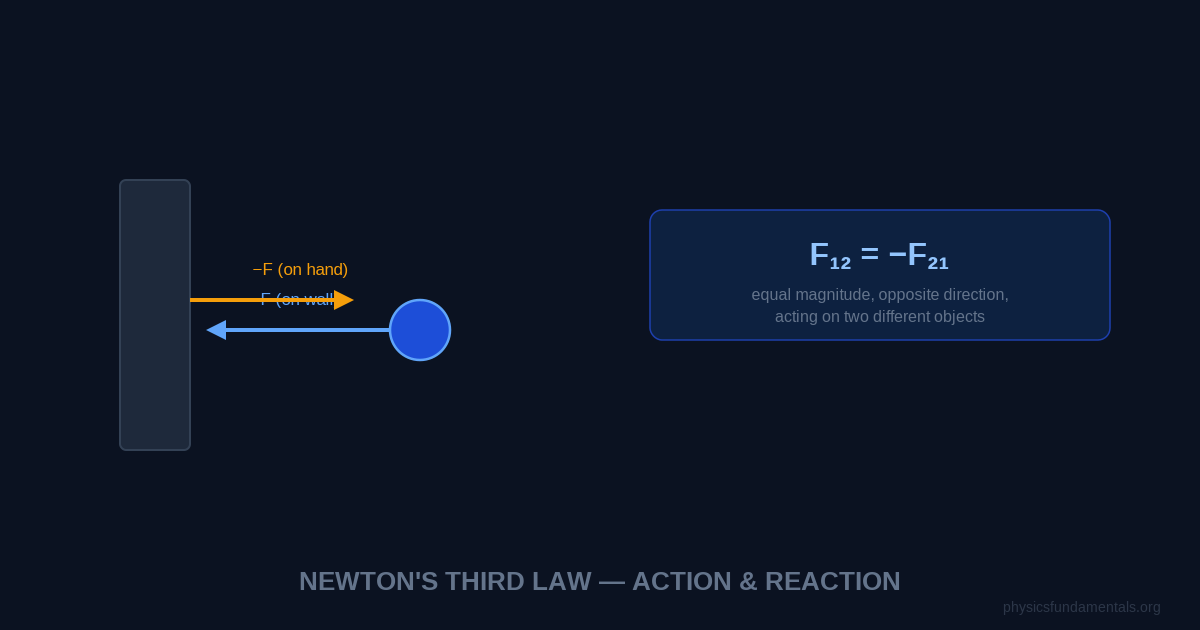
Newton's third law states that for every action there is an equal and opposite reaction: when one object exerts a force on a second object, the second object exerts a force of equal magnitude in the opposite direction back on the first. Written as an equation, F₁₂ = −F₂₁. The two forces always act on different objects, are always the same type of force, and never cancel each other out — that last point is the single most common misconception about this law, and it's the first thing to get right.
This is the third of Newton's three laws of motion, published in 1687. Where the second law (F = ma) describes how a single object responds to the net force on it, the third law describes how forces always come in pairs between two interacting objects. Skip this law and problems involving contact, collisions, propulsion, or walking don't make sense; understand it and a huge range of everyday physics suddenly clicks.
- What a third-law force pair actually is — and why the forces never cancel
- The #1 misconception: confusing a third-law pair with two forces on the same object
- Worked examples: walking, swimming, rocket propulsion, recoil, and collisions
- How the third law leads directly to conservation of momentum
Want to plug in your own numbers? Try the action-reaction force calculator to find the reaction force to any applied force, plus each object's resulting acceleration.
What Is Newton's Third Law?
For every action, there is an equal and opposite reaction. More precisely: if object A exerts a force on object B, then object B simultaneously exerts a force of equal magnitude and opposite direction on object A. Both forces are the same type (both gravitational, both normal contact forces, both tension, etc.), they act on two different objects, and neither force exists without the other — they appear and disappear together.
The modern equation form is:
Where F₁₂ is the force object 1 exerts on object 2, and F₂₁ is the force object 2 exerts on object 1. The minus sign means the two forces point in opposite directions; the equals sign (ignoring the sign) means they have identical magnitude, always, regardless of the masses or speeds of the two objects involved.
Which Law Is "Action-Reaction"? — All Three Laws Compared
Newton's third law is sometimes just called "action-reaction," but it's worth seeing it next to the other two so the distinction is clear:
| Law | Statement | Equation |
|---|---|---|
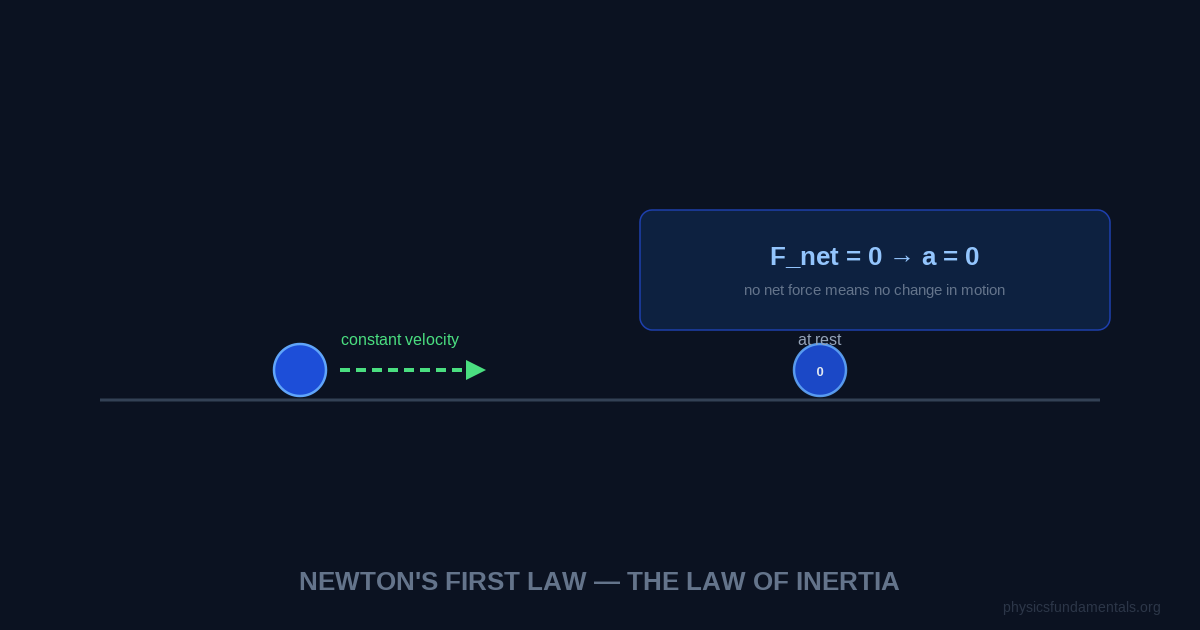
| First Law (Inertia) | An object remains at rest or in uniform motion unless acted on by a net force | F_net = 0 → a = 0 |
| Second Law (F = ma) | Net force equals mass times acceleration | F = ma |
| Third Law (Action-Reaction) | Every force has an equal, opposite reaction force on the other object | F₁₂ = −F₂₁ |
Note the key difference from the second law: F = ma is about one object and the net of all forces on it. The third law is about a pair of objects and a single interaction between them, viewed from both sides at once.
Who Discovered Newton's Third Law?
Sir Isaac Newton (1643–1727) published the third law alongside the first and second in his 1687 work Philosophiæ Naturalis Principia Mathematica. Newton's original Latin phrasing — "Actioni contrariam semper et æqualem esse reactionem" — translates almost directly to the familiar English version: to every action there is always an equal and opposite reaction. Unlike the first and second laws, which build on earlier work by Galileo, the third law was a genuinely new insight: no one before Newton had identified that forces are fundamentally a mutual, paired interaction between two objects rather than something one object simply "has."
Why Forces Don't Cancel — The #1 Misconception
Third-law force pairs never cancel because they act on two different objects. Forces can only cancel (sum to zero) when they act on the same object. This single distinction resolves almost every confusing third-law scenario.
Consider a book resting on a table. Two forces act on the book: gravity pulls it down, and the table's normal force pushes it up. These two forces are equal and opposite — but they are not a third-law pair, because both act on the same object (the book). They happen to balance because the book isn't accelerating (that's the first law), not because of the third law.
The book's actual third-law partners are different forces entirely. Gravity's partner: the book pulls Earth upward with the same force Earth pulls the book down (immeasurably small effect on something as massive as Earth, but real). The normal force's partner: the book pushes down on the table with the same force the table pushes up on the book.
Third-law pairs always: (1) act on two different objects, (2) are the same type of force, (3) are equal in magnitude, (4) are opposite in direction. If both forces act on the same object, you're not looking at a third-law pair — you're looking at two separate forces that happen to balance, which is a first-law / equilibrium situation instead.
Worked Example 1: Walking
How do you move forward when walking, if every force you apply has an equal and opposite reaction? Your foot pushes backward against the ground (action). The ground pushes forward against your foot with equal force (reaction) — and it's this reaction force, from the ground on you, that accelerates you forward. The third-law pair (your push on the ground, and the ground's push on you) never cancels, because the two forces act on different objects: the ground and you. Your forward acceleration comes from applying F = ma (the second law) to just your own body, using only the force that acts on you — the ground's push.
Worked Example 2: Swimming
A swimmer pushes water backward with their arms and legs (action). The water pushes the swimmer forward with equal force (reaction). Exactly the same logic as walking: the backward force on the water and the forward force on the swimmer are a third-law pair, acting on different "objects" (swimmer and water), and only the forward reaction force on the swimmer contributes to the swimmer's own F = ma.
Worked Example 3: Rocket Propulsion
A rocket engine expels hot gas backward at high speed (action — the rocket pushes the gas backward). The gas pushes the rocket forward with equal force (reaction). This is the clearest possible third-law example because there's no third object (like "the ground") involved — just the rocket and the exhaust gas, acting on each other. A rocket works in the vacuum of space precisely because it doesn't need anything external to push against; it only needs its own expelled propellant.
where ṁ is the mass flow rate of expelled propellant (kg/s) and v_exhaust is the exhaust velocity relative to the rocket. A typical rocket engine might expel propellant at 3,000–4,500 m/s; multiplying by the mass flow rate gives the thrust force, which by the third law is identical in magnitude to the force the rocket exerts on the propellant.
Worked Example 4: Recoil of a Gun
A rifle firing a bullet: the rifle exerts a large forward force on the bullet (action). The bullet exerts an equal backward force on the rifle (reaction) — felt as recoil against the shooter's shoulder. The forces are equal in magnitude, but because the rifle has much greater mass than the bullet, the second law (a = F/m) means the rifle's resulting acceleration — and therefore its recoil velocity — is much smaller than the bullet's. For a 4 kg rifle firing a 0.01 kg bullet at 400 m/s, conservation of momentum (which the third law directly implies — see below) gives a rifle recoil velocity of about 1 m/s: (0.01 × 400) ÷ 4 = 1 m/s.
Worked Example 5: Two Skaters Pushing Apart
Two ice skaters, initially at rest, push off each other. Skater A (mass 50 kg) pushes Skater B (mass 70 kg) backward with some force; by the third law, Skater B simultaneously pushes Skater A backward (in the opposite direction) with the same magnitude of force. Since the force magnitudes are equal but the masses differ, the second law means their resulting accelerations — and final speeds — are different: the lighter skater (A) ends up moving faster. If Skater B moves off at 3 m/s, conservation of momentum gives Skater A's speed as (70 × 3) ÷ 50 = 4.2 m/s, in the opposite direction.
Newton's Third Law and Conservation of Momentum
The third law isn't just a curiosity — it's the direct foundation of one of physics' most powerful principles: conservation of momentum. Here's the derivation in brief. For two objects interacting only with each other (no external forces):
Since force is the rate of change of momentum (F = dp/dt), this becomes:
Rearranging: d(p₁ + p₂)/dt = 0 — the total momentum of the two-object system never changes. This is exactly why the recoiling rifle and the pushing-apart skaters above could be solved just by conserving momentum, without needing to know the exact forces or how long they acted. Any time you see a collision, explosion, or "push-apart" problem solved using conservation of momentum, the third law is the reason that method is valid in the first place.
Newton's Third Law Across Physics — Where It Shows Up
Collisions: every collision — billiard balls, car crashes, subatomic particles in an accelerator — obeys the third law at the instant of contact. The force each object exerts on the other is equal and opposite, which is why momentum is conserved in every collision, elastic or inelastic.
Gravity: the Earth pulls you down with your weight, mg. By the third law, you pull the Earth up with that exact same force. Earth's mass (≈6 × 10²⁴ kg) is so enormous compared to yours that the resulting acceleration of the entire planet is utterly immeasurable — but it is, in principle, non-zero.
Electromagnetism: Coulomb's law for the force between two electric charges is itself a third-law pair — the force charge 1 exerts on charge 2 is equal and opposite to the force charge 2 exerts on charge 1, exactly like gravity. The same holds for the magnetic force between two current-carrying wires.
Fluid and aerodynamic lift: an airplane wing deflects air downward (action); the air pushes the wing upward with equal force (reaction) — this reaction force is lift. Helicopters, propellers, and swimming fish all generate thrust or lift the same way.
Common Mistakes
Pairing two forces on the same object. The most common error by far (see the misconception section above). If both forces you're comparing act on the same object, they are not a third-law pair, even if they happen to be equal and opposite.
Assuming equal forces mean equal effects. The forces in a pair are always equal in magnitude — but the resulting accelerations are not, unless the two objects have equal mass. A bullet and a rifle feel equal and opposite forces during firing, but the bullet accelerates far more because its mass is far smaller (a = F/m).
Thinking the reaction force happens after the action force. Both forces in a third-law pair exist simultaneously. There is no time delay — "action" and "reaction" is a naming convention, not a sequence. The moment one force exists, so does the other.
Forgetting the forces must be the same type. A third-law partner to a gravitational force is another gravitational force (not a normal force or friction). A partner to a normal contact force is another normal contact force. Mixing force types when identifying a "pair" is a reliable sign of a mistake.
Frequently Asked Questions
What is Newton's third law of motion?
For every action there is an equal and opposite reaction — what does this actually mean?
If every force has an equal and opposite reaction, why does anything ever move?
What is the difference between Newton's third law and equilibrium (balanced forces)?
How does Newton's third law relate to conservation of momentum?
Does Newton's third law mean the forces produce equal accelerations?
Can you give a simple real-world example of Newton's third law?
Share this article
Written by
Physics Fundamentals Editorial Team
Written and reviewed by our team of physics educators. Content is aligned with A-Level, GCSE, AP Physics, and undergraduate curricula.
About Physics Fundamentals →