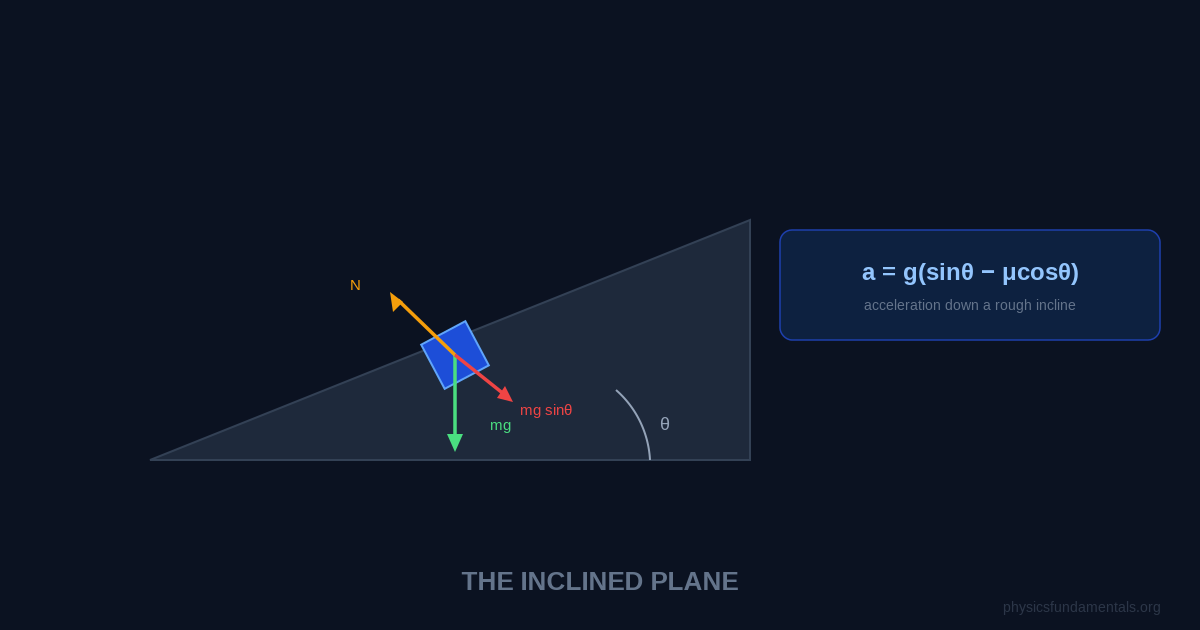
An inclined plane is a flat surface set at an angle, and it works by splitting an object's weight into two components: one pressing into the surface (balanced by the normal force) and one pulling the object down the slope. On a frictionless incline tilted at angle θ, an object slides down with acceleration a = g sinθ. With friction (coefficient μ) opposing the motion, that becomes a = g(sinθ − μcosθ). Those two equations are the entire physics of ramps, slides, hills, and wedges — everything else is just applying them carefully.
The inclined plane is one of the six classical "simple machines" (alongside the lever, pulley, wheel and axle, wedge, and screw) because it lets you trade distance for force: pushing something up a long, gentle ramp takes less force than lifting it straight up, at the cost of covering more distance. Understanding how an incline splits forces is also the foundation for a huge range of other mechanics problems — anything on a slope, a hill, a ramp, or a banked surface uses the exact same force-decomposition method.
- How to split weight into components parallel and perpendicular to the slope
- The acceleration formula with and without friction
- The critical angle at which an object starts to slide on its own
- 5 worked examples, from a frictionless slide to pushing a crate up a ramp
Want to plug in your own numbers? Try the inclined plane calculator for instant normal force, friction force, and acceleration results with a free-body diagram.
How an Inclined Plane Works
On a flat, level surface, an object's entire weight (mg) presses straight down, fully supported by the normal force. Tilt that surface into an incline at angle θ, and weight no longer points straight into the surface — it splits into two perpendicular components: one still pressing into the surface (now only mg cosθ, not the full weight), and one pulling the object along the surface, down the slope (mg sinθ). That second component is what makes objects slide, and it's entirely new — it doesn't exist at all on a flat surface.
Because the surface can only push back perpendicular to itself (that's what a normal force is), the normal force on an incline exactly balances only the perpendicular component:
Notice this means the normal force on an incline is always less than the object's full weight — the steeper the slope, the smaller the normal force, since cosθ shrinks as θ grows. At θ = 90° (a vertical wall), cosθ = 0 and the normal force vanishes entirely, which makes sense: a vertical surface can't support any weight through a horizontal push alone.
Acceleration Down a Frictionless Incline
With no friction, the only force acting along the slope is the parallel component of gravity, mg sinθ. Newton's second law along the incline gives:
Notice the mass cancels out completely — just like free fall, every object slides down a frictionless incline at the same acceleration regardless of its mass, for the same reason a feather and a hammer fall at the same rate in a vacuum. At θ = 90° this reduces to a = g, exactly matching free fall, as it should.
Acceleration With Friction
Real inclines have friction, which acts opposite to the direction of sliding. Kinetic friction has magnitude f = μkN = μkmg cosθ. For an object sliding down the slope, friction acts up the slope, opposing gravity's pull:
This is the single most useful equation for ramp problems. If μkcosθ is larger than sinθ, the formula gives a negative acceleration — meaning friction is strong enough that the object won't accelerate down the slope at all (it will either stay still or decelerate if already moving), which leads directly to the idea of a critical angle below.
The Critical Angle — When Does an Object Start to Slide?
An object resting on an incline stays put as long as static friction can fully cancel the parallel component of gravity. Static friction has a maximum value of μsN, so the object remains stationary as long as mg sinθ ≤ μsmg cosθ. Dividing both sides by mg cosθ:
The object starts to slide exactly when tanθ = μs — the critical angle is θc = arctan(μs). This is a genuinely useful real-world formula: tilt any rough surface slowly and measure the angle at which an object just starts to slip, and you've directly measured its coefficient of static friction, no force sensor required.
Worked Example 1: Frictionless Slide
A 10 kg box sits on a frictionless 30° ramp. Find the normal force and the box's acceleration.
N = mg cosθ = 10 × 9.8 × cos(30°) = 98 × 0.866 = 84.9 N
a = g sinθ = 9.8 × sin(30°) = 9.8 × 0.5 = 4.9 m/s²
Worked Example 2: Sliding With Friction
A 5 kg box slides down a 25° ramp with a kinetic friction coefficient of 0.2. Find its acceleration.
a = g(sinθ − μkcosθ) = 9.8 × (sin25° − 0.2 × cos25°) = 9.8 × (0.4226 − 0.1813) = 2.4 m/s²
Note the mass (5 kg) never entered the calculation — it cancels out of this formula exactly as it does in the frictionless case, since both gravity and the friction force it generates (through the normal force) scale with mass in the same way.
Worked Example 3: Finding the Critical Angle
A crate has a static friction coefficient of 0.4 with a ramp's surface. At what angle will it just begin to slide?
θc = arctan(μs) = arctan(0.4) = 21.8°
Below this angle, the crate stays put no matter how long you wait. Above it, it begins to accelerate down the slope on its own, with no push needed.
Worked Example 4: Pushing a Crate Up a Ramp
What constant force, applied parallel to the surface, is needed to push a 20 kg crate up a 15° ramp at constant velocity, given a kinetic friction coefficient of 0.3?
At constant velocity, the net force is zero, so the applied force must exactly balance both the parallel component of gravity (pulling the crate back down) and friction (which now acts down the slope too, since the crate is moving up):
F = 20 × 9.8 × (sin15° + 0.3 × cos15°) = 196 × (0.2588 + 0.2898) = 107.5 N
Worked Example 5: Mechanical Advantage
A loading ramp is 5 m long and rises to a platform 1 m high. What's its mechanical advantage, and how does that compare to lifting straight up?
Mechanical advantage for an inclined plane is the ratio of the distance traveled along the slope to the height gained:
Ignoring friction, this means the force needed to push a load up the ramp is only about 1/5 of the force needed to lift it straight up — at the cost of pushing it 5 times farther. This trade-off (less force, more distance, same total work) is the defining feature of every simple machine, not just the inclined plane.
Real-World Applications
Wheelchair ramps are built to a shallow, legally-mandated maximum angle (typically no steeper than about 4.8°, a 1:12 slope) specifically to keep the required pushing force low and manageable.
Mountain roads switchback up steep terrain instead of going straight up, for exactly the same mechanical-advantage reason — a longer, gentler effective slope needs less engine force (and less braking force coming down) than a short, steep one.
The Egyptian pyramids are widely believed to have been built using massive earthen ramps to move multi-ton stone blocks, trading a very long ramp distance for a dramatically reduced pushing force compared to lifting blocks vertically.
Screws and wedges are both, mechanically, an inclined plane wrapped or compressed into a different shape — a screw is an incline wound around a cylinder, and a wedge is two inclines joined back to back.
Common Mistakes
Using the full weight (mg) instead of mg cosθ for the normal force. The normal force equals the full weight only on a flat (θ = 0) surface. On any incline, it's smaller, and forgetting the cosθ factor is the single most common inclined-plane error.
Mixing up sinθ and cosθ. The component along the slope (causing sliding) uses sinθ; the component into the slope (balanced by the normal force) uses cosθ. A quick sanity check: as θ → 0 (nearly flat), sinθ → 0 and cosθ → 1 — correctly predicting almost no sliding force and nearly the full weight as normal force.
Forgetting that friction changes direction depending on motion. Friction opposes relative motion — it acts up the slope when something slides down, but down the slope when something is pushed up. Using the same sign for both cases is a common source of wrong answers.
Assuming mass matters for the acceleration formula. Both a = g sinθ and a = g(sinθ − μcosθ) are mass-independent — a heavier and lighter object released from rest on the same incline accelerate identically (ignoring air resistance).
Frequently Asked Questions
What is an inclined plane in physics?
What is the formula for acceleration on an inclined plane?
How do you find the normal force on an inclined plane?
At what angle does an object start to slide on an incline?
Why does mass not affect how fast something slides down a ramp?
What is the mechanical advantage of an inclined plane?
Share this article
Written by
Physics Fundamentals Editorial Team
Written and reviewed by our team of physics educators. Content is aligned with A-Level, GCSE, AP Physics, and undergraduate curricula.
About Physics Fundamentals →