Impulse is the product of a force and the time it acts: J = FΔt. By Newton's second law, this equals the change in momentum of the object: J = Δp = mΔv. The impulse-momentum theorem — J = Δp — is one of the most useful relationships in mechanics because it connects force, time, and the change in motion in a single equation. It doesn't matter whether the force is large and brief (a bat hitting a ball) or small and sustained (a rocket engine firing) — the change in momentum equals the impulse either way.
This is also why safety engineering is almost entirely about impulse. A car crash can't avoid a large change in momentum, but airbags and crumple zones extend the collision time, reducing the peak force on the occupants. The impulse is the same; the force is reduced by spreading it over a longer time.
- Momentum p = mv — definition, units, and vector nature
- Impulse J = FΔt — and why it equals change in momentum
- Force-time graphs — how to find impulse from the area under the graph
- Conservation of momentum in collisions
- 4 worked examples: football kick, car crash, rocket thrust, collision
Momentum: p = mv
Momentum is the product of an object's mass and velocity: p = mv. It is a vector quantity — same direction as the velocity. SI unit: kg·m/s (equivalent to N·s).
Momentum is a measure of how difficult it is to stop a moving object. A 10,000 kg truck at 2 m/s has the same momentum as a 1 kg ball at 20,000 m/s — both have p = 20,000 kg·m/s — but they feel very different to stop because the impulse must be delivered over different times and distances.
The Impulse-Momentum Theorem
From Newton's second law: F = ma = m(Δv/Δt). Rearranging:
Where J = FΔt is the impulse, measured in N·s (equivalent to kg·m/s).
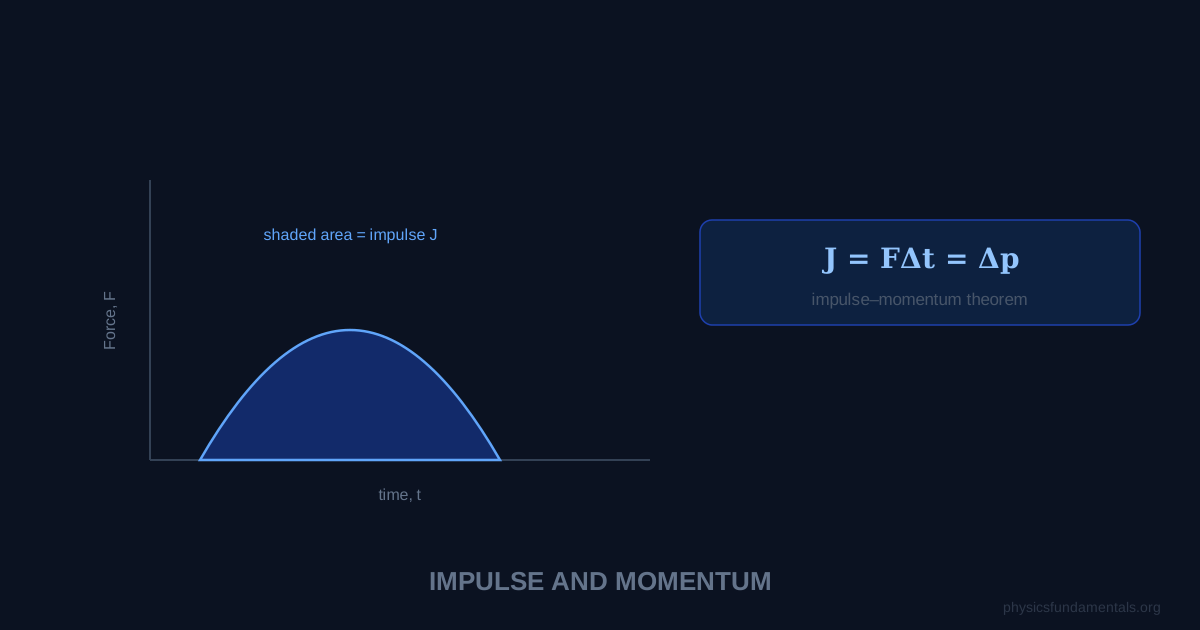
This works for variable forces too: if the force varies with time, the impulse is the area under the force-time graph:
Force-Time Graphs
The area under a force-time graph equals the impulse. This is particularly useful for impact forces that spike briefly — like a bat hitting a cricket ball — where the average force can be calculated from:
A triangular spike lasting 0.01 s with peak force 2000 N has impulse = ½ × 2000 × 0.01 = 10 N·s, identical to a constant 1000 N force acting for 0.01 s.
Conservation of Momentum
In any collision or explosion where no external forces act, the total momentum of the system is conserved:
This follows directly from Newton's third law: the force A exerts on B is equal and opposite to the force B exerts on A, and they act for the same time, so the impulses cancel. See our full article on conservation of momentum for collisions in depth.
4 Worked Examples
Example 1 — Football kick
Problem: A footballer kicks a stationary ball of mass 0.45 kg. The foot is in contact for 0.08 s and the ball leaves at 25 m/s. Find: (a) the ball's momentum after the kick, (b) the average force exerted.
Solution:
(a) p = mv = 0.45 × 25 = 11.25 kg·m/s
(b) J = Δp = 11.25 − 0 = 11.25 N·s
F_average = J/Δt = 11.25/0.08 = 140.6 N
Example 2 — Car crash safety
Problem: A 75 kg passenger in a car decelerates from 15 m/s to rest. Without airbag, the collision lasts 0.05 s. With airbag, it lasts 0.3 s. Find the average force on the passenger in each case.
Solution:
Impulse = Δp = 75 × (0 − 15) = −1125 N·s (magnitude 1125 N·s)
Without airbag: F = 1125/0.05 = 22,500 N
With airbag: F = 1125/0.3 = 3,750 N
The airbag reduces peak force by a factor of 6 — same impulse, much lower force, much lower injury risk.
Example 3 — Rocket thrust
Problem: A rocket expels gas at 500 kg/s with exhaust velocity 3000 m/s. Find the thrust force.
Solution:
Impulse per second = Δp per second = (mass expelled per second) × velocity
F = Δm/Δt × v_exhaust = 500 × 3000 = 1,500,000 N = 1.5 MN
Example 4 — Head-on collision
Problem: A 2 kg ball moving at 6 m/s east collides with a 3 kg ball moving at 2 m/s west. After the collision, the 2 kg ball moves at 1 m/s west. Find the velocity of the 3 kg ball after the collision.
Solution:
Take east as positive. Before: p_total = (2 × 6) + (3 × −2) = 12 − 6 = 6 kg·m/s
After: 6 = (2 × −1) + (3 × v₂) = −2 + 3v₂
3v₂ = 8 → v₂ = 2.67 m/s east
Common Mistakes
Mistake 1 — Treating momentum as a scalar. Momentum is a vector — direction matters. In the collision example above, the westward velocity of the 3 kg ball is negative in our convention. Getting signs wrong in collision problems is the most common error.
Mistake 2 — Confusing impulse (N·s) with force (N). Impulse is force × time; it has units of N·s. The change in momentum also has units of kg·m/s = N·s. Force alone tells you nothing about the change in momentum without knowing the contact time.
Force-Time Graphs and Variable Forces
When a force varies with time during a collision or impact, the impulse is the area under the force-time graph:
For a triangular force pulse (common in impact modelling): if peak force is F_max and duration is Δt, the impulse J = ½F_max × Δt. The average force is F_avg = J/Δt = F_max/2. Impact force sensors (used in crash testing and sports science) measure force vs time directly, and the area under the curve gives the impulse — which equals the change in momentum of whatever the force acted on.
A cricket ball hitting a bat might exert peak forces of 5,000–10,000 N over 1 ms (Δt = 0.001 s), with an impulse of 3–5 N·s — changing the ball's momentum from ~+3 kg·m/s (towards bat) to ~−10 kg·m/s (hit away), a change of 13 kg·m/s over 1 ms, requiring average force of 13,000 N. The actual bat appears to apply a smooth push, but the force-time graph shows a sharp spike lasting milliseconds.
Rocket Propulsion and Variable Mass
A rocket in space has no external forces but its mass changes as propellant is expelled. The Tsiolkovsky rocket equation follows directly from momentum conservation:
Where v_e is the exhaust speed relative to the rocket, m_i is initial mass (full of fuel), and m_f is final mass (empty). The thrust force at any instant is F = v_e × (dm/dt) — exhaust speed multiplied by mass flow rate. A Space Shuttle Main Engine expelled mass at ~500 kg/s with exhaust speed ~4,500 m/s, producing 2.25 MN of thrust. All three main engines together plus two solid boosters gave lift-off thrust of ~30 MN to lift the 2,040-tonne vehicle.
Newton's Cradle — Momentum and Energy Together
Newton's cradle (the executive desk toy with hanging steel balls) demonstrates both conservation of momentum and conservation of kinetic energy simultaneously — it's an elastic collision series. When one ball swings in and collides, one ball swings out on the other side at the same speed. When two balls swing in, two swing out. The question "why doesn't one ball swing out at double the speed?" is answered by requiring both momentum AND kinetic energy to be simultaneously conserved — the only solution for n identical balls in an elastic collision is n balls leaving at the original speed.
Momentum alone: 1 ball in at v → 1 ball out at v ✓ (mv = mv) OR 2 balls out at v/2 ✓ (mv = 2m × v/2)
Kinetic energy: ½mv² → ½mv² ✓ OR 2 × ½m(v/2)² = ¼mv² ✗
Only the first option satisfies both — which is why Newton's cradle always transfers one ball for one ball, two for two, etc.
Worked Example 5 — Jet aircraft momentum
Problem: A jet engine takes in air at 80 kg/s at 0 m/s (relative to engine) and expels it at 600 m/s. Find the thrust force.
Solution:
Thrust = rate of change of momentum of the air = (dm/dt) × Δv = 80 × (600 − 0) = 48,000 N = 48 kN
A modern commercial airliner uses engines producing 250–360 kN each — four engines giving 1–1.5 MN total thrust for a 300-tonne aircraft, just enough to maintain level flight (weight ≈ 3 MN) using lift from the wings.
Momentum in Nuclear and Particle Physics
Conservation of momentum is used extensively in particle physics to identify decay products and calculate particle masses. When a neutral particle decays into charged particles, a bubble chamber or detector records the curved tracks of each product in a magnetic field (curvature gives momentum). The vector sum of all product momenta equals the initial momentum — if the decaying particle was at rest, all product momenta must vector-sum to zero. This is how the neutral pion, neutrinos, and many other neutral particles were first identified: their presence was inferred from momentum imbalance in detected charged products.
Impulse in Sports Science
Sports scientists use impulse analysis to optimise technique. In sprinting, the impulse from each foot strike determines the change in horizontal momentum — more impulse per step means faster acceleration. Elite sprinters apply ground reaction forces of 3–5 times body weight for 80–100 ms per step, generating impulses of 200–300 N·s per stride. Long jumpers achieve their range by maximising both horizontal momentum (from run-up) and the vertical impulse during take-off (from the leg drive). In golf, the ball (mass 46 g) changes velocity from 0 to ~80 m/s in ~0.5 ms of club contact — requiring average force of 80 × 0.046/0.0005 = 7,360 N, approximately 730 times the ball's weight.
Conservation of Momentum in Explosions
In an explosion, the total initial momentum is usually zero (system at rest). After: all fragment momenta must vector-sum to zero. A bomb at rest splits into two pieces: m₁v₁ + m₂v₂ = 0, so v₁/v₂ = −m₂/m₁. The lighter fragment moves faster; the heavier one moves slower. This is recoil — the same principle makes guns kick back and rockets accelerate forward. A gun firing a 10 g bullet at 900 m/s: if the gun has mass 1 kg, recoil speed = 0.01 × 900/1 = 9 m/s. The bullet carries much more kinetic energy (½ × 0.01 × 900² = 4050 J) than the gun (½ × 1 × 9² = 40.5 J) despite equal and opposite momenta — because KE = p²/(2m), and the lighter object gets more KE for the same impulse.
Exam Summary
Momentum p = mv (kg·m/s, vector). Impulse J = FΔt = Δp (N·s = kg·m/s). The impulse-momentum theorem J = Δp follows from Newton's second law. Conservation of momentum holds when no external net force acts — valid in all collisions and explosions to a good approximation (collision duration too short for gravity or friction to deliver significant impulse). Distinguish clearly: momentum (a property of the object, always conserved in isolated systems) vs kinetic energy (only conserved in elastic collisions). The key to collision problems: write momentum conservation as one vector equation per dimension, and add the KE conservation equation only if the collision is elastic.
Worked Example 6 — Two-dimensional collision
Problem: A 3 kg ball moving east at 4 m/s collides with a 2 kg ball at rest. After the collision, the 3 kg ball moves at 30° north of east at 3 m/s. Find the velocity of the 2 kg ball.
Solution:
Conservation of momentum in x (east): 3×4 + 0 = 3×3cos30° + 2v₂ₓ
12 = 7.794 + 2v₂ₓ → v₂ₓ = 2.103 m/s east
Conservation of momentum in y (north): 0 = 3×3sin30° + 2v₂ᵧ (taking north as positive for ball 1)
0 = 4.5 + 2v₂ᵧ → v₂ᵧ = −2.25 m/s (i.e. 2.25 m/s south)
|v₂| = √(2.103² + 2.25²) = √(4.42 + 5.06) = √9.48 = 3.08 m/s
Direction: arctan(2.25/2.103) = arctan(1.070) = 47° south of east
The fundamental importance of momentum in physics goes beyond mechanics. In special relativity, momentum is redefined as p = γmv where γ = 1/√(1−v²/c²), and conservation of relativistic momentum replaces Newton's classical version. In quantum mechanics, momentum corresponds to the operator p̂ = −iħ∂/∂x, and the Heisenberg uncertainty principle ΔxΔp ≥ ħ/2 limits simultaneous knowledge of position and momentum. In electromagnetism, electromagnetic fields carry momentum density ε₀(E × B) — light exerts radiation pressure. Across every domain of physics, momentum — and its conservation — remains central. The classical impulse-momentum theorem is the entry point to this much deeper concept.
One of the most important exam skills: correctly assigning positive and negative signs to momentum in collision problems. Always declare a positive direction at the start and stick to it throughout. Velocities in the positive direction are positive; velocities in the negative direction are negative. The momentum conservation equation then handles the algebra automatically — a negative answer means the object moves in the negative (opposite) direction, not that momentum is negative in some forbidden way. Failing to sign momenta correctly is the single most common error in collision calculations at A-Level.
Try it yourself: check your own numbers with the Impulse & Momentum Calculator, which shows the formula, the worked substitution and the answer step by step.
Frequently Asked Questions
What is impulse in physics?
What is the impulse-momentum theorem?
Why do airbags reduce injury in car crashes?
How do you find impulse from a force-time graph?
Is momentum always conserved?
Share this article
Written by
Physics Fundamentals Editorial Team
Written and reviewed by our team of physics educators. Content is aligned with A-Level, GCSE, AP Physics, and undergraduate curricula.
About Physics Fundamentals →