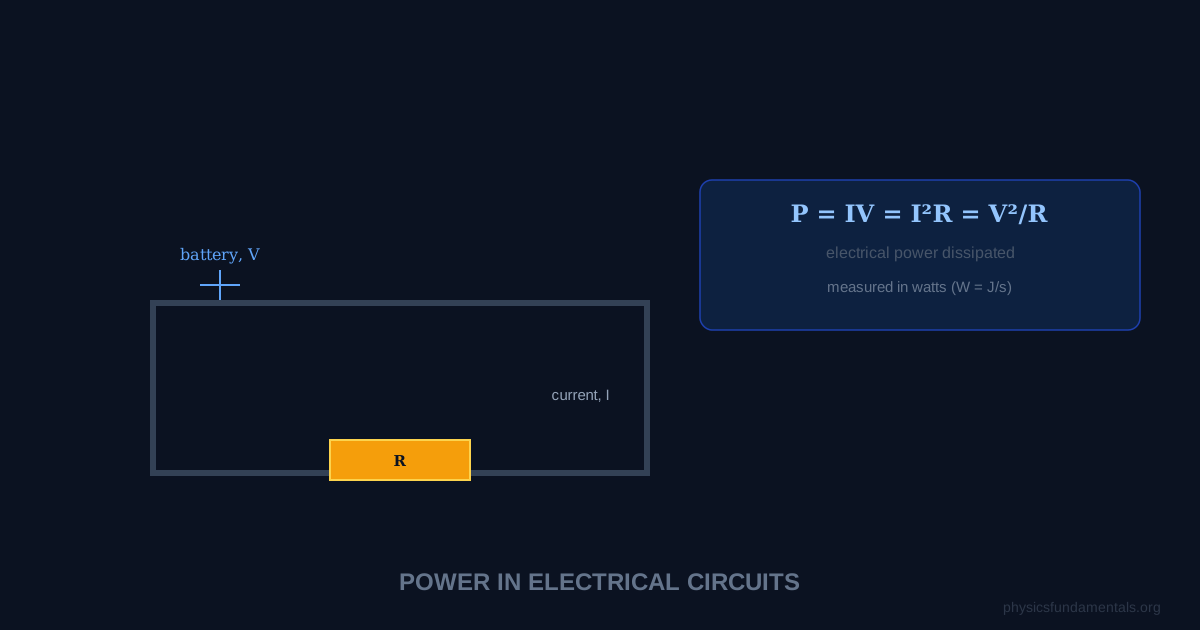
Electrical power is the rate at which energy is transferred in a circuit: P = IV, where P is power in watts (W), I is current in amperes (A), and V is potential difference in volts (V). Combined with Ohm's law (V = IR), this gives two further forms: P = I²R and P = V²/R. All three are equivalent — use whichever form has the quantities you know. A 60 W light bulb running on 230 V draws I = P/V = 60/230 = 0.26 A and has resistance R = V²/P = 230²/60 = 882 Ω.
Electrical power underpins every practical circuit calculation — from choosing the right resistor rating for a component to understanding why high-voltage transmission lines are used for long-distance power delivery. The reason is P = I²R: for the same power delivered, higher voltage means lower current, which means far less power lost as heat in the transmission cable resistance.
- P = IV, P = I²R, P = V²/R — when to use each form
- Energy dissipated: E = Pt = IVt
- Kilowatt-hours (kWh) and electricity bills
- Why high-voltage power transmission reduces energy loss
- 4 worked examples including efficiency and resistor power ratings
The Three Power Formulas
All three are equivalent — they're the same formula in different variable combinations:
- P = IV: use when you know current and voltage
- P = I²R: use when you know current and resistance — e.g. power lost in a wire of known resistance
- P = V²/R: use when you know voltage and resistance — e.g. power of a component at fixed mains voltage
The unit of power is the watt (W): 1 W = 1 J/s = 1 V·A.
Energy Transferred
Energy in joules, power in watts, time in seconds. For longer timescales, energy is measured in kilowatt-hours (kWh):
Electricity bills charge in pence per kWh (unit cost). Cost = power (kW) × time (h) × price per kWh.
Efficiency
Or equivalently: efficiency = useful energy out / total energy in × 100%.
A motor rated at 500 W input and delivering 400 W of mechanical output has efficiency = 400/500 = 80%. The remaining 100 W is dissipated as heat in the motor windings (P = I²R losses).
4 Worked Examples
Example 1 — Light bulb
Problem: A 60 W light bulb operates on 230 V mains. Find: (a) current drawn, (b) resistance of the filament, (c) energy used in 8 hours.
Solution:
(a) I = P/V = 60/230 = 0.261 A
(b) R = V²/P = 230²/60 = 52,900/60 = 882 Ω (or R = V/I = 230/0.261 = 882 Ω)
(c) E = Pt = 0.060 kW × 8 h = 0.48 kWh = 1.728 MJ
Example 2 — Power lost in a transmission cable
Problem: A power station delivers 1 MW to a town via cables of total resistance 5 Ω. Compare power lost in cables when transmitting at (a) 1000 V, (b) 100,000 V.
Solution:
(a) At 1000 V: I = P/V = 10⁶/10³ = 1000 A; P_loss = I²R = 10⁶ × 5 = 5 MW — 5× the power delivered! Completely impractical.
(b) At 100,000 V: I = 10⁶/10⁵ = 10 A; P_loss = 100 × 5 = 500 W = 0.05% of the transmitted power — negligible.
Example 3 — Resistor power rating
Problem: A 470 Ω resistor has a maximum power rating of 0.5 W. What is the maximum voltage that can be applied across it?
Solution:
P = V²/R → V_max = √(PR) = √(0.5 × 470) = √235 = 15.3 V
Example 4 — Electricity bill
Problem: A 2 kW electric kettle is used for 10 minutes per day for 30 days. At 28p per kWh, find the cost.
Solution:
Energy = P × t = 2 kW × (10/60 h × 30 days) = 2 × 5 = 10 kWh
Cost = 10 × 28p = 280p = £2.80
Power in Series and Parallel Circuits
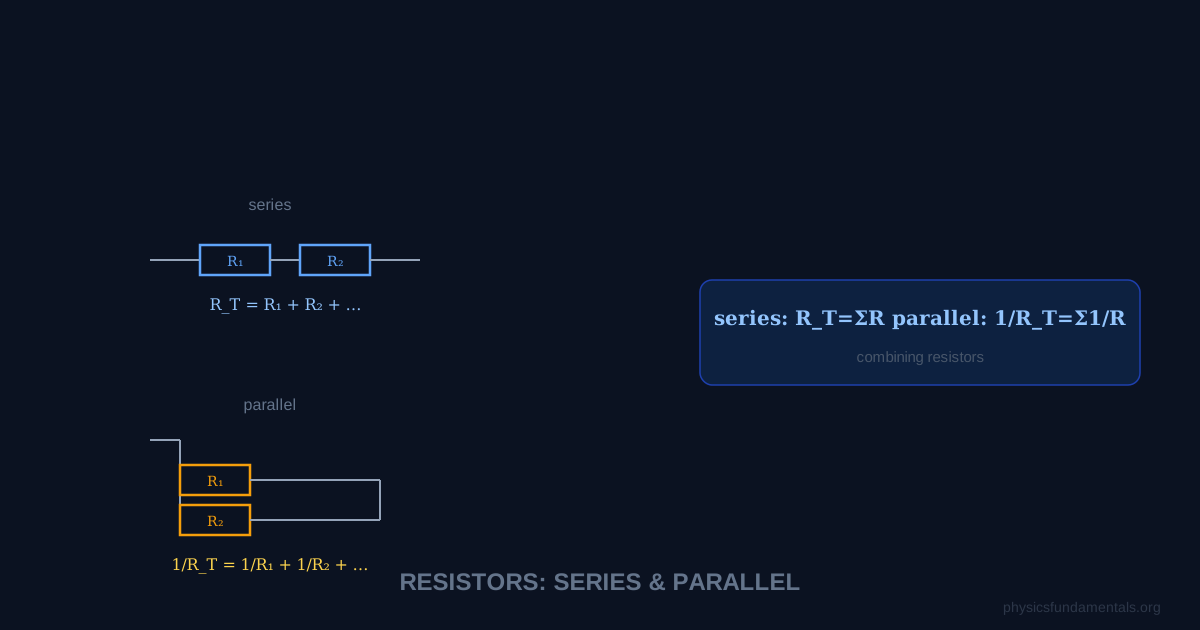
Series: Same current through all resistors. Power in each: P_n = I²R_n. Larger resistance dissipates more power.
Parallel: Same voltage across all resistors. Power in each: P_n = V²/R_n. Smaller resistance dissipates more power (more current flows through it).
This explains why appliances in a house are connected in parallel — each gets the full mains voltage regardless of what other appliances are on, and each dissipates power according to its own resistance (rating).
Power Dissipation in Resistors — Detailed Analysis
In a resistor, electrical energy converts to thermal energy as electrons collide with lattice ions. The rate of energy dissipation is the electrical power:
All three forms are equivalent — use whichever has the known quantities. For resistors in series: same current I through each, so P_n = I²R_n (power proportional to resistance — largest resistor dissipates most). For resistors in parallel: same voltage V across each, so P_n = V²/R_n (power inversely proportional to resistance — smallest resistor dissipates most). These seemingly opposite results both follow from P = IV and Ohm's law applied to the specific topology.
Maximum Power Transfer
For a source with EMF ε and internal resistance r supplying an external load R_L, the power delivered to the load is:
To find maximum P_L: dP_L/dR_L = 0 → R_L = r. Maximum power is delivered to the load when load resistance equals internal resistance. At this point P_max = ε²/(4r) and efficiency = 50% (half the power is wasted in internal resistance). This result — R_load = R_source for maximum power transfer — is fundamental in electronics and telecommunications: audio amplifiers are impedance-matched to speakers; RF transmitters are impedance-matched to antennas; sensors are matched to measurement circuits.
Worked Example 5 — Power in a complex circuit
Problem: A 12 V battery (internal resistance 0.5 Ω) is connected to three resistors: R₁ = 6 Ω in series with a parallel combination of R₂ = 4 Ω and R₃ = 12 Ω. Find: (a) total current from battery, (b) power dissipated in R₁, (c) power dissipated in each parallel resistor, (d) total power delivered by battery.
Solution:
Parallel combination: R₂₃ = (4 × 12)/(4 + 12) = 48/16 = 3 Ω
Total resistance: R_total = r + R₁ + R₂₃ = 0.5 + 6 + 3 = 9.5 Ω
(a) I_total = ε/R_total = 12/9.5 = 1.263 A
(b) P_R₁ = I²R₁ = 1.263² × 6 = 1.595 × 6 = 9.57 W
Voltage across parallel combination: V₂₃ = I × R₂₃ = 1.263 × 3 = 3.789 V
(c) P_R₂ = V²/R₂ = 3.789²/4 = 14.36/4 = 3.59 W; P_R₃ = 3.789²/12 = 1.196 W
Check: P_R₂ + P_R₃ = 3.59 + 1.196 = 4.786 W = I²R₂₃ = 1.263² × 3 = 4.78 W ✓
(d) P_battery = εI = 12 × 1.263 = 15.16 W (= P_internal + P_R₁ + P_R₂ + P_R₃ = 0.8 + 9.57 + 3.59 + 1.196 = 15.16 W ✓)
Energy and Kilowatt-Hours
The joule is the SI unit of energy, but for household electricity consumption, the kilowatt-hour (kWh) is more practical:
Electricity bills charge in pence per kWh. Typical UK unit costs in 2024–2025: ~25–30p/kWh. Running a 2 kW kettle for 5 minutes per day for a month: energy = 2 kW × (5/60) h × 30 days = 5 kWh → cost = 5 × 25p = 125p = £1.25/month. An electric vehicle typically uses 0.2–0.3 kWh/mile; at 25p/kWh, that's 5–7.5p/mile — compared to a petrol car using about £0.10–0.15/mile at typical petrol prices.
Power in Three-Phase Systems
Industrial electrical systems use three-phase AC — three sinusoidal voltages 120° apart — rather than single-phase. Three-phase provides several advantages: (1) constant total power (the three phase powers add to a constant, eliminating the 100 Hz power pulsation of single-phase); (2) smaller conductor cross-sections for the same power; (3) three-phase motors are simpler and more efficient than single-phase motors. The total three-phase power: P = √3 × V_line × I_line × cosφ, where V_line is the line-to-line voltage, I_line is the line current, and cosφ is the power factor. The UK 400 V/230 V supply system has 400 V line-to-line (three-phase) and 230 V line-to-neutral (single-phase to homes).
Power Factor and Reactive Power
In AC circuits with capacitors or inductors, current and voltage are out of phase by angle φ. The real (active) power delivered: P = VI cosφ. The apparent power: S = VI. The ratio cosφ is the power factor. For a pure resistor: φ = 0, cosφ = 1, all power is real. For a pure capacitor or inductor: φ = 90°, cosφ = 0, no real power is consumed (current and voltage are 90° out of phase and the power averages to zero over a cycle). Industrial loads (motors, fluorescent lights) have power factors of 0.7–0.95. Power companies charge industrial customers for low power factor because it requires higher currents (and therefore larger cables and more reactive power losses) to deliver the same real power. Power factor correction capacitors are installed to bring the power factor closer to 1.
Worked Example 6 — kWh cost calculation
Problem: A household uses: 8 hours of lighting at 200 W total, a 3 kW immersion heater for 1.5 hours, and a 500 W TV for 4 hours per day. At 28p/kWh, find the daily electricity cost for these appliances.
Solution:
Lighting: 0.2 kW × 8 h = 1.6 kWh
Heater: 3 kW × 1.5 h = 4.5 kWh
TV: 0.5 kW × 4 h = 2.0 kWh
Total: 8.1 kWh/day
Cost: 8.1 × 28p = 226.8p = £2.27/day
Efficiency of Electrical Devices
No electrical device converts 100% of input electrical power to the desired output. Losses occur as heat, sound, or light in unintended ways. Efficiency η = P_useful/P_input × 100%. Some typical values: incandescent light bulb 5% (95% heat); LED light bulb 30–40% (mainly light); electric resistance heater 100% (all electrical energy becomes heat — perfect efficiency for heating, terrible for lighting); electric motor 85–95% (loss to winding resistance and friction); transformer 97–99% (loss to copper and iron losses). The extraordinarily high efficiency of transformers is why AC power distribution (with easy voltage transformation) wins over DC for long-distance power transmission.
The concept of efficiency links electrical power to energy policy. LED lighting retrofits reduce lighting energy consumption by 80% — if every incandescent bulb in the UK were replaced by LED, the saving would be several GW of generating capacity. Electric vehicle efficiency (well-to-wheel) at ~60–70% compares favourably with petrol vehicles (~20–25%), even accounting for power station losses. Electrical power is the most versatile and often most efficient form of energy — which is why electrification of transport, heating, and industry is central to carbon emission reduction.
Exam Summary for Electrical Power
Three equivalent power formulas: P = IV, P = I²R, P = V²/R. Use whichever two quantities are known. Energy E = Pt (joules) or E = Pt/3,600,000 (kWh). Cost = energy (kWh) × price per kWh. For a circuit: power delivered by source = εI (total), power dissipated in internal resistance = I²r, power delivered to external circuit = IV_terminal = I(ε − Ir). Power balance: εI = I²r + I²R_external. Maximum power to load when R_load = r_internal. In parallel circuits: same voltage → use P = V²/R (smallest R gets most power). In series circuits: same current → use P = I²R (largest R gets most power).
Electrical power is the product of current and voltage — two quantities that individually tell only part of the story. A high current through a small resistance dissipates little power (P = I²R); a small current through a large resistance can dissipate a lot. A high voltage drives little current through a high resistance (P = V²/R); a low voltage drives enormous current through a short circuit (P → ∞ in theory, limited by internal resistance in practice). The three power formulas — P = IV, P = I²R, P = V²/R — are all correct and equivalent, but each is most convenient when specific pairs of quantities are known. The power-checking technique (sum of all power dissipated = total power delivered by source) is the most reliable way to verify a circuit solution: if the power balance doesn't close, there's an error in the calculation.
The biggest insight in electrical power is that the same power P = IV can be achieved with high I and low V, or low I and high V. This choice determines everything about the economics of the electrical system: high current requires thick, heavy (and expensive) conductors; high voltage requires better insulation (and more expensive switchgear) but allows thin conductors. The reason national grids operate at 400 kV (UK) or 765 kV (USA) is purely economic — at these voltages, cable losses per kilometre become acceptable over transmission distances of hundreds of kilometres. The transformer — which changes voltage and inversely changes current at near-100% efficiency — is the enabling technology. Without transformers (and therefore without AC power), the world would need generating stations within a few kilometres of every load, making large-scale electrical systems economically impossible.
Try it yourself: check your own numbers with the Electrical Power Calculator, which shows the formula, the worked substitution and the answer step by step.
Frequently Asked Questions
What is electrical power?
When do you use P = I²R vs P = V²/R?
What is a kilowatt-hour?
Why is electricity transmitted at high voltage?
What does a resistor's power rating mean?
Share this article
Written by
Physics Fundamentals Editorial Team
Written and reviewed by our team of physics educators. Content is aligned with A-Level, GCSE, AP Physics, and undergraduate curricula.
About Physics Fundamentals →