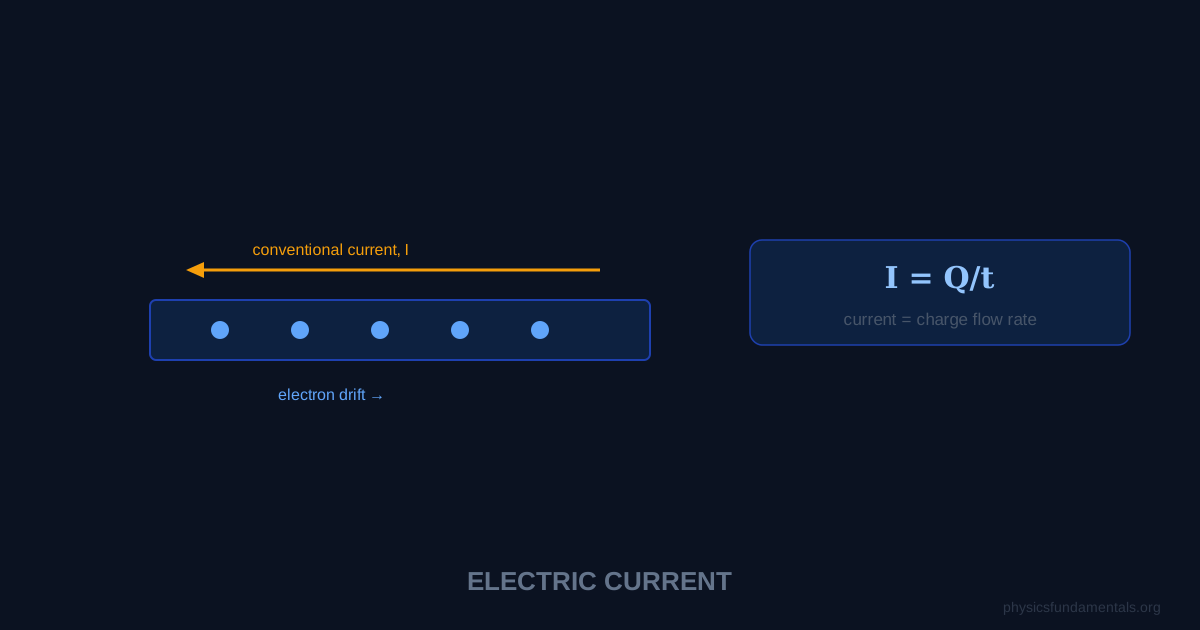
Electric current is the rate of flow of electric charge: I = Q/t, where I is current in amperes (A), Q is charge in coulombs (C), and t is time in seconds. One ampere means one coulomb of charge passes a cross-section every second. In a metal conductor, the charge carriers are free electrons drifting slowly in one direction while vibrating rapidly in all directions — the drift velocity is surprisingly small, typically around 0.1 mm/s, even for ordinary household currents.
Current is the foundation of all circuit analysis. Every calculation involving Ohm's law, Kirchhoff's laws, and electrical power starts with current. Understanding what current actually is — moving charge, not moving electrons at high speed — resolves a lot of misconceptions about how circuits work.
- Current I = Q/t — definition, units, and what 1 ampere means physically
- Conventional current direction vs electron flow direction
- Drift velocity: v_d = I/(nAq) — why it's so slow
- Current in series and parallel circuits
- 4 worked examples including drift velocity and charge calculations
Electric Current: I = Q/t
Electric current is the rate of flow of electric charge past a point in a circuit. I = Q/t, where Q is charge (C) and t is time (s). The SI unit is the ampere (A); 1 A = 1 C/s.
Rearranged: Q = It (useful for finding total charge delivered) and t = Q/I.
Some reference currents to build intuition:
- LED indicator light: ~20 mA (0.02 A)
- Smartphone charger: ~1–2 A
- Electric kettle: ~8–13 A
- Lightning bolt: ~20,000 A (but only for ~1 μs)
- Nerve impulse in the human body: ~1 nA (10⁻⁹ A)
Conventional Current vs Electron Flow
Conventional current flows from positive to negative terminal (the direction a positive charge would move). This was the original convention, established before electrons were discovered.
In reality, in metallic conductors, electrons (negative charges) flow from negative to positive — opposite to conventional current. Despite this, conventional current direction is still used universally in circuit analysis, and it doesn't cause any errors as long as you're consistent.
In some contexts the charge carriers are positive: in electrolytes (solutions), positive ions carry current in the conventional direction. In semiconductors, "holes" (positive charge carriers) move in the conventional direction alongside electrons.
Drift Velocity: v_d = I/(nAq)
Electrons in a metal move randomly at high thermal speeds (~10⁶ m/s), but their net drift in the direction of the field is very slow. The drift velocity relates current to the microscopic properties of the conductor:
Where:
- n = number density of charge carriers (electrons per m³)
- A = cross-sectional area of the conductor (m²)
- q = charge on each carrier (1.6 × 10⁻¹⁹ C for electrons)
- v_d = drift velocity (m/s)
For copper: n ≈ 8.5 × 10²⁸ electrons/m³. A 1 mm² wire carrying 1 A has v_d ≈ 0.074 mm/s — it would take the electrons over 3 hours to travel 1 metre. Yet the circuit responds almost instantaneously because the electric field propagates at nearly the speed of light.
4 Worked Examples
Example 1 — Current from charge and time
Problem: 180 C of charge flows through a resistor in 2 minutes. Find the current.
Solution:
t = 2 × 60 = 120 s
I = Q/t = 180/120 = 1.5 A
Example 2 — Charge delivered by a current
Problem: A 2 A current flows for 3 hours. How much charge passes?
Solution:
t = 3 × 3600 = 10,800 s
Q = It = 2 × 10,800 = 21,600 C
Example 3 — Drift velocity in copper
Problem: A copper wire has cross-sectional area 2.0 × 10⁻⁶ m² and carries 3 A. Find the drift velocity of electrons. (n for copper = 8.5 × 10²⁸ m⁻³, e = 1.6 × 10⁻¹⁹ C)
Solution:
v_d = I/(nAq) = 3/(8.5 × 10²⁸ × 2.0 × 10⁻⁶ × 1.6 × 10⁻¹⁹)
= 3/(2.72 × 10⁴) = 1.10 × 10⁻⁴ m/s = 0.11 mm/s
Example 4 — Number of electrons
Problem: A 100 mA current flows for 10 s. How many electrons pass a cross-section? (e = 1.6 × 10⁻¹⁹ C)
Solution:
Q = It = 0.1 × 10 = 1 C
Number of electrons = Q/e = 1/(1.6 × 10⁻¹⁹) = 6.25 × 10¹⁸ electrons
Current in Series and Parallel
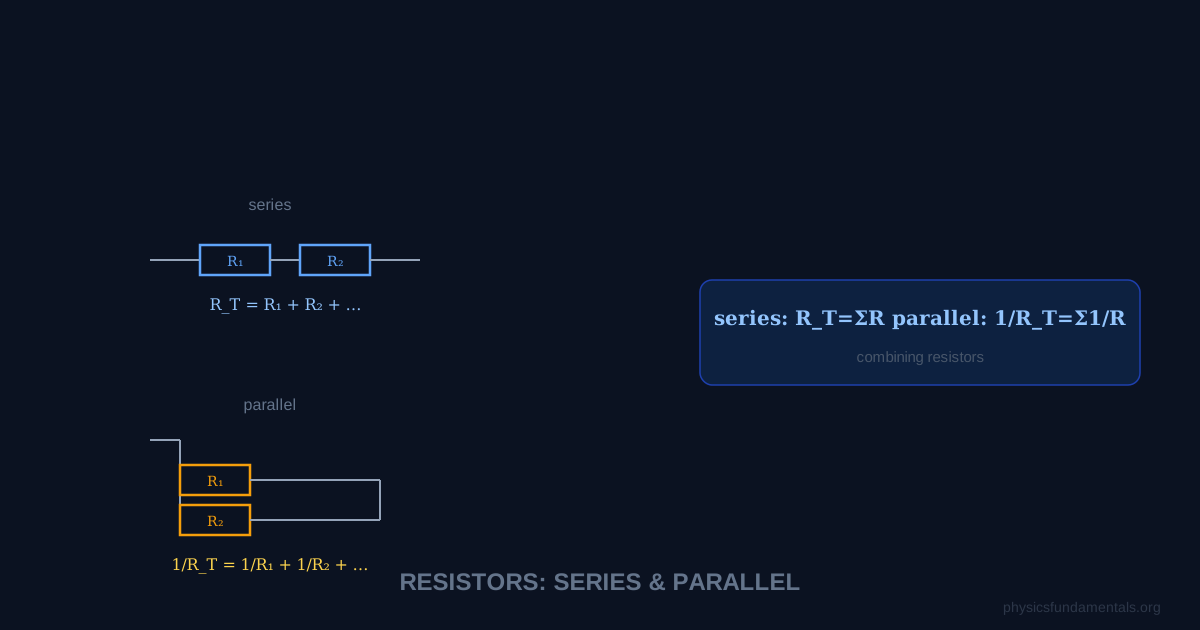
Series circuit: The same current flows through every component — there is only one path. KCL at any point confirms: current in = current out, and since there are no junctions, it's the same throughout.
Parallel circuit: Current splits at each junction. At every junction, KCL applies: I_total = I₁ + I₂ + I₃. Each branch carries a current inversely proportional to its resistance (from Ohm's law, I = V/R, and voltage is the same across parallel branches).
Current Density
Current density J is the current per unit cross-sectional area:
Units: A/m². Current density is a more fundamental quantity than current itself — it's a vector (pointing in the direction of conventional current flow) and is related to the electric field by Ohm's law in microscopic form:
Where σ (sigma) is the conductivity of the material (units: S/m = siemens per metre), and E is the electric field strength (V/m). This is Ohm's law at the microscopic level — the macroscopic R = V/I follows directly from integrating this over the geometry of a conductor of length L and cross-section A: R = L/(σA) = ρL/A, where ρ = 1/σ is the resistivity.
Conventional Current vs Electron Current — Why the Convention Persists
Benjamin Franklin established the convention in the 18th century: conventional current flows from positive to negative terminal. When electrons were discovered in 1897, it became clear that in metals, negative charges (electrons) actually flow opposite to conventional current. Yet the convention was kept for three reasons: (1) all existing circuit theory and design worked correctly with the convention; (2) in many other contexts (electrolytes, semiconductors) positive charges do carry current in the conventional direction; (3) changing the convention would have invalidated millions of existing textbooks, datasheets, and engineering drawings. Modern physics notation distinguishes between conventional current I (used in circuit analysis) and electron current I_e = −I (used when specifically discussing electron motion).
Kirchhoff's Current Law from Current Conservation
In a steady DC circuit, charge cannot accumulate at any junction — if it did, an ever-increasing charge would build up, creating an ever-increasing electric field that would drive more current away. In the steady state, the rate of charge entering any junction must equal the rate leaving: ΣI_in = ΣI_out. This is Kirchhoff's Current Law, and it's a consequence of the continuity equation for charge conservation. In AC circuits, KCL is still satisfied at every instant — even though currents are oscillating, no net charge accumulates at any node.
Worked Example 5 — Drift velocity comparison
Problem: A copper wire (n = 8.5 × 10²⁸ m⁻³) carries 5 A through a cross-section of (a) 1 mm², (b) 10 mm². Compare drift velocities.
Solution:
v_d = I/(nAq)
(a) A = 1 × 10⁻⁶ m²: v_d = 5/(8.5 × 10²⁸ × 10⁻⁶ × 1.6 × 10⁻¹⁹) = 5/(1.36 × 10⁴) = 3.68 × 10⁻⁴ m/s = 0.37 mm/s
(b) A = 10 × 10⁻⁶ m²: v_d = 5/(8.5 × 10²⁸ × 10⁻⁵ × 1.6 × 10⁻¹⁹) = 3.68 × 10⁻⁵ m/s = 0.037 mm/s
The thicker wire has 10× less drift velocity for the same current — electrons have more room to drift without exceeding their average spacing.
Conductors, Semiconductors, and Insulators
Materials differ in their charge carrier density n and mobility:
- Conductors (metals): n ~ 10²⁸–10²⁹ m⁻³ (one free electron per atom), high mobility. Resistivity ρ ~ 10⁻⁸ Ω·m. Current is carried by electrons in the conduction band.
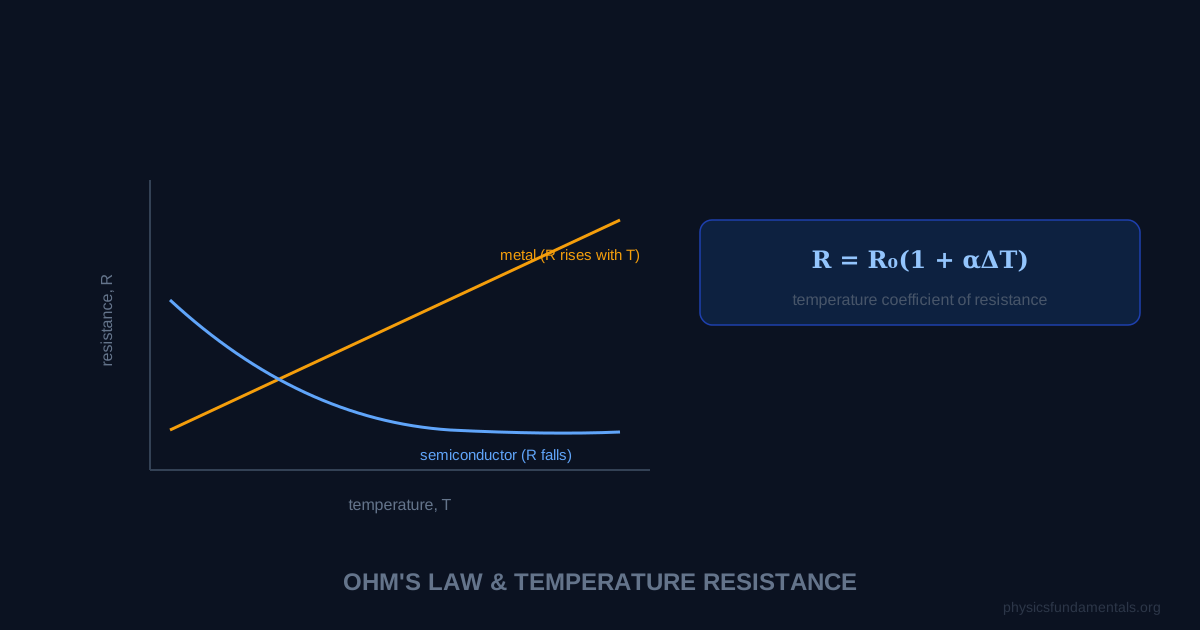
- Semiconductors (silicon, germanium): n ~ 10¹⁶–10²⁰ m⁻³ (thermally generated, or doped). Resistivity ρ ~ 10⁻³–10³ Ω·m, strongly temperature-dependent. Both electrons and holes carry current.
- Insulators (glass, rubber, PTFE): n ~ 0 (no free charge carriers). Resistivity ρ ~ 10¹²–10¹⁶ Ω·m.
Doping semiconductors — adding tiny amounts of impurities (phosphorus in silicon adds free electrons; boron adds holes) — controls n precisely from 10¹⁵ to 10²¹ m⁻³. This tunability is the foundation of the transistor and all modern microelectronics. A single modern CPU chip contains ~50 billion transistors in a 1 cm² die, each switch consuming picowatts of power.
Superconductors and Zero Resistance
Below the critical temperature T_c, certain materials become superconducting — resistance drops to exactly zero. Current flows without any electric field driving it (J = σE with σ → ∞ means any E → 0 can drive any J). In a superconducting ring, current persists for years without decaying. The mechanism is Cooper pairing: electrons pair up through lattice vibrations, forming bosons that condense into a single quantum state and flow without scattering. Superconducting currents are carried at MRI machine magnets (fields of 1.5–7 T, impossible with normal conductors without enormous resistive heating), particle accelerator bending magnets, and are being explored for lossless power transmission.
Alternating Current vs Direct Current
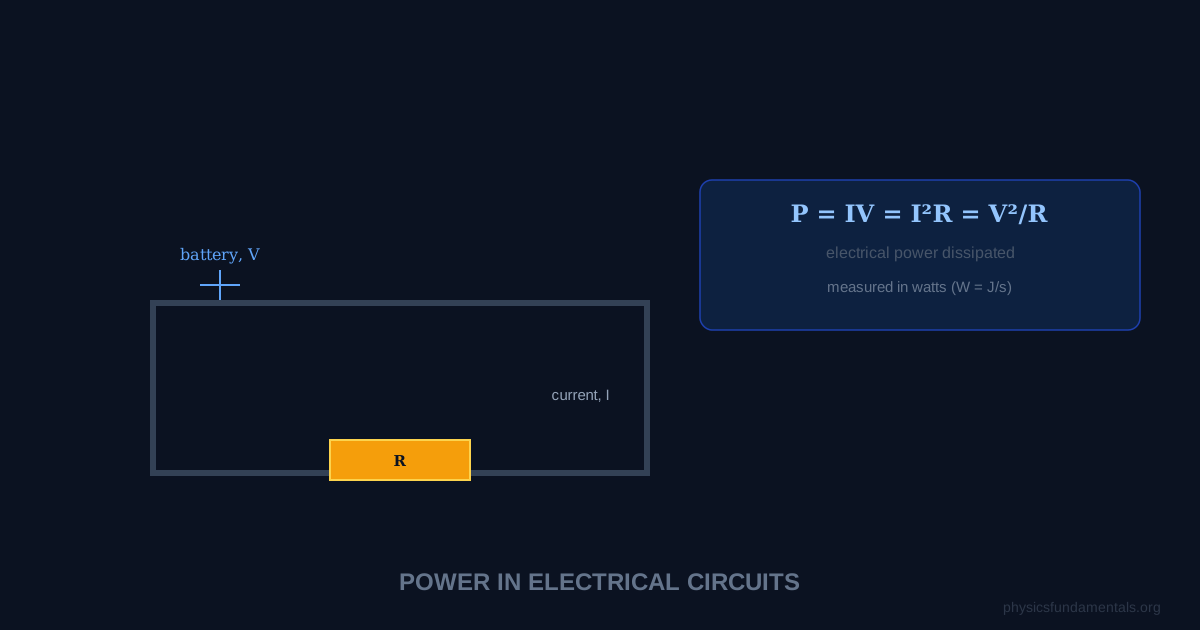
In DC circuits, current flows in one direction at constant (or slowly varying) magnitude. In AC circuits (the standard form for mains electricity), current alternates direction sinusoidally at the supply frequency (50 Hz in the UK/Europe, 60 Hz in the US). The root-mean-square (rms) values are used because they give the equivalent DC values for power calculations: I_rms = I_peak/√2, V_rms = V_peak/√2, and power P = V_rms × I_rms (for purely resistive loads).
The direction of current reversal doesn't affect the heating power of AC — a 230 V_rms supply delivers the same power to a resistor as 230 V DC. But AC has crucial advantages: voltage can be transformed (stepped up or down) efficiently using transformers, enabling high-voltage long-distance transmission that dramatically reduces I²R losses. This is why Tesla's AC system defeated Edison's DC system in the "War of Currents" of the 1880s — and why today, global electricity infrastructure is overwhelmingly AC.
Exam Summary — Electric Current
Key formulas: I = Q/t (defining current); I = nAqv_d (microscopic, from drift velocity); J = I/A = σE (current density and Ohm's law microscopically); R = ρL/A (resistance from resistivity). The drift velocity is typically mm/s or less, even in wires carrying amperes of current, because of the enormous number density n of conduction electrons. This slow drift is not a contradiction — the electric field that drives the drift propagates near the speed of light, so the circuit responds effectively instantaneously. Connecting a circuit creates a propagating electromagnetic field that sets all electrons in the conductor drifting simultaneously, not sequentially.
Measuring Current — Ammeters and Shunts
An analogue ammeter works by measuring the deflection of a coil in a magnetic field — the deflecting torque is proportional to current. The coil has a small resistance (typically 10–100 Ω for the galvanometer movement itself). To measure large currents, a low-resistance shunt resistor is placed in parallel — most of the current bypasses through the shunt, and only a small fraction flows through the sensitive galvanometer. If the galvanometer has resistance G and full-scale deflection at current I_g, and you want to measure current I_total, the required shunt resistance is R_shunt = I_g × G/(I_total − I_g).
Digital multimeters measure current by passing it through a known small resistance (the shunt), measuring the voltage across it with a high-impedance voltmeter, and displaying the calculated current I = V/R_shunt. This approach is extremely accurate and the internal resistance can be made very small (0.1–1 Ω), minimally disturbing the circuit being measured.
The key insight that students often miss: current is not "used up" as it flows around a circuit. The same current that flows into a component flows out — this is KCL. What gets used is energy, not charge. In a light bulb, electrons enter and exit with the same number but lower potential energy — the potential energy difference (qΔV) was converted to light and heat. Thinking of current as "flowing" energy (rather than charge) is wrong and leads to mistakes. Track charge (current) separately from energy (potential).
Units check: current I has units amperes (A = C/s). Charge Q has units coulombs (C). The drift velocity formula v_d = I/(nAq) has units: A/(m⁻³ × m² × C) = (C/s)/(m⁻¹ × C) = (C/s) × s/m = m/s ✓. The current density J = I/A has units A/m², and σE has units (S/m)(V/m) = (A/V)(V/m²) = A/m² ✓. Always verify units in derived formulas — a dimensional check catches algebraic errors before they propagate into numerical mistakes.
In summary: electric current I = Q/t measures charge flow rate in amperes. The microscopic picture is electrons drifting at v_d = I/(nAq) — typically less than 1 mm/s in household wiring, far slower than the electromagnetic disturbance that propagates at close to c. Current is not used up; it flows in loops. The same current enters and leaves every series component. In parallel branches, currents split at junctions (KCL) and recombine, always conserving total charge flow rate. Energy is transferred from the source to components via the electric field — tracked by potential differences, not by current magnitude alone.
Frequently Asked Questions
What is electric current?
Why does conventional current flow opposite to electron flow?
Why is drift velocity so slow if circuits respond instantly?
What is the difference between current and charge?
What affects drift velocity?
Share this article
Written by
Physics Fundamentals Editorial Team
Written and reviewed by our team of physics educators. Content is aligned with A-Level, GCSE, AP Physics, and undergraduate curricula.
About Physics Fundamentals →