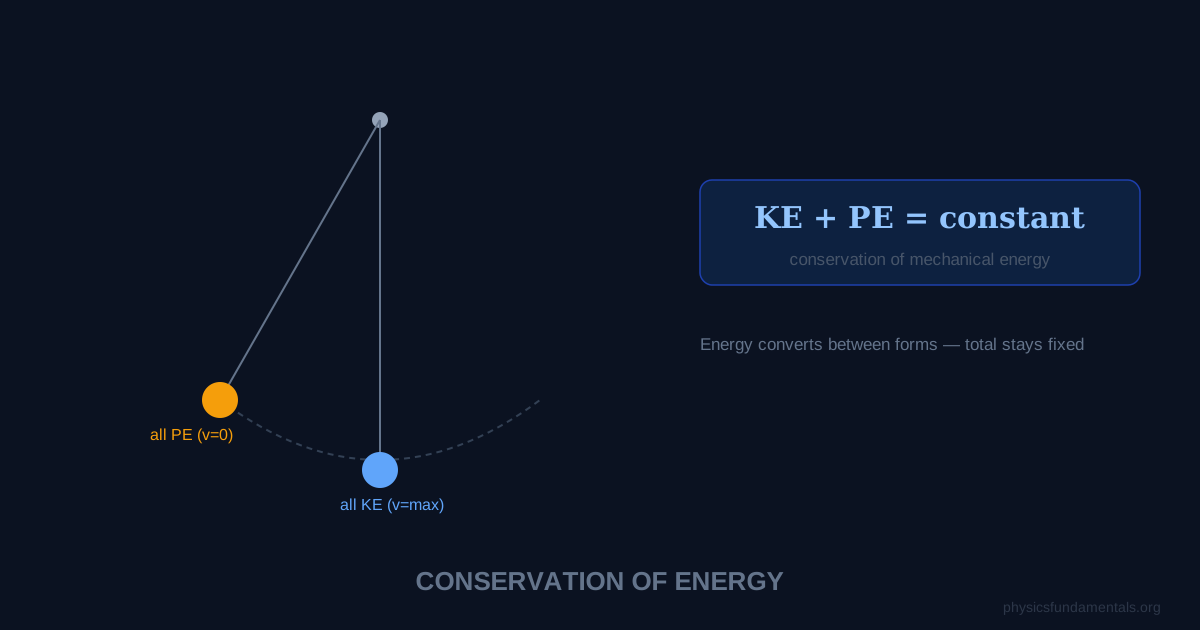
The law of conservation of energy states that energy cannot be created or destroyed — only converted from one form to another. In a closed system with no friction or air resistance, the total mechanical energy (kinetic energy plus potential energy) remains constant: KE + PE = constant. Every joule of kinetic energy lost appears as potential energy gained, and vice versa. This principle lets you solve entire problems by comparing energy at two states, without tracking forces at every intermediate instant.
Energy conservation never fails — it's one of the deepest laws in nature, rooted in Noether's theorem linking it to time symmetry. When friction acts and mechanical energy appears to decrease, the "lost" energy hasn't disappeared — it's converted to thermal energy. Total energy, including heat, is always conserved.
- The law of conservation of energy — statement and what it means physically
- Conservation of mechanical energy: KE₁ + PE₁ = KE₂ + PE₂
- When mechanical energy IS and IS NOT conserved
- Efficiency: useful energy out ÷ total energy in
- 4 fully worked examples: falling objects, pendulums, springs, and friction
The Law of Conservation of Energy
In an isolated system, the total energy remains constant. Energy can be converted between forms but the total is always the same.
In mechanics, we usually focus on mechanical energy — kinetic and gravitational potential. When only conservative forces act (gravity, springs — no friction), mechanical energy is conserved:
The mass m appears on every term, so it cancels for motion under gravity alone:
This is why all objects fall at the same speed from the same height, regardless of mass — Galileo's famous result, explained through energy.
Forms of Energy
- Kinetic energy: ½mv² — energy due to motion. Any moving object has it.
- Gravitational potential energy: mgh — energy due to position in a gravitational field. Increases with height.
- Elastic potential energy: ½kx² — energy stored in a stretched or compressed spring (Hooke's law).
- Thermal (internal) energy: energy of random molecular motion. Friction converts mechanical energy to this.
- Chemical energy: stored in molecular bonds. Released in combustion, metabolism, batteries.
- Nuclear energy: from changes in nuclear binding energy — the source of E = mc².
- Electromagnetic energy: energy of electric and magnetic fields; photons carry this.
When Mechanical Energy IS Conserved
Mechanical energy (KE + PE) is conserved when only conservative forces do work on the object. Conservative forces are those where the work done depends only on start and end positions, not the path — gravity and spring forces are conservative. In these cases, no energy leaks to heat and KE + PE stays constant throughout the motion.
Examples: a ball in free fall, a pendulum swinging with no air resistance, a block sliding down a frictionless ramp, a mass oscillating on a spring with no damping.
When Mechanical Energy IS NOT Conserved
When non-conservative forces act — friction, air resistance, applied forces — they convert mechanical energy to heat. Mechanical energy decreases by exactly the work done against these forces:
W_non-conservative is negative when friction removes energy. Total energy (including the heat generated) is still conserved — it's just that the mechanical portion decreases.
Efficiency
No real machine is 100% efficient — friction and other losses always convert some input energy to heat. Typical efficiencies: petrol car engine 25–35%; human body 20–25%; LED bulb 80–90%; electric motor 90–95%; solar panel 15–22%.
4 Worked Examples
Example 1 — Ball dropped from height
Problem: A 2 kg ball is dropped from rest at 8 m above the ground. Find its speed just before impact. (g = 9.81 m/s²)
Solution:
KE₁ + PE₁ = KE₂ + PE₂
0 + mgh = ½mv² + 0
gh = ½v²
v = √(2gh) = √(2 × 9.81 × 8) = √156.96 = 12.53 m/s
The mass doesn't appear in the final answer — all objects reach the same speed when dropped from the same height (ignoring air resistance).
Example 2 — Pendulum speed at lowest point
Problem: A pendulum bob of mass 0.5 kg is released from rest at a point 0.45 m above the lowest point of its swing. Find its speed at the lowest point.
Solution:
At release: KE = 0, PE = mgh = 0.5 × 9.81 × 0.45 = 2.207 J
At lowest point: PE = 0, all energy is KE
½mv² = 2.207
v = √(2 × 2.207 / 0.5) = √8.828 = 2.97 m/s
Example 3 — Spring launch
Problem: A spring (k = 500 N/m) is compressed by 0.20 m and launches a 0.25 kg ball vertically upward. How high does the ball rise?
Solution:
Elastic PE stored = ½kx² = ½ × 500 × 0.20² = ½ × 500 × 0.04 = 10 J
At maximum height: all elastic PE → gravitational PE
mgh = 10
h = 10 / (0.25 × 9.81) = 10 / 2.4525 = 4.08 m
Example 4 — Slope with friction
Problem: A 4 kg block slides down a 5 m ramp inclined at 30°. The friction force is 8 N. Find the block's speed at the bottom of the ramp.
Solution:
Vertical height: h = 5 × sin30° = 2.5 m
GPE lost = mgh = 4 × 9.81 × 2.5 = 98.1 J
Work done against friction = 8 × 5 = 40 J
KE gained = 98.1 − 40 = 58.1 J
½mv² = 58.1
v = √(2 × 58.1 / 4) = √29.05 = 5.39 m/s
Real-World Applications
Roller coasters convert gravitational PE at the top of the first hill into KE at the bottom. Every subsequent hill must be shorter because friction reduces total mechanical energy with each feature — the first hill is always the tallest.
Hydroelectric power converts gravitational PE of water in a high reservoir into electrical energy via turbines. The efficiency is high (~90%) because water turbines lose little energy to friction compared to combustion engines.
Regenerative braking in electric cars converts the KE of a moving car back into electrical energy stored in the battery, rather than wasting it as heat in brake pads. This is conservation of energy working in your favour.
Bouncing balls illustrate imperfect energy conservation. A superball bounces nearly elastically (90%+ efficiency); a lump of clay doesn't bounce at all (0%). The "lost" energy in each case goes to permanently deforming the material or to sound and heat at impact.
Potential Energy and Conservative Forces — Deeper Understanding
Every conservative force has an associated potential energy. The relationship is: the force equals the negative gradient of the potential energy in each direction.
For gravity: U = mgh, so F = −d(mgh)/dh = −mg downward — which is the weight force, as expected. For a spring: U = ½kx², so F = −d(½kx²)/dx = −kx — which is Hooke's law restoring force. This connection between force and potential energy is fundamental: conservative forces are precisely those that can be derived from a potential energy function.
Power and Energy Rate
Power is the rate at which energy is transferred or converted. In the context of energy conservation:
A car engine must provide power to overcome: (1) rolling resistance (friction between tyres and road), (2) aerodynamic drag (proportional to v²), and (3) gravitational PE gain rate when climbing (mgv sinθ). At high speeds, aerodynamic drag dominates — drag force is ½ρCdAv², so drag power is ½ρCdAv³, scaling as the cube of speed. Doubling speed requires eight times the power to overcome drag. This is why fuel efficiency drops drastically at motorway speeds.
Internal Energy and the Work-Energy Theorem Extended
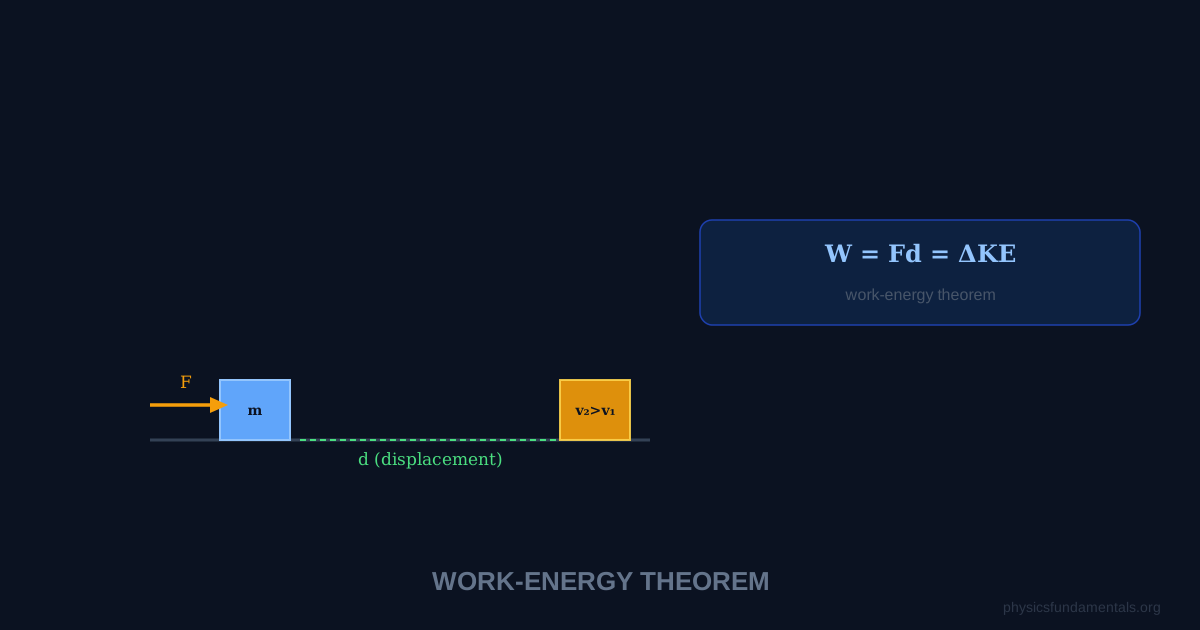
When friction acts, the work-energy theorem can be written:
Where ΔE_thermal is the thermal energy generated by friction (always positive — friction always adds heat). This extended form accounts for all energy changes and is always satisfied. The simpler form KE + PE = constant only applies when ΔE_thermal = 0 (frictionless).
The thermal energy generated equals the friction force times the relative sliding distance: ΔE_thermal = f × d_sliding. For a block sliding 3 m down a ramp with friction force 10 N: ΔE_thermal = 10 × 3 = 30 J of heat generated in the block and ramp surfaces.
Energy Conservation in Oscillating Systems
In a mass-spring system (simple harmonic motion), energy continuously converts between elastic PE (½kx²) and KE (½mv²). At maximum displacement (amplitude A): all energy is elastic PE = ½kA². At equilibrium: all energy is KE = ½mv²_max. Therefore:
At intermediate position x: E_total = ½kx² + ½mv² = ½kA² → v = ω√(A² − x²)
This shows that speed is maximum at equilibrium (x = 0) and zero at the amplitudes (x = ±A) — exactly the behaviour observed in pendulums and springs.
Worked Example 5 — Multi-stage energy problem
Problem: A 2 kg ball is fired from a spring gun (k = 500 N/m, compressed 0.15 m) at an angle of 45° on a ramp. It then travels up a frictionless 20° slope. Find: (a) the launch speed, (b) the distance it travels up the slope before stopping.
Solution:
(a) Spring PE → KE at launch: ½kx² = ½mv²
v = x√(k/m) = 0.15 × √(500/2) = 0.15 × √250 = 0.15 × 15.81 = 2.37 m/s
(b) On the 20° slope, the ball decelerates due to the component of gravity along the slope:
Using energy: ½mv² = mgs sinθ → s = v²/(2g sinθ) = 2.37²/(2 × 9.81 × sin20°)
s = 5.617/(2 × 9.81 × 0.342) = 5.617/6.712 = 0.837 m
Energy Diagrams and Turning Points
Plotting total energy (horizontal line) against potential energy curve reveals everything about a particle's motion. Where the PE curve is below the total energy line, the particle has kinetic energy (it's moving). Where PE equals total energy, KE = 0 — these are turning points where the particle momentarily stops and reverses. Where PE exceeds total energy, the particle cannot exist classically (though quantum tunnelling can allow passage through such "forbidden" regions).
For a particle oscillating in a potential well (like a mass on a spring), the turning points are symmetrically placed at ±A where ½kA² = E_total. The particle spends more time near the turning points (moving slowly) than at the equilibrium (moving fast), which is why the probability density in quantum mechanics peaks at the classical turning points for large quantum numbers.
Exam Strategy for Energy Problems
Energy methods are most powerful when: (1) you need to find speed at two different positions without caring about what happened in between; (2) forces vary with position (springs, gravity on curved paths); (3) the path is curved and force analysis at every point would be complex. Always state your reference level for GPE at the start, identify which forces are conservative (gravity, springs) and which are non-conservative (friction, air resistance), and include work done against non-conservative forces explicitly: KE₂ + PE₂ = KE₁ + PE₁ − W_friction. Show the energy equation with all terms before cancelling, and use the mass-cancellation shortcut only when it genuinely cancels (i.e. when every term contains m).
Energy and Everyday Machines
Every machine — engine, motor, turbine, pump — is an energy converter. The efficiency η = useful energy output/total energy input tells you what fraction is useful. A car engine with 30% efficiency converts 30% of the fuel's chemical energy to mechanical work; the remaining 70% goes to heat in the exhaust and cooling system. An electric motor achieves 90–95% efficiency — far better, because it doesn't rely on heat cycles that are fundamentally limited by thermodynamics (Carnot efficiency). This is one of the strongest arguments for electrification of transport: electric motors are intrinsically much more efficient than combustion engines, and even accounting for power station losses, the end-to-end energy efficiency of an electric car exceeds that of a petrol car by a factor of 2–3.
Understanding energy conservation and efficiency is central to addressing energy policy and sustainability. The total energy demand of a country is fixed by economic activity and efficiency — improving efficiency reduces demand without reducing output. Every watt saved in a data centre, every kWh saved by LED lighting, every percentage point gained in power station efficiency reduces both cost and carbon emissions. Conservation of energy is not just a physics principle — it's the quantitative foundation of energy engineering.
No matter how complex a system appears, energy conservation always provides at least one equation relating initial and final states. For a system with multiple energy forms — kinetic, gravitational PE, elastic PE, thermal — write E_total = constant for conservative systems, or E_final = E_initial − W_non-conservative for systems with friction. This single principle, applied consistently, is more reliable than attempting to track forces at every instant through a complex motion.
Frequently Asked Questions
What is conservation of energy?
When is mechanical energy NOT conserved?
Why do all objects fall at the same speed regardless of mass?
Where does energy go when friction acts?
What is the difference between conservation of energy and the work-energy theorem?
Share this article
Written by
Physics Fundamentals Editorial Team
Written and reviewed by our team of physics educators. Content is aligned with A-Level, GCSE, AP Physics, and undergraduate curricula.
About Physics Fundamentals →