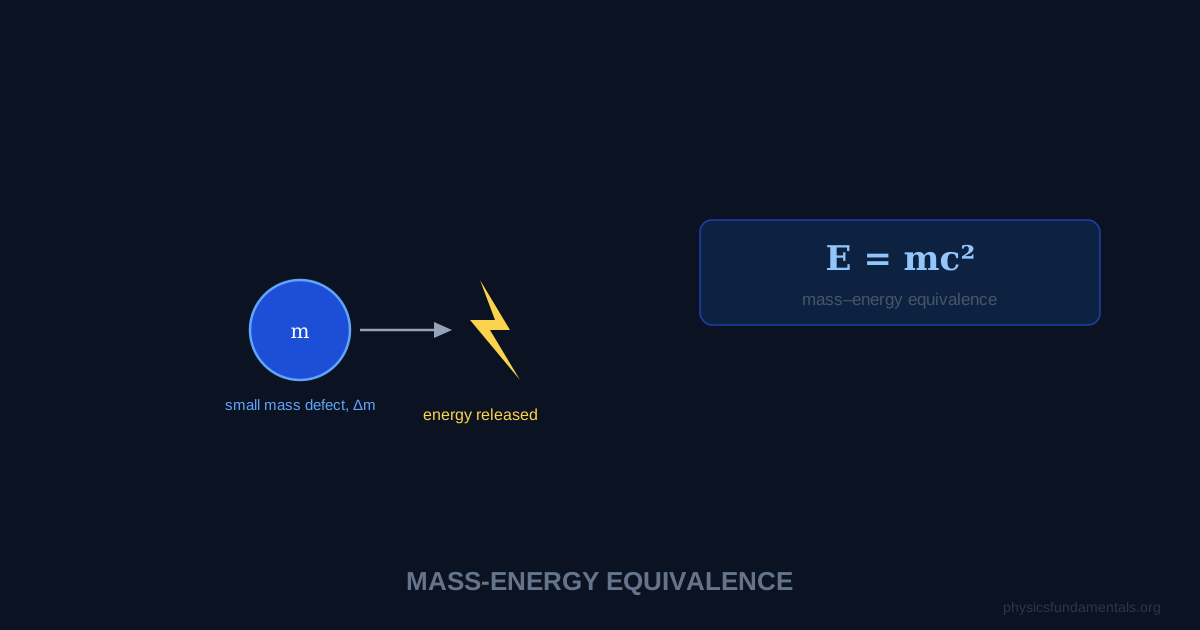
Einstein's equation E = mc² states that mass and energy are equivalent and interconvertible. A mass m at rest has an inherent energy E = mc², where c = 3 × 10⁸ m/s is the speed of light. The c² factor makes this conversion extraordinary: 1 gram of mass is equivalent to 9 × 10¹³ joules — more than the energy released by 21 kilotonnes of TNT. In nuclear reactions, tiny changes in mass (mass defect) release enormous amounts of energy, which is why nuclear power and nuclear weapons are so energetically potent.
E = mc² was published by Einstein in 1905 as a consequence of special relativity. It's arguably the most famous equation in physics, but it's often misunderstood as a bomb formula. It's actually a statement about the nature of mass itself — mass is a form of energy, and the two can be converted into each other under the right conditions.
- What E = mc² means physically — rest energy and mass-energy equivalence
- Mass defect: why nuclear products are lighter than the reactants
- Binding energy and the binding energy per nucleon curve
- Why fission and fusion both release energy
- 4 worked examples including nuclear energy calculations
E = mc² — What It Actually Means
Mass and energy are different manifestations of the same thing. Any object at rest has rest energy E₀ = mc². Energy can be converted to mass and mass can be converted to energy; the total (mass-energy) is conserved.
Where c = 2.998 × 10⁸ m/s ≈ 3 × 10⁸ m/s.
For a moving object, the total energy is E = γmc², where γ = 1/√(1−v²/c²) is the Lorentz factor. At everyday speeds v ≪ c, γ ≈ 1 + ½(v/c)², and the total energy reduces to E ≈ mc² + ½mv² — rest energy plus kinetic energy, exactly the classical result.
The rest energy mc² is always present, even for a stationary object. It represents energy locked up in the mass itself — accessible when matter is annihilated (particle-antiparticle pair) or when nuclear reactions convert a small fraction of nuclear mass to energy.
Mass Defect in Nuclear Reactions
When nucleons (protons and neutrons) bind together to form a nucleus, the nucleus is slightly lighter than the sum of its separated constituents. This difference is the mass defect Δm:
Where Z is the number of protons, N the number of neutrons, m_p = 1.0073 u, m_n = 1.0087 u (u = atomic mass unit = 1.661 × 10⁻²⁷ kg).
The energy equivalent of this mass defect is the binding energy:
Binding energy is the energy required to completely separate all nucleons — it's released when the nucleus forms. Higher binding energy = more stable nucleus.
The Binding Energy Per Nucleon Curve
Plotting binding energy per nucleon (E_B/A) against mass number A reveals the key to nuclear energy:
- Peak at iron-56 (Fe-56): E_B/A ≈ 8.8 MeV/nucleon — the most stable nucleus. Neither fission nor fusion releases energy for iron.
- Light nuclei (A < 56): E_B/A increases toward iron → fusion releases energy (combining light nuclei gives a more stable product)
- Heavy nuclei (A > 56): E_B/A decreases → fission releases energy (splitting heavy nuclei gives more stable products)
Both fission and fusion release energy because both processes move toward the iron-56 peak — toward greater binding energy per nucleon.
4 Worked Examples
Example 1 — Rest energy of 1 gram
Problem: Find the rest energy equivalent of 1 gram of matter.
Solution:
E = mc² = 0.001 × (3 × 10⁸)² = 0.001 × 9 × 10¹⁶ = 9 × 10¹³ J
This is 90 terajoules — enough to power a city for several hours.
Example 2 — Mass defect of helium-4
Problem: Helium-4 has 2 protons and 2 neutrons. Its nuclear mass is 4.0015 u. Find the mass defect and binding energy. (m_p = 1.00728 u, m_n = 1.00867 u, 1 u = 931.5 MeV/c²)
Solution:
Total constituent mass = 2 × 1.00728 + 2 × 1.00867 = 2.01456 + 2.01734 = 4.03190 u
Δm = 4.03190 − 4.0015 = 0.03040 u
E_B = 0.03040 × 931.5 MeV = 28.32 MeV
Binding energy per nucleon: 28.32/4 = 7.08 MeV/nucleon
Example 3 — Uranium fission energy
Problem: When uranium-235 undergoes fission, the mass defect per reaction is approximately 3.0 × 10⁻²⁸ kg. Find the energy released per fission event.
Solution:
E = Δmc² = 3.0 × 10⁻²⁸ × (3 × 10⁸)² = 3.0 × 10⁻²⁸ × 9 × 10¹⁶ = 2.7 × 10⁻¹¹ J ≈ 170 MeV
Example 4 — Pair production
Problem: A photon produces an electron-positron pair. What is the minimum photon energy required? (m_e = 9.11 × 10⁻³¹ kg)
Solution:
Minimum energy = rest energy of both particles = 2m_e c²
= 2 × 9.11 × 10⁻³¹ × (3 × 10⁸)²
= 2 × 9.11 × 10⁻³¹ × 9 × 10¹⁶ = 1.64 × 10⁻¹³ J = 1.02 MeV
Fission vs Fusion
Nuclear fission: Heavy nucleus (e.g. U-235) splits into medium-mass fragments. Each fragment has more binding energy per nucleon than uranium, so energy is released. One fission event releases ~200 MeV. Used in nuclear power stations and nuclear bombs.
Nuclear fusion: Light nuclei (e.g. hydrogen isotopes) combine to form helium. The product has much more binding energy per nucleon, releasing ~17.6 MeV per reaction for D+T fusion. Fusion powers the Sun and is the goal of controlled fusion research (ITER).
Per unit mass of fuel, fusion releases about four times more energy than fission, and the fuels (hydrogen isotopes) are far more abundant than uranium. The challenge is maintaining the extreme temperature (~100 million °C) needed to overcome electrostatic repulsion between nuclei.
Pair Production and Annihilation
E = mc² predicts that energy can convert to mass and vice versa. Pair production: a photon with energy ≥ 2m_ec² = 1.022 MeV creates an electron-positron pair near a nucleus (which absorbs recoil momentum):
Pair annihilation: an electron and positron annihilate, converting all their rest mass (and kinetic energy) to two gamma-ray photons travelling in opposite directions:
Two photons are required by momentum conservation (the initial total momentum can be zero in the centre-of-mass frame; a single photon carries nonzero momentum). PET scanners detect these 511 keV annihilation photons arriving simultaneously from opposite directions, locating the fluorine-18 tracer to within millimetres.
Relativistic Kinetic Energy
At speeds approaching c, the classical KE = ½mv² fails. The relativistic total energy is:
Kinetic energy: KE = (γ−1)mc². At low speeds (v ≪ c), γ ≈ 1 + ½v²/c², so KE ≈ ½mv² — the classical result. At v = 0.9c: γ = 1/√(1−0.81) = 1/√0.19 = 2.294, so KE = 1.294 mc² — 159% larger than ½mv² = 0.405 mc². Particle accelerators that ignore relativistic mass increase would fail to achieve the required particle energies — the LHC protons at 6.5 TeV have γ = 6,930, moving at 0.9999999c.
Nuclear Reactions — Energy Bookkeeping
In any nuclear reaction, energy conservation requires:
Q > 0: exothermic (energy released, products lighter than reactants). Q < 0: endothermic (energy absorbed). For uranium-235 fission:
²³⁵U + n → ⁹²Kr + ¹⁴¹Ba + 3n
Mass deficit Δm = m(U-235) + m(n) − m(Kr-92) − m(Ba-141) − 3m(n) ≈ 0.186 u
Q = 0.186 × 931.5 MeV = 173 MeV
This Q value is released as kinetic energy of the fission fragments and neutrons, which thermalise (slow down through collisions) and heat the reactor coolant. One kilogram of U-235 contains 4/235 × N_A × (10³/235) = 2.56 × 10²⁴ atoms. If all fissioned: total energy = 2.56 × 10²⁴ × 173 × 1.6 × 10⁻¹³ J = 7.1 × 10¹³ J ≈ 70 TJ — equivalent to 17,000 tonnes of TNT from 1 kg of fuel.
Worked Example 5 — Pion decay
Problem: A neutral pion (π⁰, rest mass 135 MeV/c²) decays at rest into two photons. Find the energy and wavelength of each photon.
Solution:
Total energy = rest energy = 135 MeV. Two equal photons by symmetry (momentum conservation requires equal and opposite momenta, so equal energies for identical particles).
E_each = 135/2 = 67.5 MeV
λ = hc/E = 1240 eV·nm/(67.5 × 10⁶ eV) = 1.84 × 10⁻⁵ nm = 1.84 × 10⁻¹⁴ m (gamma ray)
Solar Energy Output from E = mc²
The Sun converts mass to energy through hydrogen fusion. In the proton-proton chain, four protons fuse to form one helium-4 nucleus. The mass deficit:
Δm = 4 × m(p) − m(He-4) = 4 × 1.00728 − 4.00151 = 0.02761 u
Energy per reaction = 0.02761 × 931.5 = 25.7 MeV
The Sun radiates 3.85 × 10²⁶ W. Mass converted per second: dm/dt = P/c² = 3.85 × 10²⁶/(3 × 10⁸)² = 4.28 × 10⁹ kg/s = 4.28 million tonnes per second
The Sun has been burning for 4.6 × 10⁹ years and has lost about 4.28 × 10⁹ × 4.6 × 10⁹ × 3.15 × 10⁷ ≈ 6.2 × 10²⁶ kg through mass-energy conversion — less than 0.03% of its initial mass of ~2 × 10³⁰ kg. The Sun has fuel for another ~5 billion years.
Relativistic Momentum and Four-Vectors
In special relativity, energy and momentum combine into a four-vector (E/c, p_x, p_y, p_z). The "length" of this four-vector is invariant — the same in all reference frames:
For a massless particle (photon): m = 0 → E = pc → E = hf and p = h/λ = hf/c. For a particle at rest: p = 0 → E = mc². For a moving particle: E² − (pc)² = (mc²)². This energy-momentum relation is the fully relativistic version of both E = mc² and the classical KE relationship — it unifies them. In particle physics experiments, the invariant mass of a particle system is calculated from this relation using measured energies and momenta of all products, allowing the identification of short-lived particles that decay before reaching detectors.
Exam Summary
E = mc² means mass and energy are interconvertible at rate c². In nuclear reactions: energy released Q = Δmc² (mass defect × c²). Useful unit: 1 u = 931.5 MeV/c². For nuclear calculations, express mass defect in atomic mass units and multiply by 931.5 to get MeV directly. Pair production requires E_photon ≥ 2m_ec² = 1.022 MeV; annihilation produces two 0.511 MeV gamma rays. Fission releases ~200 MeV per event; DT fusion releases 17.6 MeV per event. The Sun converts 4.28 million tonnes of mass to energy each second — all from E = mc². The mass defect is always positive (products lighter than reactants) for spontaneous exothermic reactions; binding energy is the energy equivalent of this mass deficit.
Three key numerical conversions to memorise: 1 u = 931.5 MeV/c² = 1.661 × 10⁻²⁷ kg; electron rest energy m_ec² = 0.511 MeV; proton rest energy m_pc² = 938.3 MeV. Using these, nuclear binding energies, Q values, and pair production thresholds can be calculated quickly without converting through SI units. For example, the minimum photon energy for pair production is 2 × 0.511 = 1.022 MeV; the proton-proton chain releases about 26 MeV (from summing the Q values of each step); fission of U-235 releases about 200 MeV (approximately 0.1% of the rest mass energy 235 × 931.5 = 218,900 MeV). These numbers are part of nuclear physics fluency.
Antimatter and the Baryon Asymmetry Problem
E = mc² and pair production imply that matter and antimatter are created in equal amounts. The Big Bang should have produced equal quantities of protons and antiprotons, electrons and positrons. In that case, all matter and antimatter would have annihilated — leaving only photons and no material universe. Yet the observable universe contains essentially only matter. This "baryon asymmetry" is one of the deepest unsolved problems in physics. The Standard Model predicts a slight asymmetry (CP violation) between matter and antimatter behaviour, but the predicted asymmetry is orders of magnitude smaller than what's needed to explain the matter-dominated universe. Understanding why the universe has matter — which ultimately comes down to subtle asymmetries in how E = mc² plays out in the very early universe — is one of the central unsolved questions in cosmology and particle physics.
E = mc² is not just a formula about nuclear bombs or exotic particle physics — it underpins some of the most precise measurements in all of science. Atomic clocks rely on the precise energy levels of caesium atoms, which are fixed by the electromagnetic interactions (ultimately electric potential energy terms involving electron masses). GPS satellites must correct for both special relativistic time dilation (clocks run slow at high speed) and general relativistic time dilation (clocks run fast at high altitude) — the corrections amount to about 38 microseconds per day, which if uncorrected would cause GPS position errors of ~10 km per day. The mass-energy equivalence that makes nuclear weapons possible is the same physics that makes GPS satellites accurate to metres.
Frequently Asked Questions
What does E = mc² mean?
What is mass defect?
Why do both fission and fusion release energy?
How much energy is in 1 kg of matter?
What is the atomic mass unit (u)?
Share this article
Written by
Physics Fundamentals Editorial Team
Written and reviewed by our team of physics educators. Content is aligned with A-Level, GCSE, AP Physics, and undergraduate curricula.
About Physics Fundamentals →