Every heat engine ever built — every car, every power station, every jet turbine — is measured against a limit that was worked out mathematically almost two centuries before anyone could build an engine efficient enough to threaten it. In 1824, Sadi Carnot proved that no heat engine operating between two temperatures can ever exceed a specific maximum efficiency, no matter how cleverly it's designed or what it's made from. This isn't an engineering limitation waiting to be solved by better materials — it's a hard boundary set by the second law of thermodynamics itself. Understanding the Carnot cycle means understanding exactly why your car engine wastes most of its fuel as heat, and exactly how much of that waste is fundamentally unavoidable versus merely a matter of better engineering.
- The Carnot efficiency formula η = 1 − T_c/T_h, and why it sets an absolute ceiling on heat engine performance
- The four stages of the idealised Carnot cycle, and why each one must be reversible
- How the Carnot cycle connects directly to the second law of thermodynamics and entropy
- 3 fully worked examples: a power station, a car engine, and running the cycle backward as a refrigerator
- Why real engines always fall short of the Carnot limit, and what that gap actually costs
What a Heat Engine Actually Does
A heat engine is any device that converts heat into useful work by letting heat flow from a hot reservoir to a cold one, extracting some of that energy as work along the way. Fuel burns in a car engine's cylinders (the hot reservoir), some of that thermal energy is converted into mechanical work pushing the pistons, and the rest is dumped as waste heat into the exhaust and cooling system (the cold reservoir). No heat engine can convert 100% of input heat into work — this isn't a failure of engineering, it's a direct requirement of the second law of thermodynamics, which insists that some heat must always be rejected to a colder reservoir. The question the Carnot cycle answers is: given two temperatures to work between, what's the absolute best any engine could possibly do?
The Carnot Efficiency Formula
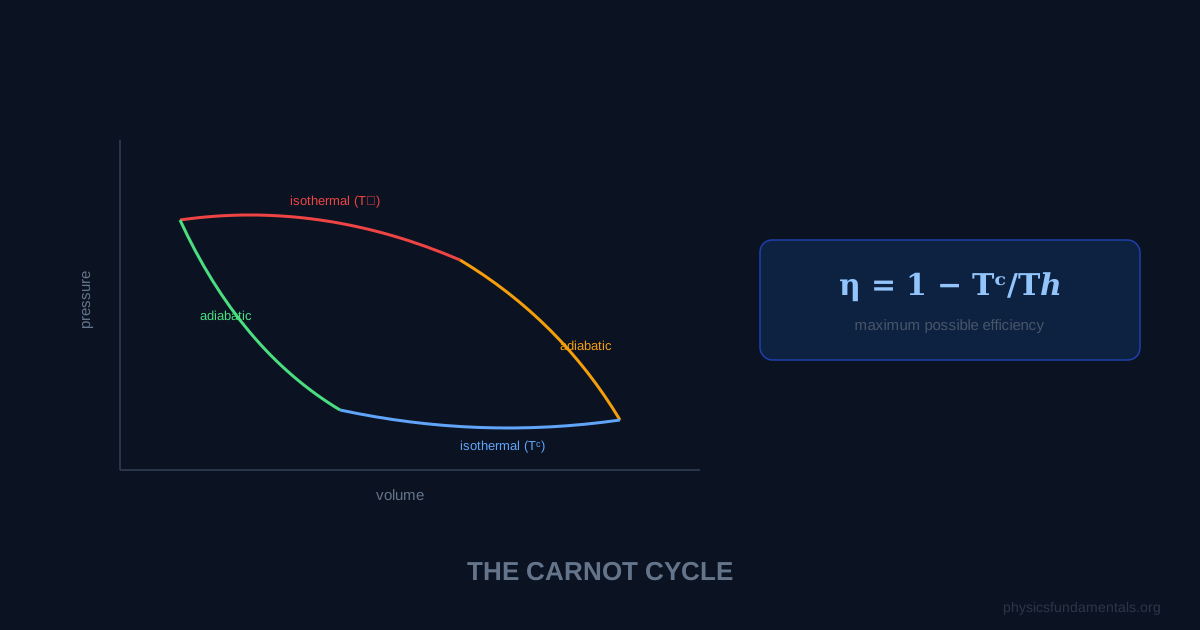
Carnot's theorem states that the maximum possible efficiency of any heat engine operating between a hot reservoir at temperature T_h and a cold reservoir at temperature T_c (both in kelvin) is:
This depends only on the two temperatures — not on what the engine is made of, what working fluid it uses, or how it's built. A steam engine, a gas turbine, and a hypothetical engine made of exotic future materials are all bound by exactly the same ceiling if they operate between the same two temperatures. The only way to raise the Carnot limit is to increase T_h, decrease T_c, or both — which is precisely why real engine design obsesses over running combustion hotter and exhaust cooler wherever materials and safety allow.
The Four Stages of the Carnot Cycle
The idealised Carnot cycle achieves this maximum efficiency through four reversible stages, usually shown on a pressure-volume diagram: (1) Isothermal expansion — the working gas expands while in contact with the hot reservoir at T_h, absorbing heat Q_h and doing work, with temperature held constant. (2) Adiabatic expansion — the gas continues expanding, now thermally isolated from any reservoir, so its temperature drops from T_h to T_c purely from doing work on its surroundings. (3) Isothermal compression — the gas is compressed while in contact with the cold reservoir at T_c, rejecting heat Q_c, with temperature held constant. (4) Adiabatic compression — the gas is compressed further, thermally isolated again, and its temperature rises back from T_c to T_h, returning the system to its starting state. Every stage is reversible in the idealised cycle — no friction, no turbulence, infinitesimally slow heat transfer across zero temperature difference — which is precisely the (physically unattainable) condition required to hit the Carnot maximum exactly.
Why This Is the Second Law in Action
The Carnot limit isn't an arbitrary formula — it's a direct consequence of entropy never decreasing in an isolated system. For a reversible cycle, the total entropy change over one complete cycle is exactly zero: the entropy given up by the hot reservoir (Q_h/T_h) exactly equals the entropy gained by the cold reservoir (Q_c/T_c). Setting these equal, Q_h/T_h = Q_c/T_c, and substituting into the efficiency definition η = 1 − Q_c/Q_h gives exactly η = 1 − T_c/T_h. Any real engine, with genuine friction and finite-rate heat transfer, necessarily generates additional entropy during operation — and that extra entropy generation is exactly what shows up as efficiency lost below the Carnot limit. The gap between real-engine efficiency and the Carnot limit is, quite literally, a direct measurement of how irreversible (how far from ideal) an engine's operation actually is.
Worked Example 1: A Coal-Fired Power Station
A power station's boiler operates at 600 K (327°C) and rejects heat to cooling water at 300 K (27°C). Find the maximum possible efficiency, and the work output for every 1,000 J of heat input at that limit.
At the Carnot limit, W = ηQ_h = 0.50 × 1,000 = 500 J of useful work for every 1,000 J of heat from burning fuel, with the remaining 500 J rejected as waste heat to the cooling water. Real coal power stations typically achieve around 35–45% efficiency — respectably close to this limit, but never able to exceed it, which is exactly why plant designers push boiler temperatures as high as materials safely allow and use cold river or sea water for cooling wherever possible.
Worked Example 2: A Car Engine
A car engine's combustion temperature reaches roughly 2,000 K, exhausting to ambient air at roughly 300 K. Find the Carnot limit.
The theoretical ceiling is remarkably high — but real car engines only achieve around 25–30% efficiency, far below this limit. The huge gap exists because real internal combustion engines are riddled with irreversibilities the idealised Carnot cycle assumes away entirely: friction between moving parts, turbulent (not infinitely slow) combustion, heat lost directly through cylinder walls, and the practical impossibility of perfectly isothermal or perfectly adiabatic strokes in a real engine cycle. This is exactly why engine efficiency has been such a stubborn engineering problem — not a lack of imagination, but a genuine fight against the many ways real processes fall short of thermodynamic idealisation.
Worked Example 3: Running the Cycle Backward — A Refrigerator
A Carnot cycle run in reverse, driven by external work rather than producing it, becomes an idealised refrigerator or heat pump. For a fridge keeping its interior at 277 K (4°C) inside a kitchen at 293 K (20°C), the coefficient of performance for cooling is:
A COP of 17.3 means the ideal fridge moves about 17.3 units of heat out of its interior for every 1 unit of electrical work put in — which sounds far better than 100% efficient, and is, because a refrigerator doesn't create heat, it moves it, and moving heat across a small temperature difference costs relatively little work. Run the same cycle to heat a house instead of cool a fridge, and the heating coefficient of performance is COP_heating = T_h/(T_h − T_c), which is why modern heat pumps — essentially refrigerators running backward — can deliver several times more heat energy into a home than the electrical energy they consume, unlike a simple resistive heater which can never exceed COP = 1.
Why Real Engines Always Fall Short
The Carnot cycle requires every stage to happen infinitely slowly and perfectly reversibly — heat transferred across an infinitesimal temperature difference, zero friction, zero turbulence. A real engine has to run at a practical speed to produce useful power, and any finite-rate process is inherently irreversible: heat transferred across a real (non-zero) temperature difference always generates some entropy, and that entropy generation always costs efficiency. There's a genuine trade-off here that Carnot's original idealised analysis doesn't capture on its own: an engine run infinitely slowly could approach the Carnot limit but would produce vanishingly little power, while an engine run fast enough to be useful inevitably sacrifices some efficiency for that power output. Real engineering is a constant negotiation between these two constraints — getting as close to the Carnot ceiling as possible while still producing power at a usable rate.
Real-World Applications
Power plant design: combined-cycle gas plants pair a gas turbine (high T_h) with a steam turbine that captures the gas turbine's waste heat (raising overall efficiency toward, but never past, the combined Carnot limit), reaching efficiencies above 60% — far better than either technology alone. Geothermal and ocean thermal power: both work with a smaller T_h − T_c gap than fossil-fuel plants, so their Carnot ceiling is inherently lower, which is exactly why they're less efficient per unit of heat but can still be worthwhile where the heat source itself is free. Refrigeration and air conditioning: engineers quote real coefficients of performance as a fraction of the theoretical Carnot COP, giving a direct, standardised measure of how close a real compressor design comes to thermodynamic perfection.
The Otto Cycle: How Real Petrol Engines Are Actually Modelled
The Carnot cycle is the theoretical ceiling, but it isn't how engineers actually model a petrol engine's behaviour — that job falls to the Otto cycle, which replaces the Carnot cycle's two isothermal stages with two constant-volume stages (rapid heat addition from combustion, and rapid heat rejection during exhaust), keeping the two adiabatic stages (compression and power stroke) essentially unchanged. The Otto cycle's efficiency depends on the compression ratio r rather than directly on the combustion temperature: η_Otto = 1 − 1/r^(γ−1), where γ is the ratio of specific heats of the working gas (about 1.4 for air). This is always lower than the Carnot limit calculated from the same peak and exhaust temperatures, precisely because constant-volume heat addition is inherently less efficient than the idealised isothermal process — it's one of the concrete reasons real engines can't approach their Carnot ceiling even before friction and other losses are considered. Raising the compression ratio increases Otto efficiency, which is exactly why high-compression and turbocharged engines exist, though pushed too far it causes uncontrolled pre-ignition ("engine knock").
Common Mistakes
Using Celsius instead of kelvin. The Carnot formula requires absolute temperature — plugging in Celsius values gives a meaningless (and sometimes negative) result. Always convert to kelvin first. Assuming a real engine could theoretically reach 100% efficiency with better technology. The Carnot limit isn't a materials-science barrier waiting for a clever fix — it's set by the second law itself, and no future engineering breakthrough can exceed 1 − T_c/T_h for given operating temperatures. Confusing the Carnot COP formulas for cooling and heating. COP_cooling = T_c/(T_h−T_c) and COP_heating = T_h/(T_h−T_c) differ only in the numerator, but mixing them up gives numbers that are both wrong and easy to mistake for plausible.
Frequently Asked Questions
What is the Carnot cycle?
What is the Carnot efficiency formula?
Why can't any engine be 100% efficient?
How is the Carnot cycle related to entropy?
Why do real engines fall short of the Carnot limit?
What is the coefficient of performance (COP)?
How can I increase an engine's efficiency toward the Carnot limit?
Share this article
Written by
Physics Fundamentals Editorial Team
Written and reviewed by our team of physics educators. Content is aligned with A-Level, GCSE, AP Physics, and undergraduate curricula.
About Physics Fundamentals →