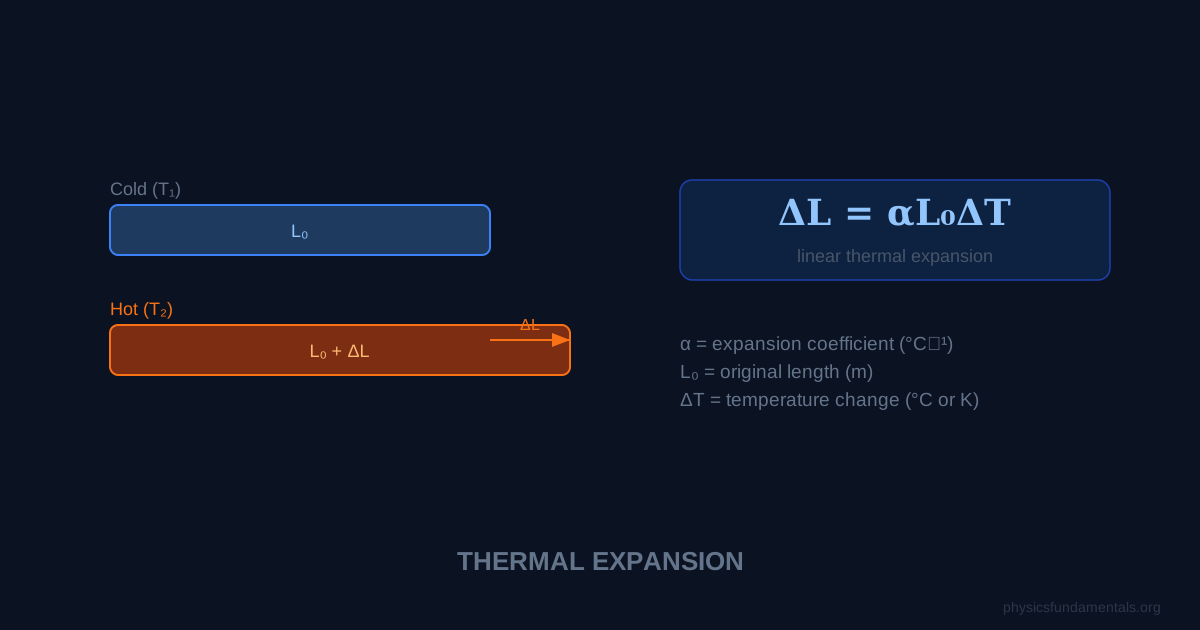
Thermal expansion is the increase in size of a material when its temperature rises. For linear expansion, the formula is ΔL = αL₀ΔT — the change in length equals the linear expansion coefficient multiplied by the original length and the temperature change. Most solids expand on heating and contract on cooling, with the expansion coefficient α varying significantly between materials: steel expands at about 12 × 10⁻⁶ per °C, aluminium at 23 × 10⁻⁶ per °C.
This might seem like a minor physical curiosity, but thermal expansion has serious engineering consequences. The Eiffel Tower is 15 cm taller in summer than in winter. Railway tracks need expansion gaps or they buckle in heat. Bridges use roller bearings and expansion joints to prevent structural damage. Getting thermal expansion calculations right is fundamental to structural and mechanical engineering.
- Linear expansion: ΔL = αL₀ΔT — formula, units, and the expansion coefficient α
- Area expansion: ΔA = 2αA₀ΔT and volumetric expansion: ΔV = βV₀ΔT
- Expansion coefficients for common materials (steel, aluminium, glass, water)
- 4 worked examples including railway gaps and liquid thermometers
- Why water is anomalous — it expands on cooling below 4°C
What Is Thermal Expansion?
Thermal expansion is the tendency of matter to change its dimensions (length, area, or volume) in response to a change in temperature. When temperature increases, atoms and molecules vibrate more energetically and occupy more space on average, causing the material to expand. The effect is reversible: cooling causes contraction.
At the atomic level, expansion happens because atoms don't sit in perfectly symmetric potential wells. The attractive force between atoms weakens more slowly with distance than the repulsive force increases with closeness — so as atoms vibrate with more energy at higher temperatures, their average separation increases slightly. This asymmetry in the interatomic potential is the microscopic origin of thermal expansion.
Different materials expand by very different amounts for the same temperature change. This is captured in the coefficient of thermal expansion — a material property that must be determined experimentally.
Linear Thermal Expansion: ΔL = αL₀ΔT
Where:
- ΔL = change in length (m)
- α = linear expansion coefficient (°C⁻¹ or K⁻¹)
- L₀ = original length at reference temperature (m)
- ΔT = change in temperature (°C or K — the difference is the same)
The final length after expansion:
Use our Thermal Expansion Calculator to find ΔL, α, L₀, or ΔT for any material.
Linear Expansion Coefficients for Common Materials
| Material | α (×10⁻⁶ per °C) | Notes |
|---|---|---|
| Steel | 12 | Bridges, railway tracks |
| Aluminium | 23 | Aircraft structures |
| Copper | 17 | Electrical wiring |
| Glass (ordinary) | 9 | Windows |
| Pyrex glass | 3.3 | Lab glassware — low expansion |
| Concrete | 12 | Matches steel (why they reinforce well) |
| Invar (steel alloy) | 1.2 | Precision instruments, clocks |
The fact that steel and concrete have nearly identical expansion coefficients (both ≈ 12 × 10⁻⁶ per °C) is not a coincidence — it's one reason reinforced concrete works so well. If they expanded at different rates, the bond between them would crack under temperature cycles.
Area and Volumetric Thermal Expansion
Linear expansion applies to one dimension. For a flat sheet, both dimensions expand, giving area expansion:
For a solid that expands in all three dimensions, use volumetric (cubic) expansion:
Where β is the volumetric expansion coefficient. For isotropic solids (uniform in all directions), β = 3α. For liquids and gases, only volumetric expansion applies — they have no fixed shape, so linear expansion is meaningless.
Volumetric expansion coefficients for liquids
- Mercury: β = 182 × 10⁻⁶ per °C — high, predictable, used in thermometers
- Ethanol: β = 750 × 10⁻⁶ per °C — very high, used in low-temperature thermometers
- Water: β ≈ 207 × 10⁻⁶ per °C at 20°C (anomalous behaviour below 4°C — see below)
4 Worked Examples
Example 1 — Railway track gap
Problem: A steel railway track is 25 m long at 10°C. What gap must be left between sections to allow for expansion on a hot day of 45°C? (α for steel = 12 × 10⁻⁶ °C⁻¹)
Solution:
ΔT = 45 − 10 = 35°C
ΔL = αL₀ΔT = 12 × 10⁻⁶ × 25 × 35
ΔL = 12 × 10⁻⁶ × 875
ΔL = 0.0105 m = 10.5 mm
Each 25 m section needs at least a 10.5 mm gap. In practice, engineers add a safety margin.
Example 2 — Eiffel Tower height change
Problem: The Eiffel Tower's iron structure is 300 m tall. If the temperature varies from −10°C in winter to +40°C in summer, how much does its height change? (α for iron = 12 × 10⁻⁶ °C⁻¹)
Solution:
ΔT = 40 − (−10) = 50°C
ΔL = 12 × 10⁻⁶ × 300 × 50
ΔL = 0.18 m = 18 cm
The tower grows by about 18 cm between its coldest and hottest extremes.
Example 3 — Aluminium rod
Problem: An aluminium rod is 2.000 m at 20°C. What is its length at 120°C? (α = 23 × 10⁻⁶ °C⁻¹)
Solution:
ΔT = 100°C
ΔL = 23 × 10⁻⁶ × 2.000 × 100 = 0.0046 m
L = L₀ + ΔL = 2.000 + 0.0046 = 2.0046 m
Example 4 — Volume of liquid in a tank
Problem: A steel tank holds 500 litres of oil at 15°C. The oil is heated to 65°C. By how much does the volume of oil increase? (β for oil = 900 × 10⁻⁶ °C⁻¹)
Solution:
ΔV = βV₀ΔT = 900 × 10⁻⁶ × 500 × 50
ΔV = 22.5 litres
The tank must have at least 22.5 litres of headroom, or oil will overflow as it heats up.
The Anomalous Expansion of Water
Water doesn't follow the normal thermal expansion pattern at low temperatures — it's one of the most important anomalies in physics. Between 0°C and 4°C, water contracts on warming (unlike almost every other substance). At 4°C it reaches maximum density. Below 4°C it expands as it cools, and ice at 0°C is less dense than liquid water at 0°C.
This anomaly has profound biological consequences: ice floats rather than sinking, which means lakes freeze from the top down and maintain liquid water at the bottom in winter — allowing aquatic life to survive. If ice were denser than water (normal behaviour), lakes would freeze solid from the bottom up.
The anomaly arises from hydrogen bonding. As water cools below 4°C, the hexagonal crystal structure of ice begins to form, and the hydrogen bonds in that structure hold water molecules further apart than in liquid water — increasing volume.
Real-World Applications
Thermometers work by using the volumetric expansion of a liquid (traditionally mercury, now often coloured ethanol) inside a narrow tube. The change in volume is amplified by the small cross-section of the tube, making small temperature changes visible.
Bimetallic strips bond two metals with different expansion coefficients (often brass and steel). When heated, the strip bends because one side expands more than the other. Used in thermostats, fire alarms, and circuit breakers.
Expansion joints in bridges and roads are deliberately engineered gaps, sometimes filled with rubber, that allow sections to expand and contract freely without buckling or cracking.
Shrink fitting in engineering: a metal ring is cooled with liquid nitrogen, fitted over a shaft, and allowed to warm up. As it expands back to room temperature, it grips the shaft with enormous force — no bolts required.
Volumetric and Area Expansion
Linear expansion (ΔL = αL₀ΔT) generalises to area and volume. For isotropic materials (same expansion in all directions):
The factors 2 and 3 arise because area expands in two dimensions and volume in three, each by α per dimension. For liquids and gases, only volume expansion is relevant (they have no fixed shape). The volume expansion coefficient for water is anomalous: it contracts from 0°C to 4°C (reaching maximum density at 4°C) then expands above 4°C. This anomaly has profound implications for aquatic life: lakes freeze from the surface down (4°C water sinks, insulating the warmer water below), preventing complete freezing in most temperate-climate winters.
Thermal Expansion of Liquids — Practical Consequences
Thermometers: liquid thermometers exploit volume expansion. Mercury (γ = 1.82 × 10⁻⁴ K⁻¹) and alcohol (γ ≈ 1.0 × 10⁻³ K⁻¹) expand in glass (γ ≈ 2.7 × 10⁻⁵ K⁻¹). The apparent expansion of liquid in glass is the difference: γ_apparent = γ_liquid − 3α_glass. For mercury in glass: γ_apparent ≈ 1.82 × 10⁻⁴ − 2.7 × 10⁻⁵ ≈ 1.55 × 10⁻⁴ K⁻¹. The thin capillary amplifies a small volume change into a measurable length change.
Car radiator coolant: water in an engine coolant system is pressurised to raise its boiling point above 100°C. The volume expands significantly when heated from cold (−20°C with antifreeze) to operating temperature (100°C) — the expansion tank accommodates this change. Without an expansion tank, the pressure would spike as volume increases against a fixed fluid volume — potentially rupturing hoses.
Hydraulic systems: hydraulic fluid (oil) expands when heated. High-performance braking systems heat the fluid, reducing brake effectiveness (brake fade) as thermal expansion can create compressible vapour bubbles. Racing cars use high-boiling-point brake fluids and vented disc brakes precisely to manage thermal effects.
Bimetallic Strips and Thermostats
A bimetallic strip bonds two metals with different expansion coefficients (e.g. brass α = 19 × 10⁻⁶ K⁻¹ and invar α = 1.2 × 10⁻⁶ K⁻¹). When temperature changes, the brass expands much more than the invar — since they're bonded, the strip bends toward the invar side when heated. This mechanical deflection:
- Thermostats: bimetallic coil opens or closes a switch at a set temperature — used in older room thermostats, kettle thermostats, and oven safety cutouts.
- Fire alarms: bimetallic strips activate alarm contacts when ambient temperature rises above threshold.
- Clock compensation: pendulum clocks use bimetallic pendulum rods to compensate for temperature-dependent length changes — as temperature rises, the grid-iron pendulum system is designed so the rising inner rods compensate for the lengthening outer rod, maintaining constant pendulum length and constant period.
Worked Example 5 — Steel rail gap
Problem: Steel railway tracks are laid at 15°C with a gap of 5 mm between 18 m sections. (a) At what temperature will the gap close? (b) What compressive stress develops if the tracks are welded continuously and heated to 50°C? (α_steel = 12 × 10⁻⁶ K⁻¹, E_steel = 200 GPa)
Solution:
(a) Gap closes when ΔL = 5 mm: αL₀ΔT = 0.005
ΔT = 0.005/(12 × 10⁻⁶ × 18) = 0.005/2.16 × 10⁻⁴ = 23.1 K
T_close = 15 + 23.1 = 38.1°C
(b) Welded: strain ε = αΔT = 12 × 10⁻⁶ × (50 − 15) = 12 × 10⁻⁶ × 35 = 4.2 × 10⁻⁴
σ = Eε = 200 × 10⁹ × 4.2 × 10⁻⁴ = 84 × 10⁶ Pa = 84 MPa
This is substantial — about 6% of steel's yield strength — which is why continuous welded rail (CWR) must be "stress-neutralised" during installation at the average annual temperature.
Gas Expansion — Revisiting Charles' Law
Gases expand far more than solids or liquids on heating. The volume expansion coefficient of an ideal gas at constant pressure:
At 300 K: γ_gas = 1/300 = 3.33 × 10⁻³ K⁻¹ — about 100–1000 times larger than for solids. This is why gas volume changes are immediately obvious and important in thermal calculations, while solid linear expansion effects are often only significant over large distances or precise engineering tolerances.
Hot air balloons exploit gas thermal expansion: heating air inside the envelope reduces its density (ρ = PM/(RT) — temperature increase at constant pressure reduces density) until the balloon plus payload achieves neutral buoyancy in the surrounding cooler air. A 2,800 m³ balloon heated from 15°C (288 K) to 100°C (373 K): density ratio = 288/373 = 0.772 → air inside is 22.8% less dense → buoyancy per cubic metre = 1.2 × 0.228 × 9.81 = 2.68 N/m³ → total uplift = 2.68 × 2800 = 7,504 N ≈ 765 kg — enough to lift the basket, burner, fuel, and several passengers.
Worked Example 6 — Expansion of a concrete bridge
Problem: A concrete bridge span is 120 m long. Temperature varies from −15°C in winter to +40°C in summer. (a) Find the total expansion. (b) Design the required expansion gap. (α_concrete = 10 × 10⁻⁶ K⁻¹)
Solution:
(a) ΔT = 40 − (−15) = 55 K
ΔL = αL₀ΔT = 10 × 10⁻⁶ × 120 × 55 = 0.066 m = 66 mm
(b) The expansion joint must accommodate 66 mm of movement. Standard bridge expansion joints are sized to 1.5× the calculated movement for safety: gap = 66 × 1.5 = 99 mm ≈ 100 mm
Large concrete and steel structures move by centimetres due to thermal expansion — all long bridges have expansion joints, visible as gaps in the deck surface covered by overlapping steel plates.
Thermal expansion is a consequence of the asymmetric interatomic potential energy curve. The potential energy minimum is not symmetric — it rises steeply on the compression side and gradually on the tension side. At higher temperatures, molecules vibrate with greater amplitude. Due to the asymmetry of the potential well, the average position shifts to slightly larger separations at higher temperatures — the material expands. If the potential well were perfectly symmetric (a parabola, i.e. exactly Hookean bonds), there would be no thermal expansion. The linear expansion coefficient α is directly related to the anharmonicity of the interatomic potential — materials with stiffer, more symmetric bonds (diamond, quartz) have very small α, while materials with softer, more asymmetric bonds (lead, polymers) have large α. Invar's anomalously low α arises from magnetic effects that partially cancel the normal thermal expansion.
Frequently Asked Questions
What is the formula for thermal expansion?
What is the unit of the thermal expansion coefficient?
Why do railway tracks have gaps?
Does thermal expansion apply to gases?
Why does water expand when it freezes?
Share this article
Written by
Physics Fundamentals Editorial Team
Written and reviewed by our team of physics educators. Content is aligned with A-Level, GCSE, AP Physics, and undergraduate curricula.
About Physics Fundamentals →