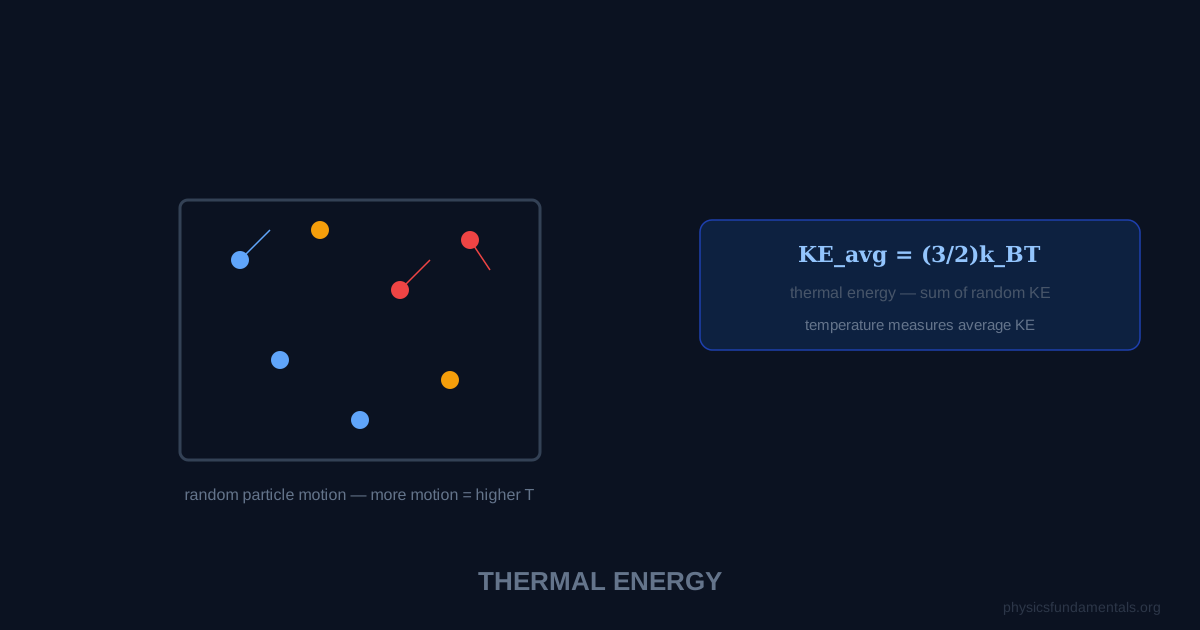
Thermal energy is the total kinetic energy of all the particles (atoms or molecules) in a substance due to their random motion. Temperature measures the average kinetic energy per particle — a hotter object has faster-moving particles. When heat Q is transferred to a substance of mass m and specific heat capacity c, the temperature change is given by Q = mcΔT. This formula connects the macroscopic quantity we measure (temperature change) to the microscopic reality of particle energies changing.
The distinction between heat, temperature, and internal energy trips up many students. They are related but fundamentally different: temperature is a measure of average particle kinetic energy, internal energy is the total energy stored in a system, and heat is the transfer of energy due to a temperature difference. The first law of thermodynamics ties them together: ΔU = Q − W.
- Thermal energy vs temperature vs heat — the critical distinctions
- Q = mcΔT — specific heat capacity and its physical meaning
- Internal energy U and what it includes
- First law of thermodynamics: ΔU = Q − W
- 4 worked examples including heat transfer and energy calculations
Temperature, Heat, and Thermal Energy
- Temperature: a measure of the average kinetic energy per particle. Measured in kelvin or Celsius. It's an intensive property — doesn't depend on how much material there is.
- Thermal energy / Internal energy: the total energy stored in a system (kinetic + potential energy of all particles). An extensive property — depends on the amount of material.
- Heat (Q): energy transferred from a hotter object to a cooler one due to a temperature difference. Heat is a process, not a property — you can't say an object "contains" heat.
Two objects can have the same temperature but very different thermal energies. A burning match and a bath of warm water might be at the same temperature, but the bath has vastly more internal energy — its enormous number of particles each carrying that average kinetic energy add up to far more total energy than the few atoms in a match flame.
Specific Heat Capacity: Q = mcΔT
Where:
- Q = heat energy transferred (J)
- m = mass of the substance (kg)
- c = specific heat capacity (J/kg·K or J/kg·°C)
- ΔT = change in temperature (K or °C — the change is the same in both scales)
Specific heat capacity c is the energy required to raise 1 kg of a substance by 1 K. It's a material property:
| Substance | c (J/kg·K) | Notes |
|---|---|---|
| Water | 4,186 | Exceptionally high — moderates climate |
| Ice | 2,090 | Roughly half that of liquid water |
| Aluminium | 897 | High for a metal |
| Iron/steel | 449 | Common engineering material |
| Copper | 385 | Good heat conductor |
| Lead | 128 | Low c — heats up quickly |
Water's remarkably high specific heat capacity (4,186 J/kg·K) explains why coastal areas have milder climates than inland areas — the ocean absorbs and releases enormous amounts of heat energy for relatively small temperature changes, moderating the local temperature.
Internal Energy
Internal energy (U) is the total energy stored in a system — the sum of all kinetic energies (translational, rotational, vibrational) of all particles, plus the potential energy of interactions between particles.
For an ideal gas: U = (3/2)nRT (for monatomic gas), where n is moles and R = 8.314 J/mol·K. Each degree of freedom contributes ½kT per molecule, where k = 1.38 × 10⁻²³ J/K is Boltzmann's constant.
First Law of Thermodynamics
The change in internal energy of a system equals the heat added to it minus the work done by it:
- Q positive: heat flows into the system (system absorbs energy)
- Q negative: heat flows out of the system
- W positive: system does work on surroundings (e.g. gas expands)
- W negative: surroundings do work on the system (e.g. gas compressed)
This is conservation of energy applied to thermodynamic systems. See our article on the First Law of Thermodynamics for an in-depth treatment.
4 Worked Examples
Example 1 — Heating water
Problem: How much energy is needed to heat 2 kg of water from 20°C to 100°C? (c_water = 4186 J/kg·K)
Solution:
Q = mcΔT = 2 × 4186 × (100 − 20) = 2 × 4186 × 80 = 669,760 J ≈ 670 kJ
Example 2 — Finding specific heat capacity
Problem: 500 J of energy raises the temperature of 0.2 kg of an unknown metal by 5.5°C. Find its specific heat capacity.
Solution:
c = Q/(mΔT) = 500/(0.2 × 5.5) = 500/1.1 = 455 J/kg·K
This is close to iron (449 J/kg·K) — probably an iron sample.
Example 3 — Mixing hot and cold water
Problem: 0.3 kg of water at 80°C is mixed with 0.5 kg of water at 20°C. Find the final temperature. (Assume no heat loss to surroundings.)
Solution:
Heat lost by hot water = heat gained by cold water
m₁c(T₁ − T_f) = m₂c(T_f − T₂)
c cancels: 0.3(80 − T_f) = 0.5(T_f − 20)
24 − 0.3T_f = 0.5T_f − 10
34 = 0.8T_f → T_f = 42.5°C
Example 4 — First law application
Problem: A gas absorbs 800 J of heat and does 300 J of work expanding against a piston. Find the change in internal energy.
Solution:
ΔU = Q − W = 800 − 300 = 500 J
The gas's internal energy increases by 500 J — its temperature rises.
Kinetic Theory and Temperature
The kinetic theory of gases derives the relationship between macroscopic temperature and microscopic particle energies. For an ideal monatomic gas, each molecule has three translational degrees of freedom, each contributing ½kT of average KE (equipartition theorem). Total average KE per molecule:
Where k = 1.381 × 10⁻²³ J/K is Boltzmann's constant. This directly links the measurable temperature T to the average molecular kinetic energy. For nitrogen at room temperature (T = 293 K): ⟨KE⟩ = 1.5 × 1.381 × 10⁻²³ × 293 = 6.07 × 10⁻²¹ J per molecule. The rms speed: v_rms = √(3kT/m) = √(3RT/M) where M is molar mass. For nitrogen (M = 0.028 kg/mol): v_rms = √(3 × 8.314 × 293/0.028) = √(261,400) = 511 m/s. Molecules in air at room temperature travel at speeds comparable to the speed of sound (343 m/s) — not a coincidence, since sound propagates through a gas by molecular collisions.
Specific Heat Capacity — Microscopic Interpretation
The specific heat capacity c tells us how many degrees of freedom absorb the heat energy. For a monatomic ideal gas: each mole has 3 translational degrees of freedom, each storing ½RT of energy. Total internal energy per mole U = (3/2)RT → molar heat capacity Cv = dU/dT = (3/2)R = 12.47 J/mol·K. For diatomic gases (N₂, O₂, H₂): at room temperature, 5 degrees of freedom (3 translational + 2 rotational) → Cv = (5/2)R = 20.79 J/mol·K. At very high temperatures, vibrational modes also activate → Cv = (7/2)R. The step-wise increase in Cv with temperature reflects the successive activation of additional degrees of freedom — a quantum mechanical effect (rotation and vibration require specific energy quanta to activate).
Latent Heat — Phase Changes at Constant Temperature
When a substance changes phase (melting, boiling), temperature remains constant while energy is added or removed. The specific latent heat L is the energy per unit mass for the phase change:
Specific latent heat of fusion (melting): L_f for ice = 334 kJ/kg. Specific latent heat of vaporisation (boiling): L_v for water = 2260 kJ/kg — about 7 times larger than L_f. Boiling requires much more energy than melting because molecules must be completely separated from the liquid (breaking all intermolecular bonds) rather than just made mobile within the liquid (weakening intermolecular bonds).
The combined heating curve: ice at −20°C heated to steam at 120°C: (1) heat ice Q = mcΔT; (2) melt ice Q = mL_f at 0°C; (3) heat water Q = mcΔT; (4) boil water Q = mL_v at 100°C; (5) heat steam Q = mcΔT. The flat sections of the heating curve (at 0°C and 100°C) represent latent heat absorption — temperature constant while phase changes.
Worked Example 5 — Heating ice to steam
Problem: Calculate the total energy needed to convert 0.5 kg of ice at −10°C to steam at 100°C. (c_ice = 2090 J/kg·K, c_water = 4186 J/kg·K, L_f = 334 kJ/kg, L_v = 2260 kJ/kg)
Solution:
Q₁ (heat ice to 0°C): 0.5 × 2090 × 10 = 10,450 J
Q₂ (melt ice at 0°C): 0.5 × 334,000 = 167,000 J
Q₃ (heat water to 100°C): 0.5 × 4186 × 100 = 209,300 J
Q₄ (vaporise at 100°C): 0.5 × 2,260,000 = 1,130,000 J
Q_total = 10,450 + 167,000 + 209,300 + 1,130,000 = 1,516,750 J ≈ 1.52 MJ
Vaporisation dominates — 74% of the total energy goes into boiling the water. This is why steam is so effective at cooking: it carries a large hidden latent heat that releases when it condenses on food.
The First Law of Thermodynamics
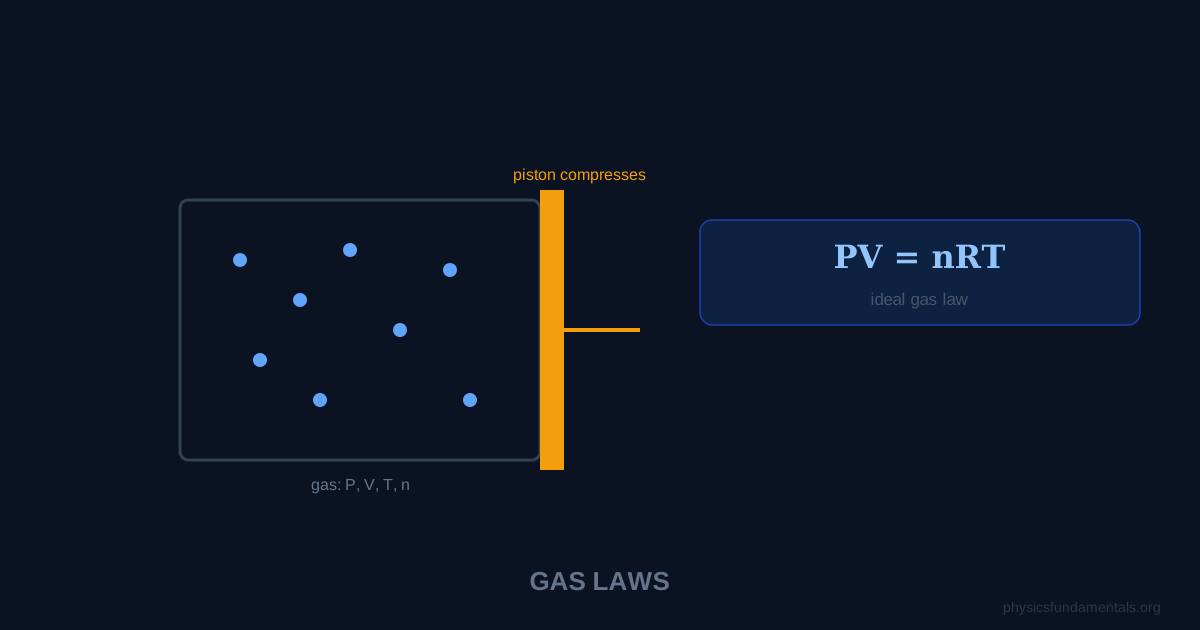
The first law: ΔU = Q − W, where ΔU is the change in internal energy, Q is heat added to the system, and W is work done by the system. For gas expansion: W = PΔV (pressure times volume change). The sign convention: Q positive means heat enters the system; W positive means system does work on surroundings.
- Isochoric process (constant volume): W = 0 → ΔU = Q. All heat goes to increasing internal energy (temperature rises).
- Isobaric process (constant pressure): W = PΔV; Q = ΔU + PΔV = ΔH (enthalpy change).
- Isothermal process (constant temperature, ideal gas): ΔU = 0 → Q = W. Heat added equals work done.
- Adiabatic process (no heat exchange): Q = 0 → ΔU = −W. System cools as it does work (expanding gas in a diesel engine, adiabatically heated during compression, reaching temperatures high enough to ignite fuel without a spark plug).
Worked Example 6 — First law application
Problem: A gas at constant pressure of 2 × 10⁵ Pa expands from 3 L to 5 L while absorbing 600 J of heat. Find: (a) work done by the gas, (b) change in internal energy.
Solution:
(a) W = PΔV = 2 × 10⁵ × (5−3) × 10⁻³ = 2 × 10⁵ × 2 × 10⁻³ = 400 J
(b) ΔU = Q − W = 600 − 400 = 200 J
The gas both does 400 J of work (expanding the piston) and increases its internal energy (temperature rises) by 200 J, all from the 600 J of heat absorbed.
Heat Transfer Mechanisms
Thermal energy is transferred by three mechanisms:
- Conduction: energy transfer through a material by direct molecular collisions (in solids and dense fluids). Rate: P = kAΔT/L, where k is thermal conductivity, A is cross-sectional area, ΔT is temperature difference, L is thickness. Good conductors (copper: k = 400 W/m·K) transfer heat rapidly; insulators (fibreglass insulation: k = 0.04 W/m·K) retard it. The ratio kA/L is the thermal conductance; L/(kA) is thermal resistance.
- Convection: energy transfer by bulk fluid movement. Warm fluid rises (less dense), cool fluid sinks, creating convection currents. Natural convection is the mechanism for central heating systems, ocean currents, and atmospheric circulation. Forced convection (pumped cooling systems, fans) is far more efficient.
- Radiation: energy transfer by electromagnetic waves (primarily infrared). All objects emit radiation; rate given by Stefan-Boltzmann law: P = εσAT⁴, where ε is emissivity (0 to 1), σ = 5.67 × 10⁻⁸ W/m²·K⁴, A is surface area, T is absolute temperature. A perfect black body (ε = 1) at 300 K emits P/A = 5.67 × 10⁻⁸ × 300⁴ = 459 W/m². At 6000 K (Sun's surface): P/A = 7.35 × 10⁷ W/m².
Exam Summary for Thermal Energy
Key formulas: Q = mcΔT (sensible heat — temperature change); Q = mL (latent heat — phase change, temperature constant); ΔU = Q − W (first law). Temperature in kelvin for gas law calculations. The distinction between heat (energy transferred due to temperature difference), temperature (average molecular KE), and internal energy (total energy in the system) is fundamental. Mixing problems: heat lost by hot = heat gained by cold (Q_hot = Q_cold), with mc∆T for each, assuming no heat loss to surroundings. Phase change problems: don't forget the latent heat — ice at 0°C requires L_f = 334 kJ/kg before any temperature rise in the resulting water begins.
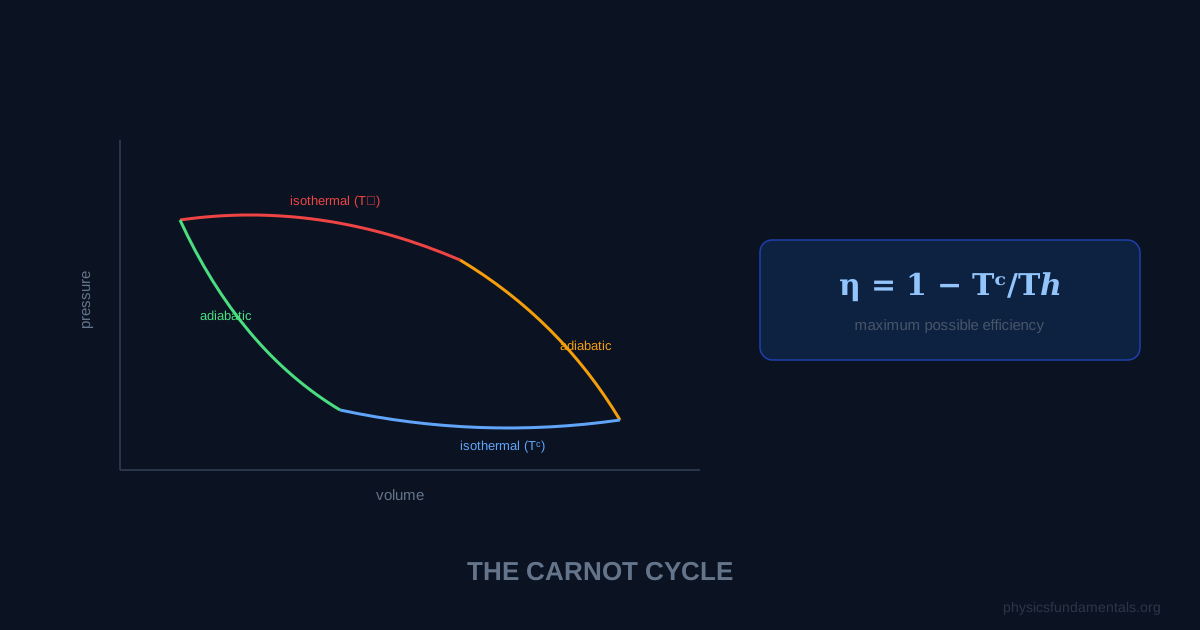
Thermal energy underpins the entire field of thermodynamics and heat engines. The first law (ΔU = Q − W) is conservation of energy applied to thermal systems. The second law (entropy always increases in isolated systems) explains why heat engines cannot be 100% efficient (Carnot limit: η_max = 1 − T_cold/T_hot), why refrigerators need work input, and why the universe tends toward disorder. Together the two laws govern all energy conversion processes — from the steam engines of the Industrial Revolution to nuclear reactors, internal combustion engines, jet turbines, and fuel cells. Q = mcΔT and Q = mL are the tools that quantify these processes; ΔU = Q − W is the accounting framework that ensures energy is never created or destroyed.
Frequently Asked Questions
What is the difference between heat and temperature?
What is specific heat capacity?
What is internal energy?
What is the first law of thermodynamics?
Why does water have such a high specific heat capacity?
Share this article
Written by
Physics Fundamentals Editorial Team
Written and reviewed by our team of physics educators. Content is aligned with A-Level, GCSE, AP Physics, and undergraduate curricula.
About Physics Fundamentals →