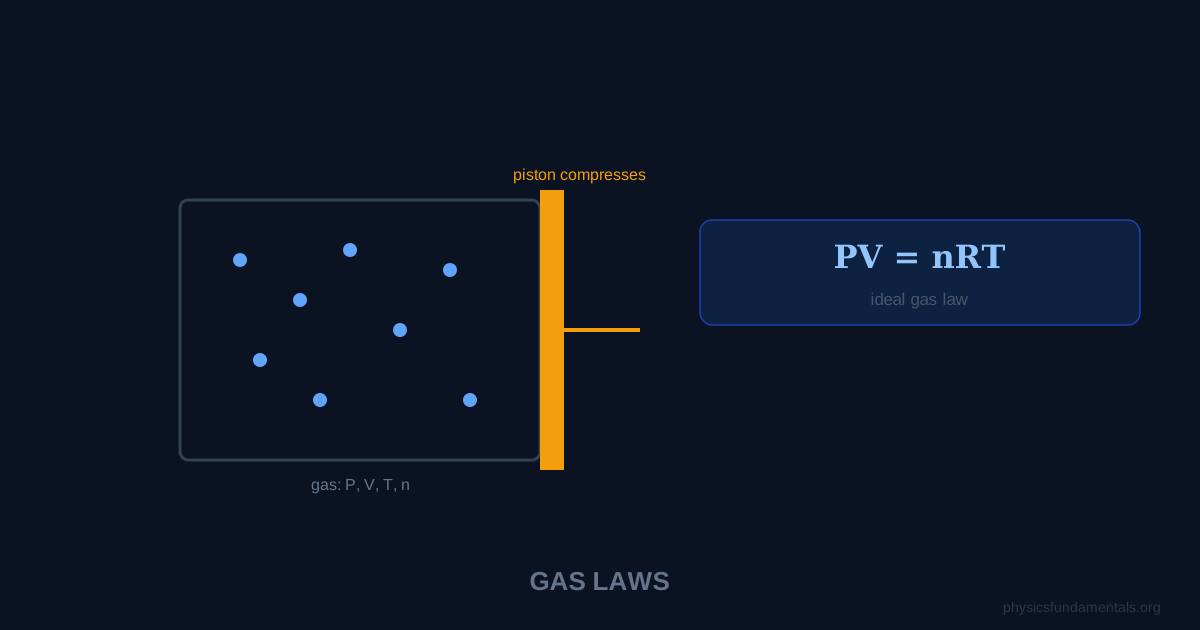
The three empirical gas laws describe how pressure, volume, and temperature relate for a fixed amount of gas: Boyle's law (P₁V₁ = P₂V₂, constant temperature), Charles' law (V₁/T₁ = V₂/T₂, constant pressure), and Gay-Lussac's law (P₁/T₁ = P₂/T₂, constant volume). Each law isolates one pair of variables by holding the third constant — together they combine into the ideal gas law PV = nRT.
These laws were discovered experimentally before their molecular explanation was understood. Robert Boyle published his pressure-volume relationship in 1662; Jacques Charles described the volume-temperature relationship in the 1780s; Joseph Gay-Lussac formalised the pressure-temperature law in 1809. Each discovery was a step toward understanding that gas behaviour emerges from the motion of vast numbers of molecules.
- Boyle's law: P₁V₁ = P₂V₂ at constant temperature
- Charles' law: V₁/T₁ = V₂/T₂ at constant pressure (T in kelvin)
- Gay-Lussac's law: P₁/T₁ = P₂/T₂ at constant volume
- The combined gas law linking all three
- 4 worked examples and how all three laws follow from PV = nRT
Boyle's Law: P₁V₁ = P₂V₂
At constant temperature, the pressure and volume of a fixed mass of gas are inversely proportional: P ∝ 1/V, or P₁V₁ = P₂V₂.
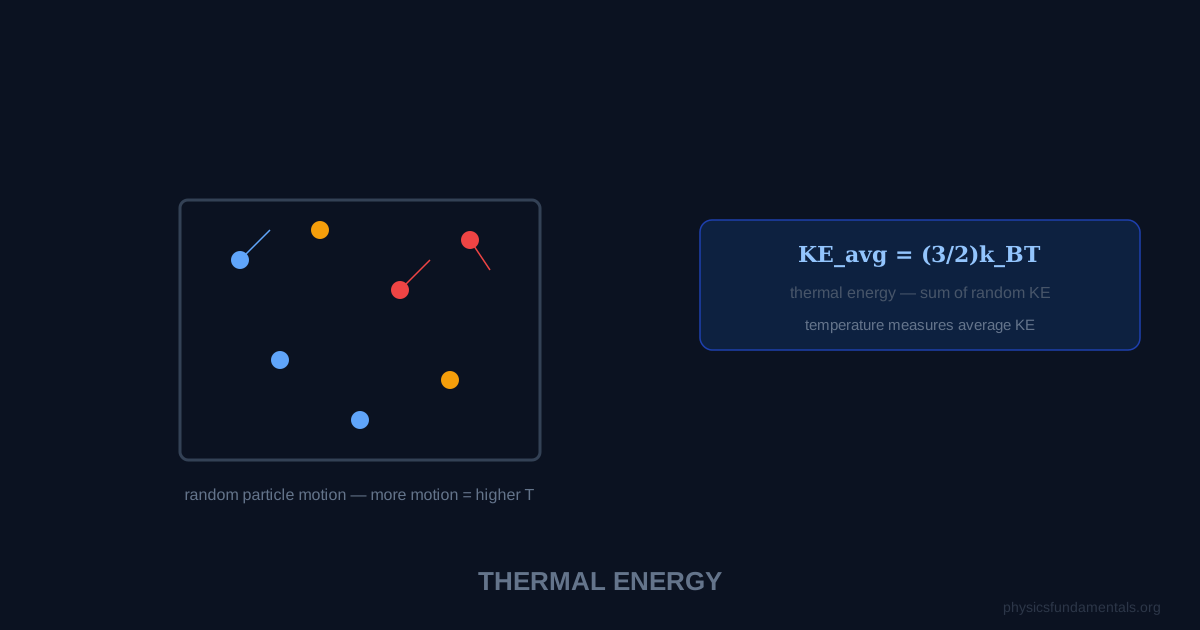
Physical reason: compressing a gas (decreasing V) forces molecules into a smaller space, so they hit the walls more often → higher pressure. At constant temperature, molecular speed is unchanged — only collision frequency changes with volume.
Charles' Law: V₁/T₁ = V₂/T₂
At constant pressure, the volume of a fixed mass of gas is directly proportional to its absolute temperature (kelvin): V ∝ T, or V₁/T₁ = V₂/T₂.
Critical: T must be in kelvin. T(K) = T(°C) + 273. Using Celsius gives wrong answers. At absolute zero (0 K, −273°C), volume would theoretically reach zero — the gas condenses or liquefies before this in practice.
Gay-Lussac's Law: P₁/T₁ = P₂/T₂
At constant volume, the pressure of a fixed mass of gas is directly proportional to its absolute temperature: P ∝ T, or P₁/T₁ = P₂/T₂.
Physical reason: at higher temperature, molecules move faster and hit the walls harder and more frequently → higher pressure. Used for sealed containers: aerosol cans, pressure cookers, gas cylinders.
The Combined Gas Law
All three laws combine into one:
Use this when pressure, volume, AND temperature all change between two states. Each individual law is a special case: Boyle's law (T₁ = T₂, cancel), Charles' law (P₁ = P₂, cancel), Gay-Lussac's law (V₁ = V₂, cancel).
4 Worked Examples
Example 1 — Boyle's Law: compressed air
Problem: A gas occupies 4.0 L at 200 kPa. What volume does it occupy at 500 kPa? (Temperature constant.)
Solution:
P₁V₁ = P₂V₂ → V₂ = P₁V₁/P₂ = (200 × 4.0)/500 = 1.6 L
Example 2 — Charles' Law: balloon heating
Problem: A balloon has volume 2.0 L at 20°C. What is its volume at 80°C? (Pressure constant.)
Solution:
T₁ = 20 + 273 = 293 K; T₂ = 80 + 273 = 353 K
V₂ = V₁ × T₂/T₁ = 2.0 × 353/293 = 2.41 L
Example 3 — Gay-Lussac's Law: sealed container
Problem: A sealed gas container has pressure 150 kPa at 27°C. What is the pressure at 127°C?
Solution:
T₁ = 300 K; T₂ = 400 K
P₂ = P₁ × T₂/T₁ = 150 × 400/300 = 200 kPa
Example 4 — Combined gas law
Problem: A gas has P = 100 kPa, V = 3.0 L, T = 27°C. It is compressed to V = 1.5 L and heated to 127°C. Find the new pressure.
Solution:
T₁ = 300 K; T₂ = 400 K
P₂ = P₁V₁T₂/(T₁V₂) = 100 × 3.0 × 400/(300 × 1.5) = 120,000/450 = 266.7 kPa
Connection to PV = nRT
All three gas laws are contained within PV = nRT. For a fixed amount of gas (n constant) and fixed R: PV/T = nR = constant. That constant is the same for both states 1 and 2: P₁V₁/T₁ = P₂V₂/T₂ — the combined gas law. Each individual law sets one variable constant and the others follow directly from PV/T = constant.
Why Temperature Must Be in Kelvin
Charles' law V ∝ T and Gay-Lussac's law P ∝ T only hold when T is measured on an absolute scale. The reason is fundamental: at absolute zero (0 K = −273.15°C), all molecular motion would cease and both volume and pressure would theoretically reach zero. The Celsius scale is shifted — 0°C is just the freezing point of water, not the absence of thermal energy. If you used Celsius, V/T₁ = V/T₂ would give nonsensical results for temperature ratios.
Always convert: T(K) = T(°C) + 273.15 ≈ T(°C) + 273. Failing to convert is by far the most common error in gas law calculations. A temperature "doubling" from 20°C to 40°C is not a doubling in kelvin (293 K to 313 K is only a 7% increase), so the volume increase is only 7%, not 100%.
Real Gases vs Ideal Gases
The ideal gas laws assume: (1) molecules have negligible volume, (2) no intermolecular forces act between molecules. Real gases deviate from these assumptions at high pressure (molecules are close together, finite volume matters) and low temperature (molecules are slow, intermolecular attractions are significant). The van der Waals equation corrects for both: (P + an²/V²)(V − nb) = nRT, where a accounts for intermolecular attraction and b for molecular volume. For most A-Level and first-year university calculations, the ideal gas approximation is excellent.
Microscopic Explanation of the Gas Laws
Each gas law has a clean molecular explanation from the kinetic theory of gases:
- Boyle's Law (P ∝ 1/V at constant T): Temperature constant means average molecular speed constant. Halve the volume → molecules hit the walls twice as often per unit area (container half as large, but same number of molecules at same speed) → double the pressure.
- Charles' Law (V ∝ T at constant P): Raise temperature → molecules move faster → hit the walls harder and more often → pressure would rise if volume were fixed. To maintain constant pressure, the container must expand until the collision rate per unit area returns to its original value → volume increases proportionally with T.
- Gay-Lussac's Law (P ∝ T at constant V): Raise temperature in a fixed volume → molecules move faster and hit the walls harder and more often → pressure increases proportionally with T (in kelvin).
Standard Temperature and Pressure (STP)
When comparing gas volumes, chemists and physicists use standard conditions:
- IUPAC STP: T = 273.15 K (0°C), P = 100 kPa. One mole of ideal gas occupies 22.4 L.
- Older STP: T = 273.15 K, P = 101.325 kPa (1 atm). Molar volume = 22.4 L.
- SATP (Standard Ambient): T = 298 K (25°C), P = 100 kPa. Molar volume = 24.8 L.
These standard conditions allow direct comparison of gas volumes in chemical reactions and engineering calculations without specifying actual conditions each time.
Worked Example 5 — Gas in a cylinder with a piston
Problem: A gas in a cylinder is at 1.5 × 10⁵ Pa, 2.0 L, and 300 K. The piston is pushed in until the volume is 0.8 L and the temperature rises to 450 K. Find the new pressure.
Solution:
Use combined gas law: P₁V₁/T₁ = P₂V₂/T₂
P₂ = P₁V₁T₂/(T₁V₂) = 1.5 × 10⁵ × 2.0 × 450/(300 × 0.8)
= 1.35 × 10⁸ / 240 = 5.625 × 10⁵ Pa ≈ 5.6 atm
Real Gas Deviations
Real gases deviate from ideal behaviour at high pressures and low temperatures — the conditions where molecules are close enough that intermolecular forces and finite molecular volume matter. The van der Waals equation corrects for both:
The correction an²/V² accounts for intermolecular attraction (which reduces the effective pressure), and nb accounts for the finite volume of the molecules (which reduces the available volume). For nitrogen at room temperature and 1 atm, the ideal gas law is accurate to within 0.1%. At 100 atm and −100°C, deviations reach 20% or more — the van der Waals equation is needed. In A-Level, ideal gas behaviour is always assumed unless explicitly stated otherwise.
Gas Laws in Engineering Applications
Internal combustion engines use Gay-Lussac's law (and the adiabatic compression law) in their thermodynamic cycle. During compression (constant volume at ignition): the fuel-air mixture is ignited, temperature rises rapidly, and pressure increases 4–8× — driving the piston down on the power stroke. The efficiency of an ideal Otto cycle (petrol engine) depends on the compression ratio r: η = 1 − (1/r)^(γ−1) where γ = Cp/Cv ≈ 1.4 for air. Higher compression ratios give higher efficiency — limited by pre-ignition (knocking) in petrol engines, which is why diesel engines with their higher compression ratios are more fuel-efficient.
Scuba diving relies on Boyle's law. Air is compressed into tanks at 200–300 atm. As a diver descends, the surrounding water pressure increases (by 1 atm per 10 m depth). A breath of air taken at 30 m depth (4 atm) would expand to 4× its volume if the diver ascended too rapidly to the surface — causing air embolism. Safe ascent rates (≤9 m/min) allow dissolved nitrogen to come out of solution slowly, and regulator valves ensure the diver always breathes at the ambient water pressure.
Absolute Zero and the Kelvin Scale
Extrapolating Charles' law to zero volume gives the temperature at which an ideal gas would have zero volume — and therefore zero molecular motion. This temperature, −273.15°C, is absolute zero (0 K). It's the lowest possible temperature: no energy can be extracted from a system at absolute zero. Real gases liquefy before reaching 0 K, so the extrapolation is theoretical, but absolute zero itself is real and has been approached to within billionths of a kelvin in physics laboratories. The third law of thermodynamics states that absolute zero cannot actually be reached in a finite number of steps — you can get arbitrarily close but never there.
The Kelvin scale is the SI temperature scale, defined so that 0 K is absolute zero and the triple point of water (the temperature and pressure at which all three phases coexist) is exactly 273.16 K. This gives 0°C = 273.15 K and 100°C = 373.15 K. For all gas law calculations, always convert to kelvin first — the laws involve absolute temperature ratios that make physical sense only on the Kelvin scale.
Exam Summary
Three laws, three conditions: Boyle's (constant T) → P₁V₁ = P₂V₂; Charles' (constant P) → V₁/T₁ = V₂/T₂; Gay-Lussac's (constant V) → P₁/T₁ = P₂/T₂. All three combine into P₁V₁/T₁ = P₂V₂/T₂ — use when all three variables change. Temperature always in kelvin. Each law is a special case of PV = nRT with n and R constant: fix T → PV = const (Boyle's); fix P → V/T = const (Charles'); fix V → P/T = const (Gay-Lussac's). The molar form nR = PV/T is the bridge to the full ideal gas law.
Worked Example 6 — Atmospheric pressure and altitude
Problem: At sea level, P = 101 kPa and T = 288 K. At 5,500 m altitude, T = 253 K and pressure has dropped to 50.5 kPa (roughly half). A sealed 1.2 L balloon is released at sea level. What is its volume at 5,500 m?
Solution:
P₁V₁/T₁ = P₂V₂/T₂
V₂ = P₁V₁T₂/(T₁P₂) = 101,000 × 1.2 × 253/(288 × 50,500)
= 30,663.6/145,440 = 2.11 L
The balloon almost doubles in volume. Weather balloons released at sea level with 1 m diameter can expand to 8–10 m diameter at 30 km altitude before bursting, as pressure drops to less than 1% of sea-level value.
Connection to the Ideal Gas Law
All three individual gas laws are special cases of the ideal gas law PV = nRT, where n is the number of moles and R = 8.314 J/mol·K is the universal gas constant. Boyle's law: fix n and T → PV = nRT = constant. Charles' law: fix n and P → V = nRT/P = (nR/P)T ∝ T. Gay-Lussac's law: fix n and V → P = nRT/V = (nR/V)T ∝ T. The combined gas law P₁V₁/T₁ = P₂V₂/T₂ follows from nR = P₁V₁/T₁ = P₂V₂/T₂ (same amount of gas both times). Understanding this hierarchy — three laws as limiting cases of one equation — is a central theme of physics: specific results emerging from a more general principle.
Partial Pressures — Dalton's Law
In a mixture of gases, each gas contributes to the total pressure independently. Dalton's law of partial pressures states that the total pressure equals the sum of the partial pressures of each component:
Where P₁ = n₁RT/V, P₂ = n₂RT/V, etc. Atmospheric air at 101 kPa: nitrogen contributes ~79 kPa, oxygen ~21 kPa, argon ~0.9 kPa, carbon dioxide ~0.04 kPa. Scuba divers must track partial pressures carefully — breathing pure oxygen at depths above 6 m causes oxygen toxicity (partial pressure exceeds 160 kPa); nitrogen above ~300 kPa causes nitrogen narcosis. Trimix diving uses helium to replace some nitrogen, lowering both risks while keeping the oxygen partial pressure in the safe range of 21–160 kPa.
Try it yourself: check your own numbers with the Combined Gas Law Calculator, which shows the formula, the worked substitution and the answer step by step.
Frequently Asked Questions
What are the three gas laws?
Why must temperature be in kelvin for gas law calculations?
What is Boyle's law in simple terms?
What is the combined gas law?
What is a real-world example of Gay-Lussac's law?
Share this article
Written by
Physics Fundamentals Editorial Team
Written and reviewed by our team of physics educators. Content is aligned with A-Level, GCSE, AP Physics, and undergraduate curricula.
About Physics Fundamentals →