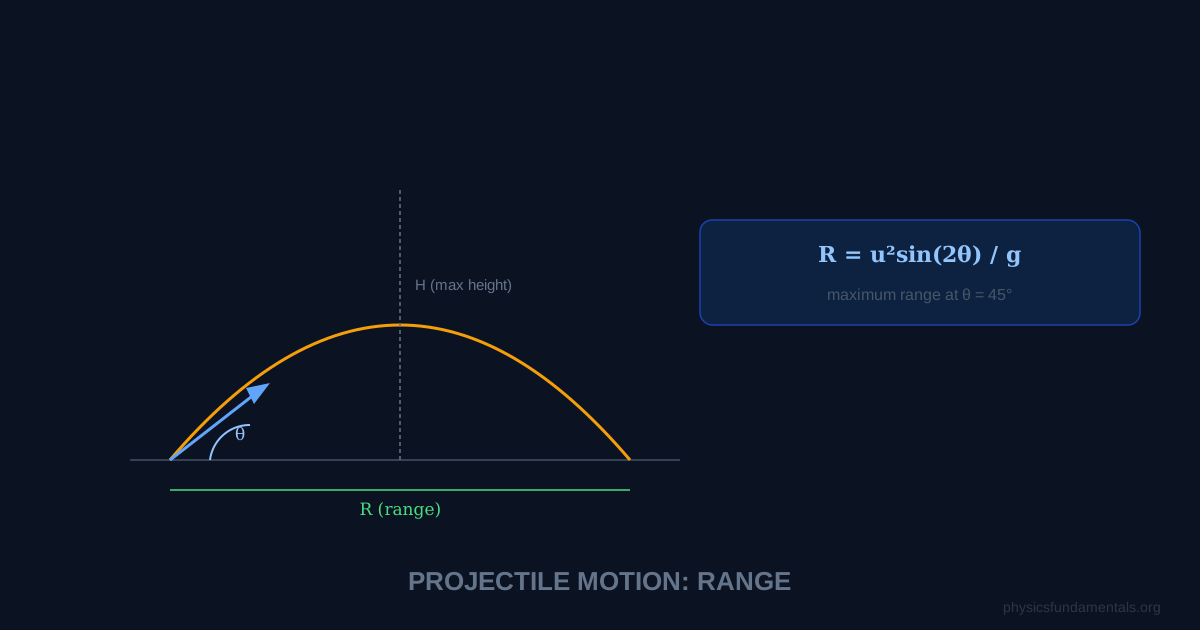
The horizontal range of a projectile launched at angle θ with initial speed v is R = v²sin2θ/g. This formula comes from combining the horizontal and vertical equations of motion. The range is maximum when sin2θ = 1, i.e. θ = 45°. A football kicked at 30° and at 60° land the same distance away — complementary angles give equal ranges. These results assume launch and landing at the same height and no air resistance.
Projectile motion is one of the most satisfying topics in physics because two apparently simple observations — horizontal velocity is constant, vertical motion is free fall — combine to produce rich, non-obvious results. The parabolic trajectory, the 45° optimum, the complementary angle symmetry: all emerge from the independence of horizontal and vertical motion.
- Horizontal range: R = v²sin2θ/g — derived step by step
- Time of flight: T = 2v sinθ/g
- Maximum height: H = v²sin²θ/(2g)
- Why θ = 45° gives maximum range
- 4 worked examples: football, cannon, cliff launch, finding angle
The Two Key Assumptions
The standard projectile range formula assumes:
- No air resistance — horizontal velocity remains constant throughout.
- Launch and landing at the same height — the projectile returns to the same vertical level it was launched from.
If either condition is violated, you must return to the component equations and solve from scratch — the R = v²sin2θ/g formula doesn't apply.
Deriving the Range Formula
Start with the initial conditions: launch speed v at angle θ above horizontal.
- Horizontal component: vₓ = v cosθ (constant)
- Vertical component: vᵧ = v sinθ (initial, decreases due to gravity)
Time of flight: The vertical displacement is zero when the projectile lands: 0 = vᵧt − ½gt²
t(vᵧ − ½gt) = 0, so t = 0 (launch) or t = T = 2vᵧ/g = 2v sinθ/g
Horizontal range: R = vₓ × T = v cosθ × 2v sinθ/g = v²(2sinθcosθ)/g
Using the double angle identity: 2sinθcosθ = sin2θ:
Maximum height: Reached when vᵧ = 0: vᵧ² = v²sin²θ − 2gH → H = v²sin²θ/(2g)
Why θ = 45° Gives Maximum Range
R = v²sin2θ/g is maximised when sin2θ = 1, i.e. 2θ = 90°, so θ = 45°.
At θ = 45°: R_max = v²/g (since sin90° = 1).
Complementary angle symmetry: sin2θ = sin(180° − 2θ) = sin(2(90° − θ)). So angle θ and angle (90° − θ) give the same range. Examples: 30° and 60°, 25° and 65°, 10° and 80° — all complementary pairs give the same R.
4 Worked Examples
Example 1 — Football kick
Problem: A football is kicked at 20 m/s at 35° above the horizontal. Find the range, time of flight, and maximum height.
Solution:
T = 2v sinθ/g = 2 × 20 × sin35° / 9.81 = 2 × 20 × 0.574 / 9.81 = 2.34 s
R = v²sin2θ/g = 20² × sin70° / 9.81 = 400 × 0.940 / 9.81 = 38.3 m
H = v²sin²θ/(2g) = 400 × sin²35° / (2 × 9.81) = 400 × 0.329 / 19.62 = 6.71 m
Example 2 — Maximum range
Problem: A javelin is thrown at 15 m/s at the optimal angle. Find the maximum range.
Solution:
θ = 45° for maximum range
R_max = v²/g = 15²/9.81 = 225/9.81 = 22.9 m
Example 3 — Finding the launch angle
Problem: A stone must hit a target 60 m away and is thrown at 30 m/s. Find the required launch angle(s).
Solution:
R = v²sin2θ/g → sin2θ = Rg/v² = 60 × 9.81 / 900 = 0.654
2θ = arcsin(0.654) = 40.8°, so θ = 20.4°
Or 2θ = 180° − 40.8° = 139.2°, so θ = 69.6°
Both angles give the same range — two solutions exist (below and above 45°).
Example 4 — Launched from a cliff
Problem: A ball is launched horizontally at 12 m/s from a cliff 45 m high. Find the horizontal distance travelled before hitting the ground.
Solution:
Note: This is NOT the standard range formula (launch and landing heights differ). Use component equations.
Vertical: 45 = ½gt² → t = √(2 × 45/9.81) = √9.174 = 3.03 s
Horizontal: R = vₓ × t = 12 × 3.03 = 36.3 m
Time of Flight and Maximum Height — Full Derivations
Starting from component equations with initial speed v at angle θ above horizontal, taking upward as positive:
Horizontal: x = v cosθ × t (constant velocity — no horizontal force)
Vertical: y = v sinθ × t − ½gt² (constant downward acceleration g)
Time of flight (landing when y = 0, assuming same height):
0 = v sinθ × T − ½gT² = T(v sinθ − ½gT)
T = 0 (launch) or T = 2v sinθ/g
Range (horizontal distance at T):
R = v cosθ × T = v cosθ × 2v sinθ/g = v²(2sinθcosθ)/g
Maximum height (when v_y = 0: v sinθ − gt_top = 0 → t_top = v sinθ/g):
H = v sinθ × t_top − ½g × t_top² = v²sin²θ/g − ½v²sin²θ/g
Why 45° Gives Maximum Range
R = v²sin2θ/g is maximised when sin2θ = 1, i.e. 2θ = 90°, so θ = 45°. At θ = 45°: R_max = v²/g. Physically: range depends on both horizontal speed (v cosθ — maximised at θ = 0°) and time of flight (2v sinθ/g — maximised at θ = 90°). These compete. The optimal balance is at 45° where both sin and cos equal 1/√2 ≈ 0.707, giving their product sin2θ = 2×0.707×0.707 = 1.
Complementary angles: R(θ) = R(90°−θ) because sin2θ = sin(180°−2θ) = sin2(90°−θ). So 30° and 60° give the same range; 25° and 65° give the same range. The 30° launch is faster, lower, and lands sooner; the 60° launch is slower, higher, and spends more time in the air — but both cover the same horizontal distance.
Effect of Air Resistance
Without air resistance: 45° gives maximum range. With air resistance (always opposing velocity), the trajectory is no longer parabolic and the optimum angle for maximum range drops below 45° — typically to 30–40° depending on speed and aerodynamics. A cricket ball bowled at 30 m/s optimally travels at about 35° with air resistance rather than 45°. A long-range artillery shell may be optimally launched at 25–30° for maximum range with drag. The exact optimum requires solving the differential equations of motion with drag included — not tractable analytically but straightforward numerically.
Worked Example 5 — Finding the angle for a given range
Problem: A ball must be launched at 25 m/s to hit a target 50 m away on the same horizontal level. Find both possible launch angles.
Solution:
R = v²sin2θ/g → sin2θ = Rg/v² = 50 × 9.81/625 = 490.5/625 = 0.7848
2θ = arcsin(0.7848) = 51.7° → θ₁ = 25.85° ≈ 25.9°
Or 2θ = 180° − 51.7° = 128.3° → θ₂ = 64.15° ≈ 64.2°
Check: sin(2 × 25.9°) = sin51.8° = 0.785 ✓; sin(2 × 64.2°) = sin128.4° = 0.785 ✓
Projectile Motion with Initial Horizontal Velocity Only
When launched horizontally (θ = 0°): v_x = v (constant), v_y = 0 initially then increases. This does NOT use R = v²sin2θ/g (which gives 0 for θ = 0) — that formula only applies for same-height launches. Instead:
- Vertical: y = ½gt² → time to fall height h: t = √(2h/g)
- Horizontal: R = v × t = v√(2h/g)
A ball rolled off a table at 3 m/s from height 1.2 m: t = √(2 × 1.2/9.81) = √0.245 = 0.495 s; R = 3 × 0.495 = 1.48 m.
Projectile Motion in Sport — Real Examples
Football penalty kick: a ball struck at 25 m/s at 15° has: T = 2×25×sin15°/9.81 = 1.32 s; R = 25²×sin30°/9.81 = 31.9 m. The penalty spot is 11 m from goal — the ball reaches it in t = 11/(25cos15°) = 0.455 s, well before bouncing, and at height y = 25×sin15°×0.455 − ½×9.81×0.455² = 2.95 − 1.01 = 1.94 m — within the goal frame (crossbar at 2.44 m).
Golf: a driver launches the ball at ~70 m/s at ~12° (with significant backspin creating lift, modifying the trajectory). Without air effects: R = 70²×sin24°/9.81 = 4900×0.407/9.81 = 203 m. Real drives reach 250–350 m because aerodynamic lift from backspin acts like an upward force, greatly extending range. The Magnus effect (lift from spin) is the dominant aerodynamic effect in golf, cricket (swing), and tennis (topspin).
Worked Example 6 — Projectile from a moving vehicle
Problem: A car moving at 20 m/s horizontally launches a ball upward at 15 m/s relative to the car. Find: (a) the ball's initial velocity relative to the ground, (b) the range relative to the ground, (c) the range relative to the car.
Solution:
(a) Horizontal velocity (ground frame): v_x = 20 m/s (car velocity); Vertical: v_y = 15 m/s
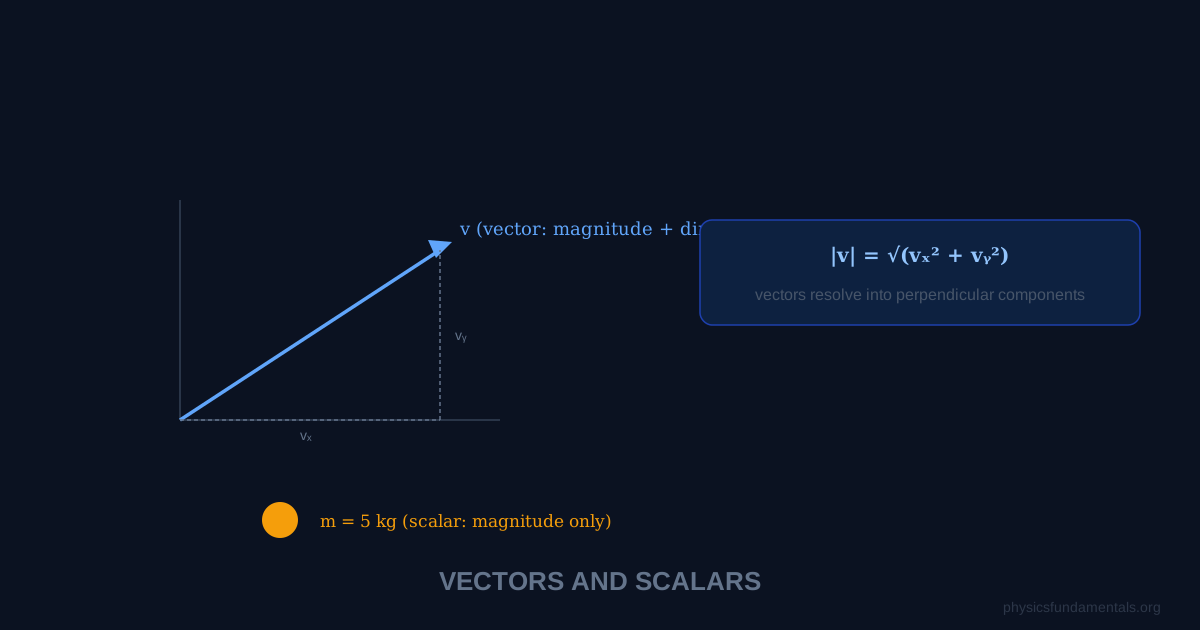
Speed relative to ground: √(20² + 15²) = √(400 + 225) = √625 = 25 m/s at arctan(15/20) = 36.87° above horizontal
(b) Time of flight: T = 2v_y/g = 2×15/9.81 = 3.058 s
Range (ground): R_ground = v_x × T = 20 × 3.058 = 61.16 m
(c) Range (car): horizontal distance relative to car = (v_x − v_car) × T = 0 × T = 0 m
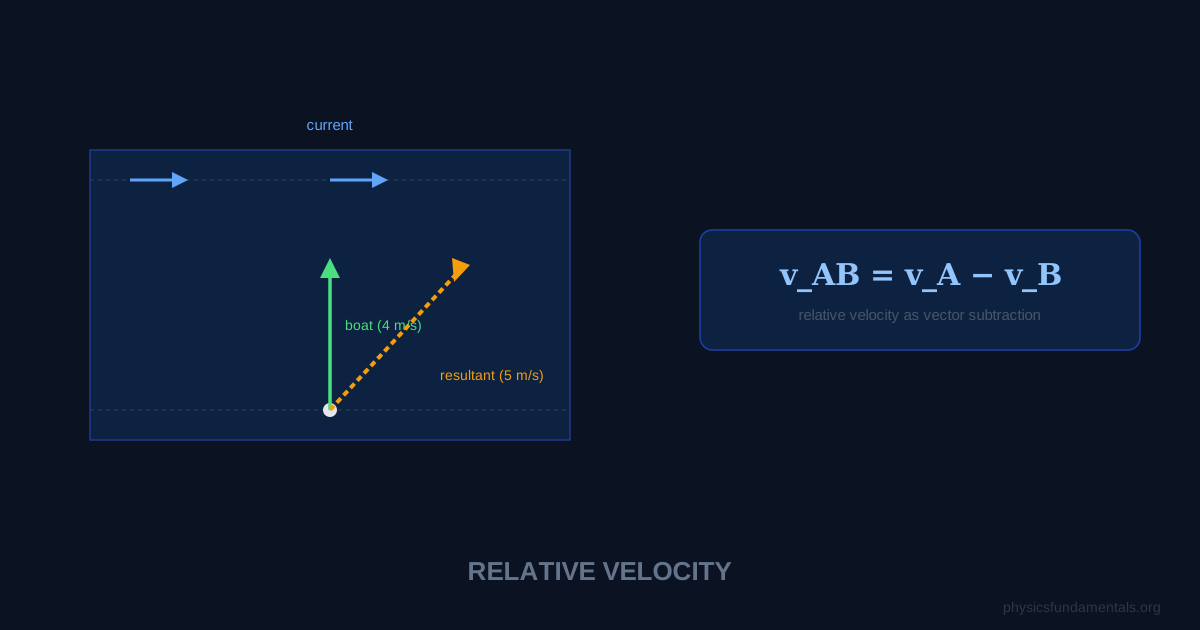
The ball lands back in the car (if thrown straight up relative to car)! Relative to the car, the ball goes straight up and comes straight down — exactly as in an inertial frame at rest. The horizontal velocity is shared between ball and car, so their relative horizontal velocity is zero.
Exam Summary for Projectile Motion
The two key principles: horizontal and vertical motions are independent; horizontal velocity is constant (no air resistance), vertical motion is free fall with a = g downward. Always resolve initial velocity: v_x = v cosθ, v_y = v sinθ. Equations: x = v_x t, y = v_y t − ½gt². For same-height launch: T = 2v sinθ/g; R = v²sin2θ/g; H = v²sin²θ/(2g). For horizontal launch from height h: t = √(2h/g); R = v_x × t. The R = v²sin2θ/g formula does NOT apply for different launch and landing heights — always revert to component equations in those cases. Maximum range at 45° (no air resistance); complementary angles give equal ranges; adding a third polariser between crossed polarisers can increase transmission (analogous result in wave optics).
Projectile motion is the prototype for all two-dimensional kinematics with a constant force. The key mathematical insight — that perpendicular components of motion are completely independent — generalises beyond projectiles. In electromagnetic fields, a charged particle's motion perpendicular to E and B fields can be treated independently from motion parallel to those fields. In quantum mechanics, a particle in a 2D box has independent x and y wave functions. The separation of variables that makes projectile motion tractable is the same technique used throughout mathematical physics to solve partial differential equations. Mastering projectile motion is not just about calculating ranges — it is the introduction to one of the most powerful analytical techniques in all of physics.
For exam projectile questions: (1) always draw the trajectory first, labelling the known quantities (v, θ, horizontal range, or target height); (2) write separate equations for x and y; (3) connect them through time t. The variable t is the bridge between horizontal and vertical motion — eliminate it to get range directly, or find it first to get everything else. Never mix horizontal and vertical accelerations: horizontal acceleration is always zero (no air resistance); vertical acceleration is always g = 9.81 m/s² downward (always, for the entire flight). Remember that at maximum height, only the vertical velocity is zero — horizontal velocity remains v cosθ throughout. This means the ball is still moving at the top of its arc, just momentarily not moving vertically.
Projectile Motion with a Tailwind or Headwind
Air resistance acts opposite to the velocity vector at every point — it has both horizontal and vertical components that vary as the velocity direction changes. This makes exact analysis complex (requiring numerical methods). Qualitatively: a headwind reduces horizontal range (reduces effective v_x); a tailwind increases it. Air resistance also reduces maximum height (drag opposes upward motion) and makes the trajectory asymmetric — the descent is steeper and faster than the ascent. For a ball thrown horizontally, air resistance makes it follow a path that falls below the ideal parabola. At A-Level, air resistance is always neglected unless explicitly stated — the ideal parabolic trajectory is the standard assumption.
A note on accuracy: for balls and bullets at modest speeds (below ~50 m/s), the air-resistance correction to range is typically 5–15%, well within the "ignore air resistance" approximation at A-Level. For a cricket ball at 40 m/s with drag coefficient 0.5 and diameter 7 cm, the drag force is ~½ × 1.2 × 0.5 × π(0.035)² × 40² ≈ 1.8 N — compared to weight of 0.156 × 9.81 ≈ 1.53 N. At this speed, drag and weight are comparable — the air-resistance-free approximation overestimates range by about 30%. For exam purposes, always use the no-air-resistance formulas unless told otherwise.
Frequently Asked Questions
What is the range formula for projectile motion?
Why does 45° give maximum range?
Why do complementary angles give the same range?
When can't you use R = v²sin2θ/g?
Does mass affect the range of a projectile?
Share this article
Written by
Physics Fundamentals Editorial Team
Written and reviewed by our team of physics educators. Content is aligned with A-Level, GCSE, AP Physics, and undergraduate curricula.
About Physics Fundamentals →