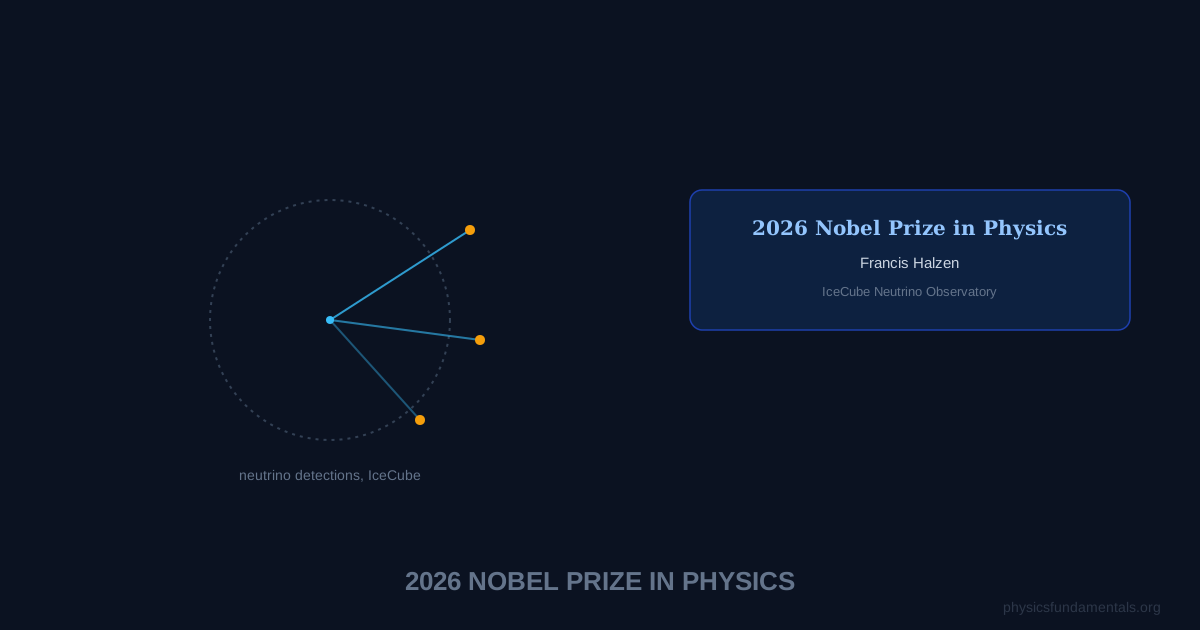
The Royal Swedish Academy of Sciences announced the 2026 Nobel Prize in Physics on 6 October, awarding it to Francis Halzen, the Wisconsin IceCube Particle Astrophysics Center's principal investigator, for his leadership of the IceCube Neutrino Observatory and the discovery of high-energy astrophysical neutrinos — particles arriving at Earth from some of the most violent events in the universe.
- Who Francis Halzen is and what IceCube actually does
- Why detecting neutrinos is one of the hardest problems in experimental physics
- What "high-energy astrophysical neutrinos" means, in plain terms
- Why this discovery opened an entirely new way of observing the universe
Who Is Francis Halzen?
Francis Halzen is a theoretical physicist at the University of Wisconsin–Madison, where he has worked since 1972. His research sits at the interface of particle physics, astrophysics, and cosmology — but he is best known as the driving force behind IceCube, a detector unlike almost anything else in experimental science: a full cubic kilometre of Antarctic ice, instrumented with thousands of optical sensors, built specifically to catch an almost undetectable particle passing through from deep space.
IceCube's first fully instrumented physics run began in 2011, after more than a decade of design and construction at the South Pole. Halzen has described the observatory's foundational result simply: "neutrino astronomy exists." The 2026 Nobel Prize recognises exactly that achievement — proving that neutrinos from beyond our solar system can be detected, tracked back to their sources, and used as a genuine astronomical tool.
Why Neutrinos Are So Hard to Catch
Neutrinos are sometimes called "ghost particles," and the nickname is well earned. They carry no electric charge and interact with matter so weakly that trillions of them pass through your body every second without a single collision. A neutrino could, in principle, travel through a light-year of solid lead with a good chance of never interacting with anything along the way.
That weak interaction is exactly what makes neutrinos valuable scientifically — and exactly what makes them so hard to detect. Unlike light or charged particles, neutrinos aren't absorbed, scattered, or deflected by the dust, gas, and magnetic fields that fill the space between us and distant astrophysical sources. A neutrino that reaches Earth has travelled in an essentially straight line from wherever it was produced, carrying direct information about its origin that light alone often can't provide.
How IceCube Actually Detects Them
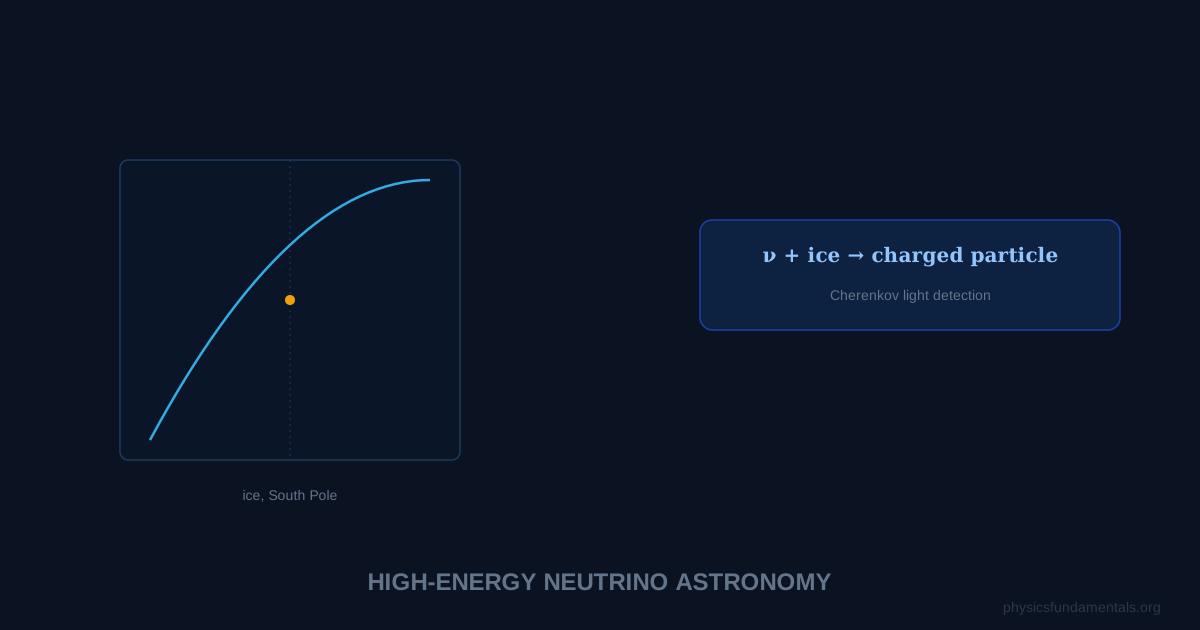
IceCube doesn't detect neutrinos directly — nothing can, easily. Instead, it waits for the extremely rare event where a neutrino does interact with an atomic nucleus in the ice, producing a fast-moving charged particle. That charged particle, travelling faster than the speed of light in ice (though still slower than light's speed in a vacuum), emits a faint blue glow called Cherenkov radiation — the same effect that gives nuclear reactor pools their eerie blue glow.
Thousands of light sensors, frozen into the ice at depths of 1.5 to 2.5 kilometres below the South Pole, watch for that faint flash. From the pattern and timing of light across the sensor array, physicists can reconstruct the energy and direction the original neutrino came from — effectively turning a cubic kilometre of ice into a telescope.
What "High-Energy Astrophysical Neutrinos" Means
Most neutrinos reaching Earth come from mundane, nearby sources — the Sun, Earth's own atmosphere, nuclear reactors. What IceCube discovered was something different: neutrinos with far higher energies than any of those sources can produce, arriving from outside our galaxy. These high-energy neutrinos are believed to originate from the universe's most extreme environments — supermassive black holes actively feeding on surrounding matter, and other violent cosmic accelerators capable of flinging particles to energies far beyond anything human-built accelerators can reach.
In 2018, IceCube achieved a landmark result: it traced a single high-energy neutrino back to a flaring blazar — a galaxy with a supermassive black hole at its core, beaming a jet of particles almost directly at Earth. It was the first time a cosmic neutrino had ever been linked to a specific astrophysical source, opening the door to neutrinos as a genuine tool for studying the universe's most energetic objects.
Why This Matters for Astronomy
For most of history, everything we've learned about the universe beyond our solar system has come from light — visible light, radio waves, X-rays, gamma rays. Neutrino astronomy adds an entirely different messenger, one that isn't blocked by dust or deflected by magnetic fields, and one that can escape from regions so dense that even light can't get out.
This is often described as opening a new "window" on the universe, alongside the other major new messengers of the 21st century: gravitational waves (recognised by the 2017 Nobel Prize in Physics) and now high-energy neutrinos. Together, these multiple messengers let astronomers study the same cosmic events — a black hole merger, a supernova, a blazar flare — from several completely independent angles at once, a field now called multi-messenger astronomy.
- For the physics behind how neutrino detectors work, see our explainer: What Is High-Energy Neutrino Astronomy?
- For the nuclear physics behind particle interactions, see our Nuclear Binding Energy Calculator
Frequently Asked Questions
Who won the 2026 Nobel Prize in Physics?
What is IceCube?
Why are neutrinos so hard to detect?
What are "high-energy astrophysical neutrinos"?
Why does this discovery matter?
Share this article
Written by
Physics Fundamentals Editorial Team
Written and reviewed by our team of physics educators. Content is aligned with A-Level, GCSE, AP Physics, and undergraduate curricula.
About Physics Fundamentals →