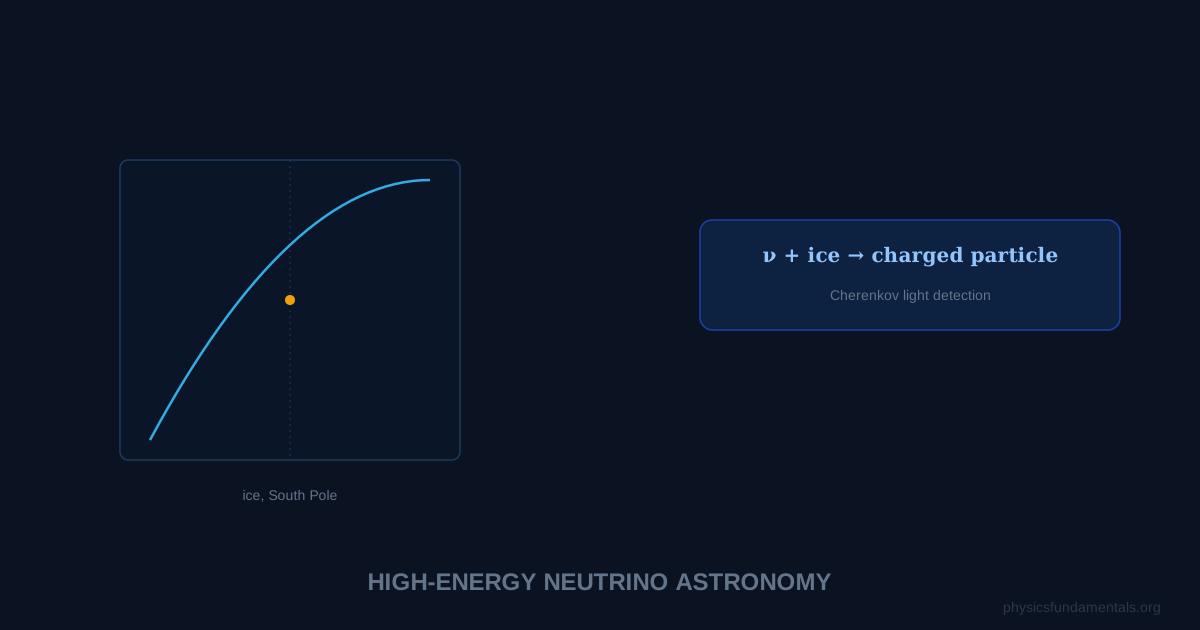
Every second, roughly 100 trillion neutrinos pass through your body. You'll never feel a single one. Neutrinos interact with matter so weakly that detecting even a handful requires building one of the strangest telescopes ever constructed — not a telescope made of mirrors and lenses pointed at the sky, but a cubic kilometre of solid ice buried at the South Pole, watching for faint flashes of blue light. This is neutrino astronomy, and it's opened an entirely new way of observing the universe.
- What a neutrino actually is, and why it barely interacts with anything
- Why "high-energy astrophysical" neutrinos are different from the ones passing through you right now
- How a detector made of ice can catch a nearly massless, chargeless particle
- What neutrino astronomy has revealed about the universe's most violent objects
What Is a Neutrino?
A neutrino is one of the fundamental particles of the Standard Model of particle physics — the same framework that describes electrons, quarks, and the forces between them. Neutrinos are leptons, the same family as the electron, but with two properties that make them almost uniquely difficult to study: they carry no electric charge, and their mass is so tiny it wasn't even confirmed to be nonzero until 1998.
Because a neutrino has no charge, it doesn't interact with the electromagnetic force at all — the force responsible for almost every interaction you can see, feel, or measure in everyday life. Light, electric fields, magnetic fields, chemical bonds: none of these affect a neutrino in the slightest. Neutrinos interact only through the weak nuclear force and gravity, both of which are, at the scale of a single particle, astonishingly feeble.
The practical consequence: a typical neutrino could pass through a light-year of solid lead and still have a good chance of never interacting with a single atom along the way. Detecting neutrinos at all, let alone determining where they came from, requires an enormous amount of material and an enormous amount of patience.
Not All Neutrinos Are Equal: What "High-Energy" Means
Neutrinos reach Earth from several very different sources, each with a characteristic energy range. Solar neutrinos, produced by nuclear fusion in the Sun's core, are relatively low-energy and arrive by the billions through every square centimetre of Earth every second. Atmospheric neutrinos are produced when cosmic rays slam into Earth's upper atmosphere, creating showers of particles that decay into neutrinos.
High-energy astrophysical neutrinos are different again — and far rarer. These carry energies millions to billions of times greater than solar neutrinos, and they're believed to originate from the most extreme particle accelerators in the known universe: material spiralling into supermassive black holes, the aftermath of massive stellar explosions, and other environments capable of accelerating particles to energies no human-built machine can reach, even the Large Hadron Collider.
Because these high-energy neutrinos are so rare, picking them out from the much larger background of lower-energy solar and atmospheric neutrinos is itself a major experimental challenge — one that drove the design of detectors like IceCube.
Why Ice? How IceCube Actually Works
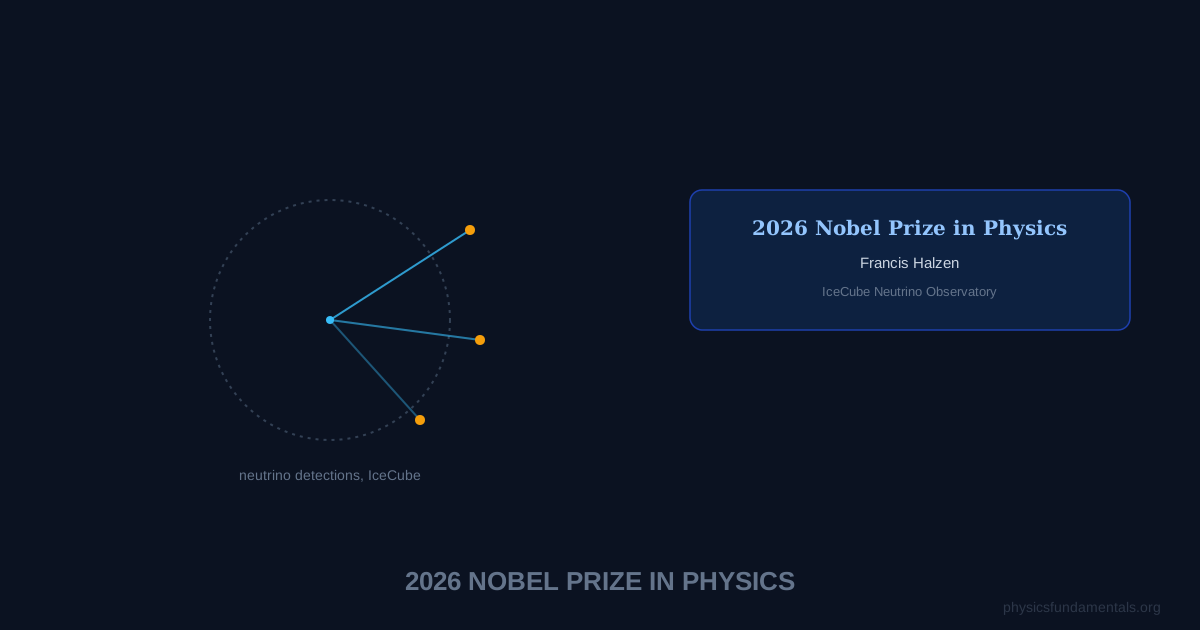
IceCube, the observatory behind the breakthrough recognised by the 2026 Nobel Prize in Physics, takes a strikingly literal approach to the detection problem: if you can't make neutrinos interact more often, build a detector so large that even a tiny interaction probability yields a usable number of events. IceCube uses a full cubic kilometre of extremely clear, deep Antarctic ice as its detection medium — chosen because ice is transparent enough for faint light signals to travel long distances through it without scattering away.
Buried in that ice, at depths between 1.5 and 2.5 kilometres, are 5,160 optical sensors arranged along 86 vertical strings. These sensors don't detect neutrinos directly. Instead, they wait for the extraordinarily rare event where a neutrino collides with an atomic nucleus in the ice, producing a secondary charged particle — a muon, electron, or tau, depending on the type of neutrino and the nature of the collision.
That secondary charged particle travels faster than light travels through ice (though still slower than light's absolute speed limit in a vacuum). This faster-than-light-in-medium motion produces a cone of faint blue light called Cherenkov radiation — the same effect responsible for the eerie blue glow seen in nuclear reactor cooling pools. IceCube's sensors detect this light, and the pattern of which sensors light up, and when, lets physicists reconstruct the energy, direction, and likely particle type of the original neutrino.
From Detection to Astronomy: Tracing Sources
Detecting a high-energy neutrino is only half the problem. To do astronomy with it, physicists need to know where it came from — and because neutrinos travel in straight lines, largely undeflected by magnetic fields or blocked by intervening matter, a sufficiently well-reconstructed neutrino direction can, in principle, point directly back at its source.
In September 2017, IceCube detected a single exceptionally high-energy neutrino and, within hours, sent an automated alert to telescopes around the world pointing to its likely direction of origin. Follow-up observations found a flaring blazar — a galaxy whose central supermassive black hole was actively beaming a jet of accelerated particles almost directly toward Earth — in exactly that direction. It was the first time a specific cosmic neutrino had been linked to a specific astrophysical object, transforming neutrino detection from a statistical curiosity into a genuine astronomical tool.
Multi-Messenger Astronomy: Seeing the Universe Several Ways at Once
For most of the history of astronomy, essentially everything we've learned about objects beyond our solar system has come from light, in one form or another — visible light, radio waves, X-rays, gamma rays. The 21st century has added two genuinely new messengers to that list: gravitational waves (ripples in spacetime itself, first directly detected in 2015) and high-energy neutrinos.
Each messenger carries different information and travels through the universe differently. Light can be absorbed by dust or blocked entirely by dense material. Gravitational waves pass through almost anything completely unimpeded, but carry information mainly about mass and motion, not composition. Neutrinos sit in between — they escape from regions so dense that even light can't get out, yet they do interact (rarely) with matter, carrying information about the particle physics happening at their source.
When multiple messengers from the same cosmic event can be captured together — light, neutrinos, and gravitational waves from the same source, ideally at the same time — astronomers get a far richer picture than any single messenger could provide alone. This approach, called multi-messenger astronomy, is one of the fastest-growing areas of modern astrophysics, and high-energy neutrino detection is one of its three essential pillars.
Why Weak Interaction Is a Feature, Not Just a Bug
It's worth pausing on something that seems paradoxical at first: the very property that makes neutrinos so hard to detect — their extremely weak interaction with matter — is exactly what makes them scientifically valuable. Because neutrinos barely interact with anything, they escape directly from regions that are completely opaque to light: the dense core of a collapsing star, the turbulent interior of a black hole's accretion disk, the heart of a supernova in its first instants.
Light from these environments, by contrast, gets absorbed and re-emitted many times before it can escape, or is blocked entirely — which is why a supernova's light curve doesn't reveal what was actually happening deep inside the collapsing star in its final moments. A neutrino that escaped that same core carries direct, largely unprocessed information about conditions no telescope using light alone could ever observe.
- For the 2026 Nobel Prize announcement itself, see 2026 Nobel Prize in Physics: Francis Halzen Wins for IceCube Discoveries
- For the nuclear physics behind particle mass and binding energy, see our Nuclear Binding Energy Calculator
- For radioactive decay, a related weak-force process, see our Half-Life Calculator
Frequently Asked Questions
What is a neutrino, in simple terms?
Why are high-energy neutrinos different from ordinary neutrinos?
How does IceCube detect neutrinos using ice?
What is Cherenkov radiation?
What is multi-messenger astronomy?
Can neutrinos pass through the entire Earth?
Share this article
Written by
Physics Fundamentals Editorial Team
Written and reviewed by our team of physics educators. Content is aligned with A-Level, GCSE, AP Physics, and undergraduate curricula.
About Physics Fundamentals →