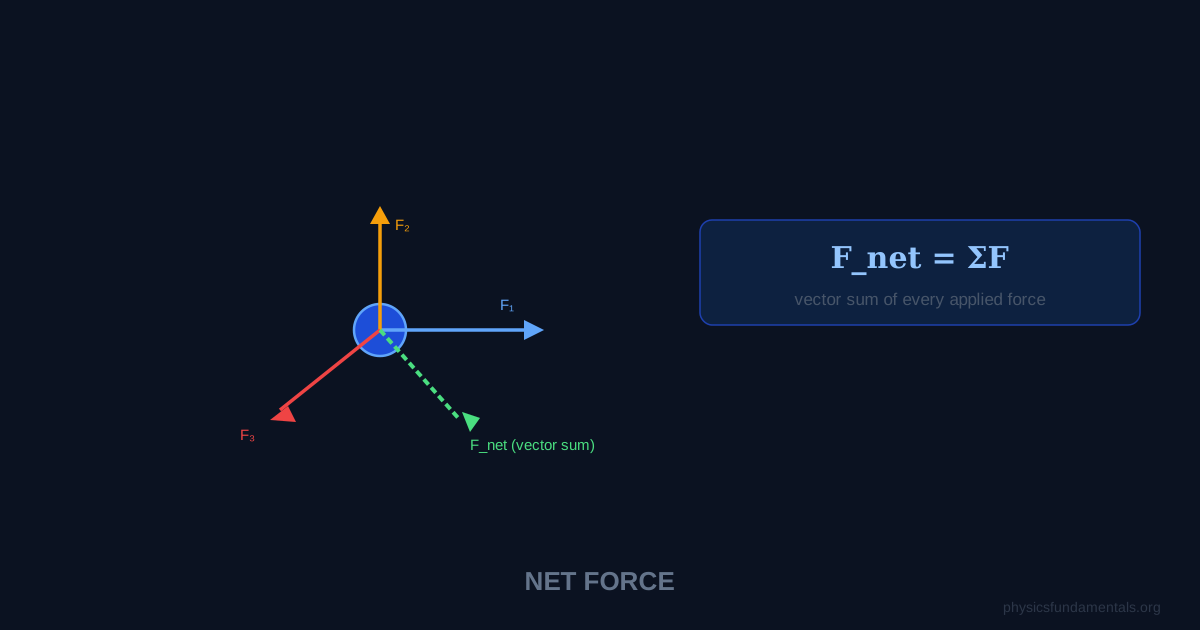
Net force is the vector sum of all forces acting on an object: F_net = ΣF. By Newton's second law, this net force causes acceleration: F_net = ma. If the net force is zero, the object is in equilibrium — it either stays at rest or continues at constant velocity (Newton's first law). If the net force is non-zero, the object accelerates in the direction of the net force with magnitude a = F_net/m.
Every mechanics problem starts here: identify all forces on the object, draw a free body diagram, resolve into components, sum the components in each direction, apply Newton's second law. This procedure works for every situation from a book resting on a shelf to a rocket in flight. Getting it right is the difference between solving problems systematically and guessing.
- Net force definition and Newton's second law: F_net = ma
- How to draw free body diagrams correctly
- Balanced forces (equilibrium) vs unbalanced forces (acceleration)
- Resolving forces into components for 2D problems
- 4 fully worked examples: inclined plane, Atwood machine, friction, connected objects
Net Force and Newton's Second Law
The net force on an object is the vector sum of all forces acting on it. It determines the object's acceleration via Newton's second law: F_net = ma.
Key points:
- Net force is a vector — direction matters. Forces must be added as vectors, accounting for direction.
- F_net = 0 → a = 0: equilibrium. The object moves at constant velocity (or stays at rest).
- F_net ≠ 0 → a ≠ 0: the object accelerates in the direction of F_net.
- Forces from all sources: gravity, normal force, tension, friction, applied forces, buoyancy — every force on the object must be included.
Free Body Diagrams
A free body diagram (FBD) shows a single object with all forces acting on it drawn as arrows from the object's centre (or the point of application). Rules:
- Draw only the object — not the surface it rests on or anything it's connected to.
- Draw only forces acting ON the object — not forces the object exerts on other things (Newton's third law pairs go on the other object's FBD).
- Label every force with its name and arrow in the correct direction.
- Choose a coordinate system that simplifies the problem (often along and perpendicular to a slope for inclined plane problems).
Common forces to include: Weight (W = mg, downward), Normal force (N, perpendicular to surface), Tension (T, along the string), Friction (f, opposing relative motion), Applied force (F, in specified direction), Air resistance/drag (opposing motion).
4 Worked Examples
Example 1 — Object on a flat surface with friction
Problem: A 10 kg box is pushed with a 40 N horizontal force on a surface with kinetic friction coefficient μ_k = 0.25. Find the acceleration. (g = 9.81 m/s²)
Solution:
Vertical: N = mg = 10 × 9.81 = 98.1 N
Friction: f = μ_k N = 0.25 × 98.1 = 24.5 N (opposing motion)
Horizontal: F_net = 40 − 24.5 = 15.5 N
a = F_net/m = 15.5/10 = 1.55 m/s²
Example 2 — Inclined plane (frictionless)
Problem: A 5 kg block slides down a frictionless 30° incline. Find its acceleration.
Solution:
Along the slope (taking down-slope as positive):
Component of weight = mg sin30° = 5 × 9.81 × 0.5 = 24.5 N
Normal force (perpendicular to slope): N = mg cos30° = 42.4 N (no friction)
F_net along slope = 24.5 N
a = F_net/m = 24.5/5 = 4.91 m/s² down the slope
Example 3 — Atwood machine (two masses over a pulley)
Problem: Masses m₁ = 3 kg and m₂ = 5 kg hang on either side of a frictionless pulley. Find the acceleration of the system and tension in the string.
Solution:
Net force = (m₂ − m₁)g = (5 − 3) × 9.81 = 19.62 N
Total mass = m₁ + m₂ = 8 kg
a = F_net/(m₁ + m₂) = 19.62/8 = 2.45 m/s²
For m₁ (accelerating upward): T − m₁g = m₁a → T = m₁(g + a) = 3(9.81 + 2.45) = 36.8 N
Example 4 — Connected objects on a surface
Problem: Two boxes are connected by a string on a frictionless surface: m₁ = 4 kg (front) and m₂ = 6 kg (rear). A 20 N force pulls on m₂. Find the acceleration and the tension in the connecting string.
Solution:
System: F_net = 20 N, total mass = 10 kg
a = 20/10 = 2 m/s²
For m₁ alone: T = m₁a = 4 × 2 = 8 N
Equilibrium — When Net Force Is Zero
An object is in static equilibrium when it's stationary and the net force is zero: ΣFₓ = 0 and ΣFᵧ = 0. An object is in dynamic equilibrium when it moves at constant velocity with net force zero. In both cases, the object is not accelerating.
Equilibrium problems require setting up component equations and solving for unknowns. A sign hanging by two wires at different angles: the horizontal components of tension must cancel, and the vertical components must equal the weight.
Newton's Third Law Pairs and Free Body Diagrams
Every force has a Newton's third law reaction pair — equal in magnitude, opposite in direction, acting on a different object. Critical rule: the reaction pair never appears on the same free body diagram. If Earth's gravity pulls a book down with 10 N, the book pulls Earth up with 10 N — but only 10 N appears on the book's FBD (from Earth) and only 10 N appears on Earth's FBD (from the book). Confusion between Newton's 3rd law pairs and pairs of forces that happen to be equal (like normal force and weight on a stationary book) is one of the most persistent misconceptions in mechanics.
The normal force on a book on a horizontal table is NOT the Newton's 3rd law reaction to the book's weight. The reaction to the book's weight (Earth pulling book down) is the book pulling Earth up. The normal force is a separate force — the table pushing the book up. It happens to equal the weight in magnitude only because the book is in equilibrium. Place the book in an accelerating lift and the normal force no longer equals the weight, proving they are not a Newton's 3rd law pair.
Friction Forces in Detail
There are two types of friction to distinguish:
- Static friction (f_s): acts on a stationary object to prevent sliding. Its magnitude adjusts automatically to match the applied force, up to a maximum of f_s_max = μ_s N. Above this maximum, the object slides. Static friction can have any magnitude from 0 to μ_s N.
- Kinetic friction (f_k): acts on a sliding object. Magnitude is approximately constant: f_k = μ_k N. Usually slightly less than f_s_max for the same surfaces (μ_k ≈ 0.7–0.9 × μ_s), which is why objects are harder to start sliding than to keep sliding.
Friction direction: always opposes the direction of sliding (kinetic) or the direction the object would slide if friction were removed (static).
Tension in Connected Objects
When multiple objects are connected by strings, the tension in the string is an internal force to the system but an external force on each individual object. For two blocks m₁ and m₂ pulled by force F on a frictionless surface:
- System: a = F/(m₁+m₂)
- Tension in string between them: T = m₁a = m₁F/(m₁+m₂)
The string tension is always less than the applied force (unless m₂ = 0). The string pulls m₁ forward with T and pulls m₂ backward with T — Newton's 3rd law pair, both of magnitude T, acting on different objects.
Worked Example 5 — Three blocks
Problem: Three blocks on a frictionless surface: A (2 kg), B (3 kg), C (5 kg) connected in a line. A 20 N force is applied to A, pulling all three. Find: (a) acceleration, (b) tension between A and B, (c) tension between B and C.
Solution:
(a) Total mass = 10 kg; a = 20/10 = 2 m/s²
(b) T_AB pulls B and C (mass 8 kg): T_AB = 8 × 2 = 16 N
(c) T_BC pulls only C (mass 5 kg): T_BC = 5 × 2 = 10 N
Check: on A: 20 − T_AB = 2 × 2 = 4 → T_AB = 16 N ✓
Normal Force in Non-Horizontal Situations
The normal force is always perpendicular to the contact surface — not always vertical. On a slope at angle θ, the normal force is perpendicular to the slope surface: N = mg cosθ (for an object on the slope in equilibrium perpendicular to the slope). In circular motion, the normal force may be directed inward (providing centripetal force) rather than simply opposing gravity. At the bottom of a dip in a road: N − mg = mv²/r → N = mg + mv²/r (you feel heavier). At the top of a hill: mg − N = mv²/r → N = mg − mv²/r (you feel lighter). These are not special cases — they follow directly from applying F_net = ma with the correct geometry.
Resolving Forces on Inclined Planes
The most efficient coordinate system for inclined plane problems is along and perpendicular to the slope, not horizontal and vertical. Along the slope: F_net = mg sinθ − f (friction) − T (if attached to a rope). Perpendicular to the slope: N = mg cosθ (equilibrium, no acceleration perpendicular to slope). Once N is found, kinetic friction f = μN = μmg cosθ can be substituted into the along-slope equation. This approach requires only two force components rather than the four needed in horizontal/vertical coordinates, halving the algebra.
Net Force and Newton's Laws — The Complete Picture
Newton's three laws together completely determine how objects move under any force system. First law (inertia): F_net = 0 → constant velocity (including rest). Second law (dynamics): F_net = ma → determines acceleration. Third law (reaction pairs): every force has an equal and opposite reaction on the other object. Free body diagrams make these laws operational: draw every force on the object, sum them as vectors, apply F_net = ma in each direction. The standard procedure — FBD → component equations → Newton's 2nd law → solve — works for every mechanics problem from a stationary book to a rocket in flight. Master the FBD technique and every forces problem becomes tractable.
Worked Example 6 — Lift with passenger
Problem: A 70 kg person stands in a lift. Find the normal force on them (which they feel as their "apparent weight") when the lift: (a) accelerates upward at 2 m/s², (b) decelerates at 2 m/s² (moving upward), (c) is in free fall.
Solution:
Let up = positive. N − mg = ma → N = m(g + a)
(a) a = +2: N = 70(9.81 + 2) = 70 × 11.81 = 826.7 N (feels heavier)
(b) a = −2 (deceleration while moving up): N = 70(9.81 − 2) = 70 × 7.81 = 546.7 N (feels lighter)
(c) a = −9.81 (free fall): N = 70(9.81 − 9.81) = 0 N (weightless — floor exerts no force)
The power of Newton's second law F_net = ma lies in its generality. Every force that acts on an object contributes to F_net — gravity, normal force, friction, tension, air resistance, electromagnetic forces, nuclear forces. In all cases, the resulting acceleration is a = F_net/m, and the subsequent motion follows from the kinematic equations. Mastering the FBD technique — identifying all forces, their directions, resolving into components, applying F_net = ma in each direction — is the single most important mechanical skill in physics. Once learned, it applies unchanged from a sliding block to a satellite orbit to the motion of charged particles in electric fields.
Net force problems ultimately reduce to one procedure: identify all forces on each object (FBD), resolve into convenient coordinate directions (often along and perpendicular to the motion or slope), apply F_net = ma in each direction, and solve for the unknown. This procedure never changes regardless of the scenario — horizontal surface, inclined plane, vertical motion, circular motion, or coupled systems. The key skills are: recognising all forces (never forget friction, tension, or the normal force), choosing a smart coordinate system, and keeping signs consistent. With these skills, every Newton's laws problem in A-Level and first-year university physics is solvable.
Newton's laws were published in 1687 in the Principia Mathematica and remained the foundation of mechanics for over 200 years. They are superseded by Einstein's special relativity at speeds approaching c and by quantum mechanics at atomic scales, but at the macroscopic, sub-relativistic scales of everyday life and engineering they are exact to extraordinary precision. The Space Shuttle trajectory, bridge load calculations, car crash simulations, and satellite orbital mechanics all use Newtonian force analysis with Newton's laws as the bedrock. Understanding net force, free body diagrams, and F = ma is not just an exam skill — it is the entry point to virtually all of applied physics and mechanical engineering.
Frequently Asked Questions
What is net force?
How do you draw a free body diagram?
What is the difference between balanced and unbalanced forces?
Why must forces be added as vectors, not scalars?
What forces act on an object on an inclined plane?
Share this article
Written by
Physics Fundamentals Editorial Team
Written and reviewed by our team of physics educators. Content is aligned with A-Level, GCSE, AP Physics, and undergraduate curricula.
About Physics Fundamentals →