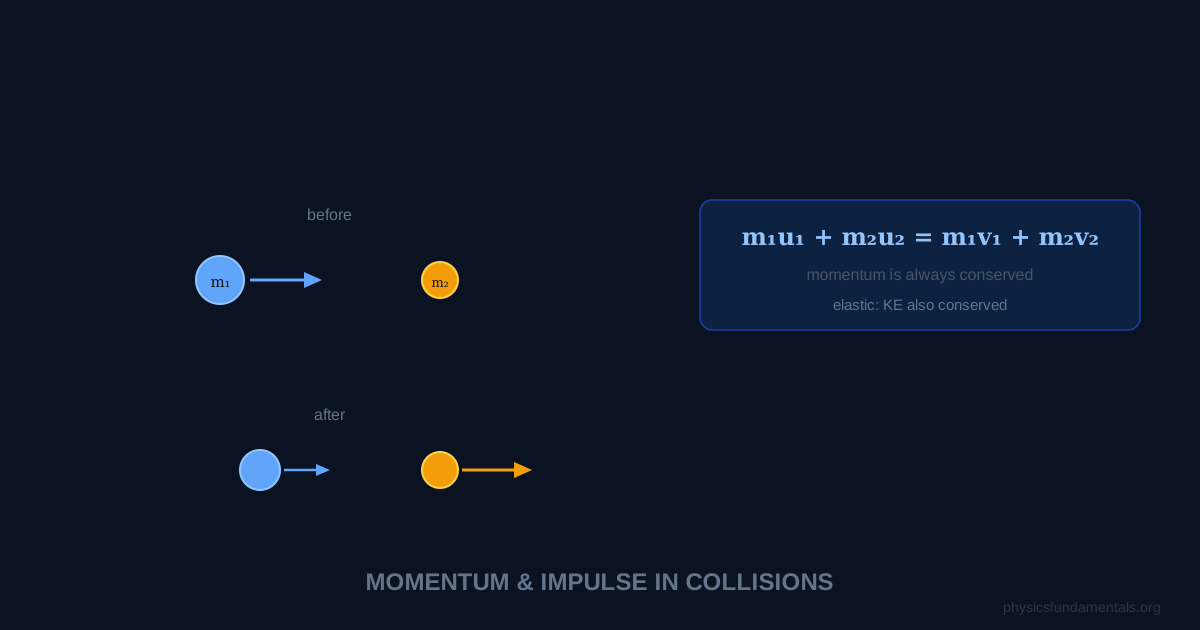
In an elastic collision, both momentum and kinetic energy are conserved. In an inelastic collision, only momentum is conserved — kinetic energy is lost to heat, sound, or deformation. Perfectly elastic collisions are an idealisation that atomic and subatomic particles approach, but macroscopic collisions are always at least slightly inelastic. A perfectly inelastic collision is one where the objects stick together after impact — maximum kinetic energy is lost while momentum is still conserved.
The key insight is that momentum is always conserved in any collision where no external forces act, but kinetic energy is only conserved in elastic collisions. This distinction drives every collision calculation — whether you're analysing a snooker ball, a car crash, or a particle accelerator experiment.
- Elastic collisions: m₁u₁ + m₂u₂ = m₁v₁ + m₂v₂ AND ½m₁u₁² + ½m₂u₂² = ½m₁v₁² + ½m₂v₂²
- Inelastic collisions: momentum conserved, KE not
- Perfectly inelastic: objects stick together, maximum KE loss
- Coefficient of restitution: e = relative speed after / relative speed before
- 4 fully worked examples including head-on and 1D collisions
Conservation of Momentum
In all collisions (elastic and inelastic), provided no external force acts on the system during the collision:
Where u denotes velocity before and v denotes velocity after. This is a vector equation — directions matter. Choose a positive direction and assign signs accordingly.
Elastic Collisions
In an elastic collision, kinetic energy is also conserved:
Combined with momentum conservation, this gives two equations for two unknowns (v₁ and v₂). For equal masses (m₁ = m₂), an elegant result emerges: the velocities simply exchange. A moving billiard ball hitting a stationary one of the same mass stops completely, and the stationary ball moves off with the original velocity — which is exactly what happens on a billiard table.
For unequal masses, the solutions are:
Inelastic Collisions
Only momentum is conserved. Kinetic energy decreases — lost as heat, sound, deformation. The amount of KE lost:
Perfectly inelastic (objects stick together): m₁u₁ + m₂u₂ = (m₁ + m₂)v
Maximum kinetic energy is lost in a perfectly inelastic collision.
Coefficient of Restitution
The coefficient of restitution e characterises how elastic a collision is:
- e = 1: perfectly elastic — no energy loss
- 0 < e < 1: partially inelastic — some energy lost
- e = 0: perfectly inelastic — objects stick together
For a ball bouncing from a surface: e = √(h₂/h₁), where h₁ is drop height and h₂ is bounce height.
4 Worked Examples
Example 1 — Head-on elastic collision
Problem: A 2 kg ball moving at 6 m/s strikes a stationary 2 kg ball elastically. Find the velocities after collision.
Solution:
Equal masses in elastic collision: velocities exchange.
Ball 1 (moving): stops → v₁ = 0 m/s
Ball 2 (stationary): moves at original ball 1 speed → v₂ = 6 m/s
Check KE: before = ½×2×36 = 36 J; after = ½×2×36 = 36 J ✓
Example 2 — Perfectly inelastic collision
Problem: A 3 kg trolley moving at 4 m/s east collides with and sticks to a stationary 1 kg trolley. Find the velocity after collision and the kinetic energy lost.
Solution:
v = m₁u₁/(m₁ + m₂) = (3 × 4)/(3 + 1) = 12/4 = 3 m/s east
KE before = ½ × 3 × 16 = 24 J
KE after = ½ × 4 × 9 = 18 J
ΔKE = 24 − 18 = 6 J lost
Example 3 — Elastic collision, unequal masses
Problem: A 4 kg ball at 5 m/s east collides elastically with a 1 kg ball at 2 m/s west. Find the final velocities.
Solution:
Take east as positive: u₁ = +5, u₂ = −2 m/s
v₁ = [(4−1)×5 + 2×1×(−2)]/(4+1) = [15 − 4]/5 = 11/5 = 2.2 m/s east
v₂ = [2×4×5 + (1−4)×(−2)]/(4+1) = [40 + 6]/5 = 46/5 = 9.2 m/s east
Check momentum: 4×5 + 1×(−2) = 18; 4×2.2 + 1×9.2 = 8.8 + 9.2 = 18 ✓
Example 4 — Coefficient of restitution
Problem: A ball is dropped from 1.6 m and bounces back to 0.9 m. Find the coefficient of restitution and the energy retained after the bounce.
Solution:
e = √(h₂/h₁) = √(0.9/1.6) = √0.5625 = 0.75
Energy retained = (KE after)/(KE before) = e² = 0.75² = 0.5625 = 56.25%
43.75% of the kinetic energy was lost to heat and sound on impact.
Elastic Collision Formulas for Unequal Masses
For a 1D elastic collision where mass m₁ moves at u₁ and mass m₂ is at rest (u₂ = 0), the exact post-collision velocities are:
Special cases: if m₁ = m₂: v₁ = 0, v₂ = u₁ (velocities exchange — Newton's cradle). If m₁ ≫ m₂: v₁ ≈ u₁ (heavy ball barely slows), v₂ ≈ 2u₁ (light ball moves at twice the incident speed). If m₁ ≪ m₂: v₁ ≈ −u₁ (ball bounces back), v₂ ≈ 0 (heavy wall barely moves). These limiting cases are useful checks and appear directly in exam questions about ball-wall collisions.
Perfectly Inelastic Collision — Maximum Energy Loss
When two objects stick together (perfectly inelastic), the kinetic energy lost is:
This is always positive (energy is always lost) and proportional to the square of the relative velocity. A head-on crash between equal-mass vehicles at 30 m/s each (closing speed 60 m/s) loses four times more energy than two identical vehicles colliding at 15 m/s each — even though each vehicle only travels at half the speed. This is why head-on collisions are so much more destructive than rear-end collisions at the same individual speeds.
Ballistic Pendulum — Classic Collision Measurement
The ballistic pendulum is a classic method for measuring bullet speed. A bullet of mass m embeds in a suspended block of mass M (perfectly inelastic). The block-and-bullet swings up to height h:
- Step 1 — Collision (momentum conserved): mu = (m + M)v → v = mu/(m + M)
- Step 2 — Swing (energy conserved): ½(m+M)v² = (m+M)gh → v = √(2gh)
- Combine: u = (m+M)/m × √(2gh)
Example: bullet m = 0.01 kg, block M = 2 kg, height h = 0.15 m:
u = (0.01 + 2)/0.01 × √(2 × 9.81 × 0.15) = 201 × √2.943 = 201 × 1.715 = 345 m/s
Oblique Collisions and 2D Momentum
In 2D collisions, momentum is conserved in both x and y directions independently. For a collision of mass m₁ with stationary m₂ where m₁ deflects at angle α above the original direction and m₂ moves at angle β below:
For elastic collisions, add the kinetic energy equation: ½m₁u₁² = ½m₁v₁² + ½m₂v₂². These three equations for three unknowns (v₁, v₂, and one angle if the other is known) fully determine the 2D elastic collision.
Crumple Zones and Crash Safety
Modern cars use crumple zones — sections of the vehicle designed to deform progressively during a crash. The physics: impulse J = FΔt = Δp. The change in momentum (impulse) is fixed by the crash severity. Extending the stopping time Δt by allowing controlled deformation reduces the peak force F on the occupants. A crumple zone that extends the crash duration from 0.05 s to 0.15 s reduces peak force by a factor of 3 — the difference between a survivable and a fatal impact. Combined with airbags (extending the occupant's stopping time further by 0.05–0.15 s), seatbelts (distributing force over the chest), and head restraints (preventing whiplash), modern safety engineering uses momentum and impulse physics to make crashes survivable at speeds that would have been universally fatal 50 years ago.
Coefficient of Restitution in Oblique Collisions
For oblique collisions (e.g. a ball bouncing off a surface at an angle), the coefficient of restitution e applies only to the velocity component perpendicular to the surface (the normal component). The tangential component (along the surface) is unchanged if friction is ignored:
- Normal component before: v_n = v sinθ (toward surface)
- Normal component after: v_n' = e × v sinθ (away from surface)
- Tangential component: unchanged = v cosθ
- Angle of reflection: tanφ = v_n'/v_t = e × v sinθ/(v cosθ) = e tanθ
If e < 1, the angle of reflection φ is less than the angle of incidence θ — the ball bounces off at a shallower angle than it arrived. A squash ball (e ≈ 0.9) bounces at nearly the same angle; a wet clay pellet (e ≈ 0.1) barely rebounds.
Conservation Laws and Collision Types — Summary Table
| Collision type | Momentum | KE | e |
|---|---|---|---|
| Perfectly elastic | ✓ conserved | ✓ conserved | e = 1 |
| Partially inelastic | ✓ conserved | ✗ not conserved | 0 < e < 1 |
| Perfectly inelastic | ✓ conserved | ✗ (maximum loss) | e = 0 |
Momentum is always conserved in any collision where no external net force acts during the impact. KE is only conserved for perfectly elastic collisions. All real macroscopic collisions are at least slightly inelastic. The most elastic real collisions occur between hard steel balls (e ≈ 0.95–0.98) or at the atomic/nuclear scale where quantum mechanics governs the interaction. The ballistic pendulum, Newton's cradle, and car crash safety engineering all rely on applying these conservation laws correctly — momentum conservation to find velocities, kinetic energy accounting to find what energy was lost and where it went.
Worked Example 7 — Ballistic pendulum verification
Problem: A 5 g bullet is fired into a 2 kg suspended block. The block rises 12 cm. Verify momentum is not conserved if you incorrectly apply energy conservation to the collision itself, then show the correct two-step approach.
Solution:
Correct approach: Step 1 (collision, momentum): mv = (m+M)V → 0.005u = 2.005V → u = 401V
Step 2 (swing, energy): ½(m+M)V² = (m+M)gh → V = √(2 × 9.81 × 0.12) = √2.354 = 1.534 m/s
u = 401 × 1.534 = 615 m/s
Wrong approach (energy throughout): ½mu² = (m+M)gh → u = √(2 × 2.005 × 9.81 × 0.12/0.005) = √(9.43) × √100 = 943 m/s — 53% too high.
The wrong answer dramatically overestimates bullet speed because it assumes all bullet KE converts to PE — ignoring the 99.6% of KE that becomes heat during the perfectly inelastic collision. Always use the two-step method: momentum conservation through the collision, then energy conservation for the subsequent motion.
Explosions — The Reverse Collision
An explosion is the reverse of a perfectly inelastic collision: objects start together and end apart. Momentum is conserved (total momentum usually zero if system starts at rest); kinetic energy increases (provided by chemical, nuclear, or spring potential energy). A gun firing: bullet and gun start at rest (p = 0); bullet exits at high speed forwards; gun recoils backwards at lower speed. If bullet mass m = 0.01 kg, v_bullet = 900 m/s, gun mass M = 1 kg: v_gun = mv_bullet/M = 0.01 × 900/1 = 9 m/s rearward. The gun has kinetic energy ½ × 1 × 81 = 40.5 J; the bullet has ½ × 0.01 × 810,000 = 4,050 J — 100 times more, even though they have the same momentum magnitude. This illustrates KE = p²/(2m): same p, smaller m → much more KE.
Exam Summary for Collisions
In every collision problem: (1) Define positive direction. (2) Write momentum conservation: Σp_before = Σp_after. (3) If elastic, add KE conservation. (4) If sticking together, set final velocity equal for both masses. (5) Solve for unknowns. (6) Check with energy: elastic means no energy loss; inelastic means energy loss is positive. The ballistic pendulum requires two-stage analysis: momentum conservation for the collision, energy conservation for the subsequent swing — never apply energy conservation across a perfectly inelastic collision itself, as kinetic energy is not conserved. The coefficient of restitution e = relative speed after/before handily characterises how elastic a collision is without needing to solve the full dynamics.
Collision physics is one of the most broadly applicable topics in all of physics. At the microscopic scale, all chemical reactions involve atomic collisions — the activation energy is the kinetic energy needed for reacting molecules to collide with sufficient force. At the nuclear scale, particle accelerators collide protons or heavy ions to create new particles from the released energy (E = mc²). At the astronomical scale, the formation of planets, the growth of black holes through accretion, and the mergers of galaxies are all essentially collision processes governed by momentum and energy conservation. The A-Level treatment of elastic and inelastic collisions is the entry point to this vast domain.
Momentum conservation derives from Newton's third law: during any collision, the force A exerts on B equals minus the force B exerts on A (at every instant). By Newton's second law, each force changes its respective object's momentum. Since the forces are equal and opposite and act for the same duration, the impulses (FΔt) are equal and opposite — the momentum gained by A is exactly the momentum lost by B. Total momentum is therefore unchanged. This derivation shows that momentum conservation is not a coincidence or an empirical fact — it is a logical consequence of Newton's third law, valid for all forces, in all collision types, at all scales.
Frequently Asked Questions
What is the difference between elastic and inelastic collisions?
Is kinetic energy always lost in a collision?
Why is momentum always conserved but KE is not?
What happens when two equal masses collide elastically?
What is the coefficient of restitution?
Share this article
Written by
Physics Fundamentals Editorial Team
Written and reviewed by our team of physics educators. Content is aligned with A-Level, GCSE, AP Physics, and undergraduate curricula.
About Physics Fundamentals →