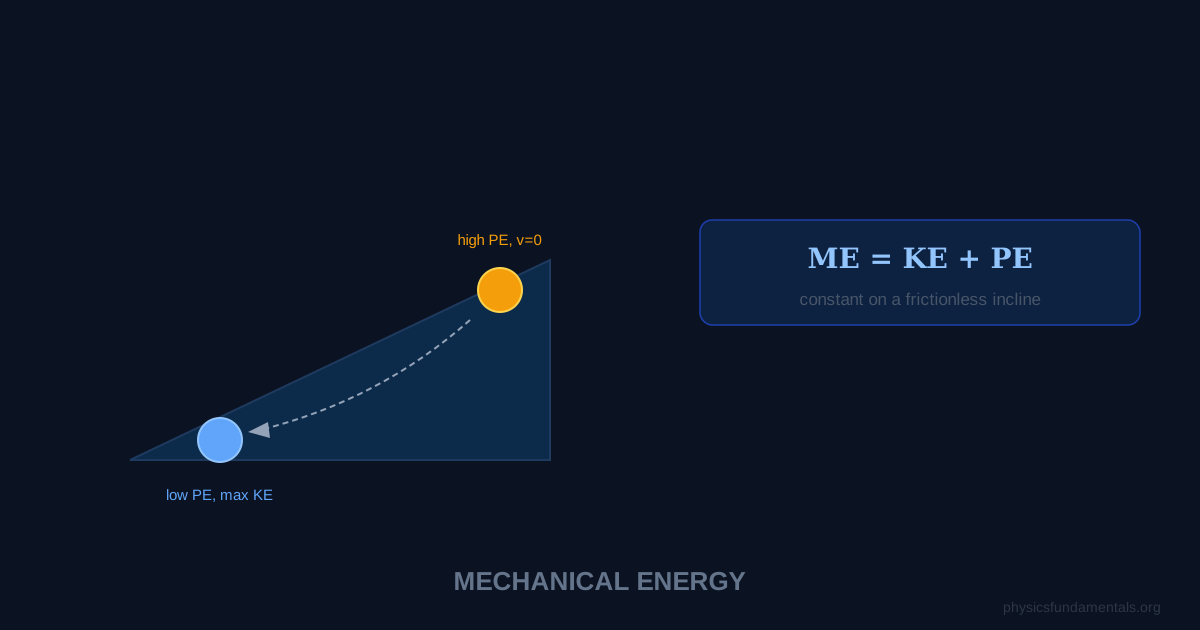
Mechanical energy is the sum of kinetic energy and potential energy: E_mech = KE + PE. When only conservative forces act on a system (gravity, spring forces — no friction or air resistance), mechanical energy is conserved: KE + PE = constant. Any decrease in PE appears as an increase in KE and vice versa. When non-conservative forces like friction act, mechanical energy decreases — the lost energy converts to heat — but total energy (including thermal) is still conserved.
The concept of mechanical energy provides a powerful shortcut in mechanics: instead of solving force equations at every point along a path, you can jump directly from one point to another using energy. This is especially useful for curved paths (roller coasters, projectiles on slopes, pendulums) where force analysis would be extremely complex.
- Mechanical energy E_mech = KE + PE and its conservation
- When mechanical energy IS conserved (no friction)
- When it IS NOT conserved (friction, air resistance)
- Energy transformations in pendulums, springs, and projectiles
- 4 worked examples including roller coasters and pendulums
Mechanical Energy Defined
In more general form, including elastic PE:
Conservation of Mechanical Energy
If only conservative forces do work on an object, its mechanical energy is constant: E_mech = KE + PE = constant.
Conservative forces: gravity (including spring restoring force). Non-conservative forces: friction, air resistance, tension in an inextensible string (this does no work), normal force (perpendicular to motion, does no work).
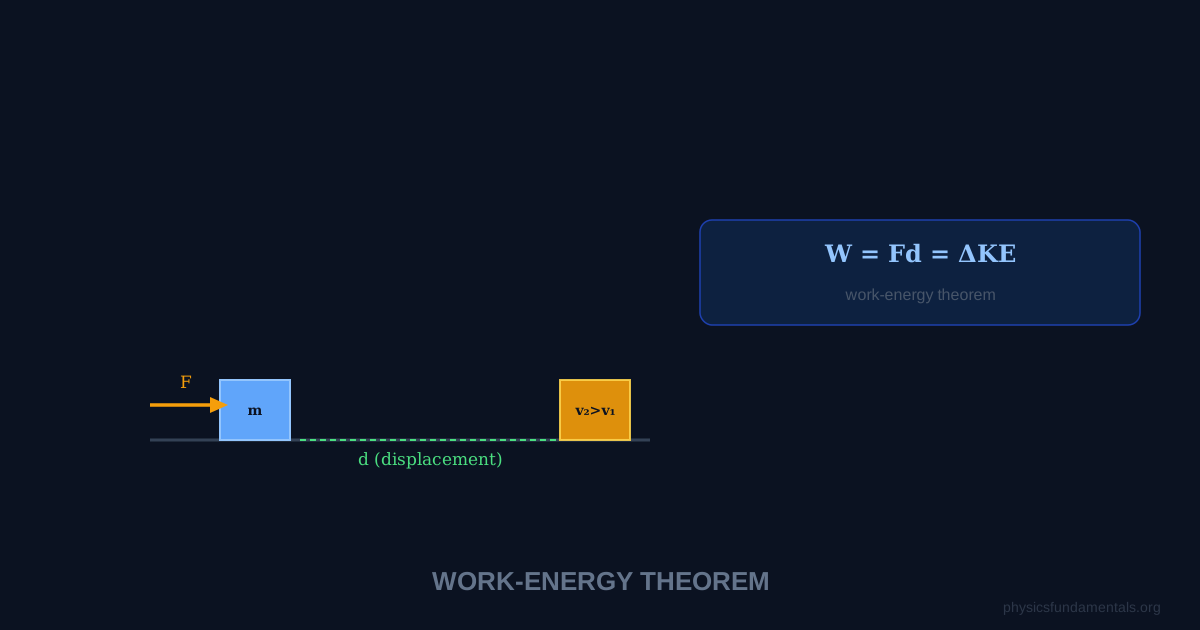
Note: the normal force and string tension do no work — they act perpendicular to motion, so W = Fd cosθ = 0 (θ = 90°). Only forces with a component along the displacement do work.
When Mechanical Energy Is Not Conserved
When friction or air resistance acts, mechanical energy decreases by the work done against these forces:
The work done by friction W_friction = f × d (always positive as a magnitude — friction removes energy from the mechanical system). The lost energy appears as heat in the surfaces in contact. Total energy is still conserved; only the mechanical portion decreases.
Energy Transformations
Pendulum (no air resistance):
- At the extreme (highest point): KE = 0, PE = maximum
- At the lowest point: KE = maximum, PE = 0 (if reference there)
- At any intermediate point: KE + PE = constant
Spring-mass system (no friction):
- At maximum compression/extension: KE = 0, elastic PE = maximum = ½kx²
- At natural length: KE = maximum, elastic PE = 0
Projectile (no air resistance):
- At maximum height: KE = ½mv_x² (horizontal component only), GPE = maximum
- Speed at any height h: v = √(v₀² − 2gh) — from energy conservation
4 Worked Examples
Example 1 — Roller coaster
Problem: A roller coaster (mass 500 kg including passengers) starts from rest at the top of a 40 m hill and reaches the bottom of a 15 m dip. Find the speed at the dip (frictionless).
Solution:
E_mech conserved: mgh₁ = ½mv² + mgh₂
g(h₁ − h₂) = ½v²
v = √(2g(h₁ − h₂)) = √(2 × 9.81 × (40 − 15)) = √(2 × 9.81 × 25) = √490.5 = 22.1 m/s
Example 2 — Pendulum with friction loss
Problem: A pendulum released from 0.5 m above its lowest point reaches only 0.4 m on the other side due to air resistance. Find the energy lost and the fraction of mechanical energy dissipated.
Solution:
Initial ME = mgh₁ = m × 9.81 × 0.5 = 4.905m J
Final ME = mgh₂ = m × 9.81 × 0.4 = 3.924m J
Energy lost = 4.905m − 3.924m = 0.981m J
Fraction lost = 0.981/4.905 = 20% of initial mechanical energy lost per half-swing
Example 3 — Spring-launched projectile
Problem: A compressed spring (k = 400 N/m, compressed 0.05 m) launches a 0.02 kg ball horizontally from a table 1.2 m high. Find the ball's speed when it hits the floor.
Solution:
Spring PE → KE at launch: ½kx² = ½mv₀²
v₀ = x√(k/m) = 0.05 × √(400/0.02) = 0.05 × √20,000 = 0.05 × 141.4 = 7.07 m/s (horizontal)
From table height: vertical speed = √(2gh) = √(2 × 9.81 × 1.2) = 4.85 m/s
Total speed at floor: v = √(7.07² + 4.85²) = √(49.98 + 23.52) = √73.5 = 8.57 m/s
Example 4 — Speed at intermediate height on a slope
Problem: A 2 kg block slides from rest down a frictionless slope, starting 8 m above the ground. Find its speed when it is 3 m above the ground.
Solution:
E_mech₁ = mgh₁ = 2 × 9.81 × 8 = 156.96 J
E_mech₂ = ½mv² + mgh₂ = ½ × 2 × v² + 2 × 9.81 × 3 = v² + 58.86
156.96 = v² + 58.86 → v² = 98.1
v = 9.90 m/s
Simple Harmonic Motion and Mechanical Energy
In simple harmonic motion (SHM), mechanical energy oscillates between kinetic and potential but the total remains constant (no friction). For a mass m on a spring of constant k with amplitude A:
At position x (measured from equilibrium): E_KE = ½m v² = ½k(A²−x²) and E_PE = ½kx². The velocity at any position: v = ω√(A²−x²), where ω = √(k/m). Maximum speed is at x = 0 (equilibrium); zero speed at x = ±A (turning points). This energy analysis gives the complete picture of SHM dynamics without solving the differential equation — it's faster and more intuitive for most problems.
Energy in the Pendulum
For a simple pendulum of length L and mass m, swinging with amplitude θ_max (in radians, for small angles):
Using the small angle approximation 1 − cosθ ≈ θ²/2: E_total ≈ mgLθ²_max/2. At the bottom of the swing (θ = 0): all kinetic, v_max = θ_max√(gL). At the top (θ = θ_max): all potential. This is why pendulum clocks work — the period T = 2π√(L/g) is independent of amplitude (for small swings) and depends only on length and gravity, making it an accurate timekeeper regardless of how much the pendulum gradually loses energy to air resistance.
Worked Example 5 — SHM energy
Problem: A 0.5 kg mass on a spring (k = 200 N/m) oscillates with amplitude 8 cm. Find: (a) total mechanical energy, (b) speed at x = 5 cm from equilibrium.
Solution:
(a) E_total = ½kA² = ½ × 200 × 0.08² = ½ × 200 × 0.0064 = 0.64 J
(b) E_KE = E_total − ½kx² = 0.64 − ½ × 200 × 0.05² = 0.64 − 0.25 = 0.39 J
½mv² = 0.39 → v = √(2 × 0.39/0.5) = √1.56 = 1.25 m/s
Power and Mechanical Energy
The rate at which mechanical energy changes equals the net power input from non-conservative forces:
For a car decelerating due to air resistance (F_drag = ½ρCdAv²) and rolling friction (F_roll = μ_rr mg): the power lost = (F_drag + F_roll) × v. At 30 m/s with F_drag = 400 N and F_roll = 100 N: power loss = 500 × 30 = 15,000 W = 15 kW — the engine must supply at least this just to maintain speed at constant velocity. Accelerating requires additional power to increase KE: P_accel = F_net × v = ma × v.
Energy Efficiency in Mechanical Systems
Every real mechanical system converts some input mechanical energy to heat through friction. The mechanical efficiency:
A bicycle drivetrain (chain, gears, bearings) has efficiency ~95–98% — very high because rolling bearings have very low friction. A car gearbox ~97%. A worm gear ~50–70% (self-locking but lossy). A ball screw used in CNC machines ~90%. By comparison, a human leg running at marathon pace converts chemical energy to mechanical at about 25% efficiency — the rest is heat (which is why runners need to dissipate several hundred watts of metabolic heat through sweating, convection, and radiation).
Roller Coaster Design Physics
A roller coaster is a masterclass in mechanical energy management. The chain lift at the start converts electrical energy to gravitational PE. From that point on, only friction and air resistance dissipate mechanical energy — the designer must ensure every subsequent feature has less height than the first hill (accounting for accumulated losses). Typically, 10–20% of the initial PE is lost to friction over a full ride. Loop-the-loop features must ensure v² ≥ gr at the top (minimum for contact with the track); inversions require v > √(gr) with comfortable margin. Engineers use energy accounting at every feature to verify the coaster never stalls mid-ride — a dangerous failure mode if the train doesn't make it over a hill and rolls back.
Exam Tips for Mechanical Energy Problems
Always start by identifying the reference level for gravitational PE (usually the lowest point in the problem). List the initial and final states with all three contributions: KE = ½mv², GPE = mgh, elastic PE = ½kx². Apply E_initial = E_final (if no friction) or E_final = E_initial − W_friction (if friction acts). The friction work W_f = f × d uses the distance along the surface, not the vertical height. A block sliding 3 m down a 30° slope travels 3 m along the slope but rises/falls by 3 sin30° = 1.5 m vertically — use 3 m for friction work, 1.5 m for the change in GPE.
Common mistakes: (1) using vertical distance for friction work — should be the actual path length along the surface; (2) forgetting elastic PE when springs are involved; (3) choosing a reference height inconsistently between initial and final states. Check your answer by estimating: if a 1 kg object falls 10 m with no friction, it gains ~100 J of KE and reaches ~14 m/s. If your calculated speed is wildly different, check your working.
Mechanical energy conservation is ultimately a consequence of Newton's laws — it can be derived from F = ma and the work-energy theorem. But energy methods often provide elegant shortcuts that force-based analysis cannot match. The classic example: a ball rolls without slipping down a slope. Force analysis requires handling the rotational dynamics and the friction force simultaneously. Energy analysis simply distributes the lost PE between translational KE (½mv²) and rotational KE (½Iω²), giving the final speed directly. This power of energy methods — jumping from initial to final state without tracking intermediate dynamics — makes them the preferred tool for a large class of mechanics problems. Conservation of mechanical energy is the most commonly applied energy principle in A-Level physics, and mastering it opens the door to elegant solutions across all mechanics topics.
Kinetic Energy of Rotation
A rotating object has kinetic energy due to its rotation, in addition to any translational KE:
Where I is the moment of inertia (kg·m²) and ω is angular velocity (rad/s). For a rolling object (rotating and translating without slipping, v = rω):
For a solid sphere: I = 2mr²/5, so KE_total = ½mv²(1 + 2/5) = 7/10 mv². A solid sphere rolling down a slope reaches the bottom at v = √(10gh/7) — slower than a sliding block (v = √(2gh)) because some PE goes into rotational KE. A hollow sphere (I = 2mr²/3) is slower still; a thin ring (I = mr²) is the slowest of all. The ratio I/(mr²) determines what fraction of the energy goes into rotation: higher I → more into rotation → lower v at the bottom. This can be tested experimentally by racing different shaped objects down a slope.
Energy Storage in Flywheels
Flywheels store rotational kinetic energy: E = ½Iω². A steel flywheel of mass 100 kg and radius 0.5 m (I = ½mr² = 12.5 kg·m²) spinning at 3000 rpm (ω = 314 rad/s) stores ½ × 12.5 × 314² = 616,000 J = 616 kJ — comparable to a small lead-acid battery but deliverable in seconds rather than minutes. Flywheel energy storage is used in: Formula 1 KERS (Kinetic Energy Recovery System) units that capture braking energy and release it on acceleration; UPS (Uninterruptible Power Supply) systems that bridge power outages for data centres; and London Bus hybrid systems that capture braking energy in a flywheel and return it during acceleration, reducing fuel consumption by ~20%.
The conservation of mechanical energy is ultimately a statement about time symmetry in physics — Noether's theorem shows that if the laws of physics are the same today as they were yesterday (time-translation symmetry), then energy is conserved. This deep connection means energy conservation is not an empirical observation that might someday fail — it is a mathematical consequence of the temporal uniformity of physical law. Every engine, every power station, every falling stone, every oscillating spring is subject to the same conservation law, derived from the same symmetry. Mechanical energy, as KE + PE, is merely the portion of total energy associated with the motion and position of macroscopic objects — the portion most directly accessible to measurement and most useful in everyday mechanics calculations.
Frequently Asked Questions
What is mechanical energy?
When is mechanical energy conserved?
How does the speed at the bottom of a slope depend on height?
Why does a pendulum lose height on each swing in the real world?
What is the difference between mechanical energy and total energy?
Share this article
Written by
Physics Fundamentals Editorial Team
Written and reviewed by our team of physics educators. Content is aligned with A-Level, GCSE, AP Physics, and undergraduate curricula.
About Physics Fundamentals →