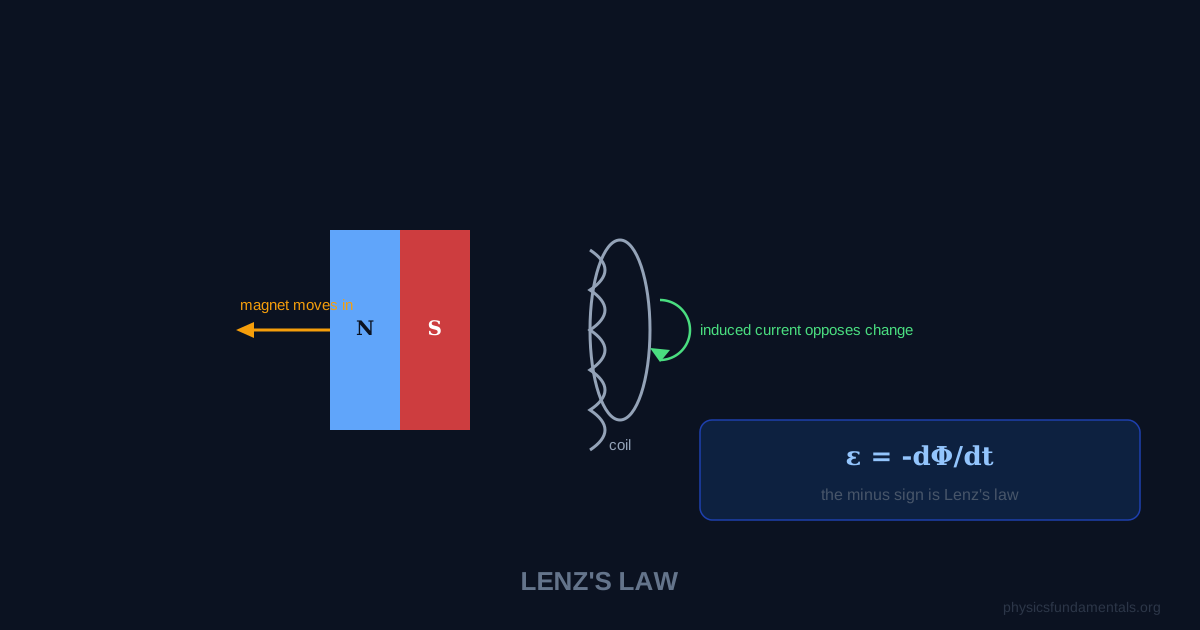
Lenz's law states that the direction of an induced current is always such that it opposes the change in magnetic flux that produced it. This is the physical meaning of the negative sign in Faraday's law: EMF = −NdΦ/dt. If the flux through a coil is increasing, the induced current flows in a direction to create a magnetic field opposing the increase. If flux is decreasing, the induced current tries to maintain it. Lenz's law is conservation of energy applied to electromagnetic induction — a current that reinforced its cause would violate energy conservation by generating energy from nothing.
The law was formulated by Heinrich Lenz in 1834, one year after Faraday's discovery of electromagnetic induction. It's a remarkably powerful rule: given the direction of flux change, you can immediately determine the direction of induced current without any calculation — just by asking "what direction would a current need to flow to oppose this change?"
- Lenz's law — statement, physical meaning, and why it must be true
- How to determine induced current direction using Lenz's law step by step
- The connection to Faraday's law: the negative sign explained
- Eddy currents — Lenz's law in conducting sheets
- 4 worked examples: magnet-coil interactions and practical applications
Lenz's Law — Statement
The induced electromotive force (EMF) and the resulting induced current have a direction such that they oppose the change in magnetic flux that produced them.
It's simplest to remember as: "the induced current opposes the change."
- Flux increasing through a coil: induced current creates a field opposing the increase (opposing the external B field that's increasing)
- Flux decreasing through a coil: induced current creates a field trying to maintain it (same direction as the external B field that's decreasing)
- Magnet approaching a coil: coil repels the magnet (opposes approach)
- Magnet receding from a coil: coil attracts the magnet (opposes departure)
Why Lenz's Law Must Be True
Lenz's law follows directly from energy conservation. Suppose the induced current instead reinforced the flux change:
- More flux → larger induced EMF → more current → even more flux → runaway
- The coil would accelerate the magnet approaching it (instead of slowing it) and create more current continuously
- This would be a perpetual motion machine — free electrical energy from nothing
The fact that this is impossible tells us the induced current must oppose, not reinforce, the cause. The magnet must be pushed against a braking force; work must be done on the system to produce the electrical energy. This is why generators require mechanical input.
The Negative Sign in Faraday's Law
Faraday's law: EMF = −NdΦ/dt. The negative sign is Lenz's law in mathematical form. If dΦ/dt is positive (flux increasing), EMF is negative, meaning the induced EMF drives current in the direction that opposes the increase. The sign tells you: induced effects always oppose their cause.
Step-by-Step Method for Applying Lenz's Law
- Identify the direction of the magnetic flux through the coil (into or out of the page/coil face).
- Determine if flux is increasing or decreasing (is the magnet approaching or receding? Is the current in a nearby coil increasing or decreasing?).
- Decide what field the induced current must create to oppose the change: if flux into the coil is increasing, induced B must point out of the coil; if flux out is decreasing, induced B must point out.
- Use the right-hand rule to find the current direction that produces the required induced B field.
4 Worked Examples
Example 1 — North pole approaching a coil (face-on)
Problem: A bar magnet's north pole is moved toward the left face of a coil. Determine the direction of the induced current as viewed from the left.
Solution:
Step 1: The north pole creates flux pointing rightward (away from north pole = into the left face of the coil).
Step 2: As the magnet approaches, this rightward flux through the coil increases.
Step 3: To oppose the increase, the induced current must create a leftward field through the coil (to counteract the increasing rightward flux).
Step 4: Right-hand rule — curling fingers to create a leftward B field through the coil: current flows anticlockwise as viewed from the left.
The left face acts as a north pole, repelling the approaching magnet — opposing the approach.
Example 2 — Magnet withdrawing from a coil
Problem: The same north pole is now pulled away from the left face. What is the current direction?
Solution:
Rightward flux is now decreasing. Induced current must oppose the decrease → create rightward flux → current flows clockwise as viewed from the left. The left face now acts as a south pole, attracting the receding magnet — opposing its departure.
Example 3 — Two coils (mutual induction)
Problem: Coil A carries current flowing clockwise (viewed from the right), creating flux pointing left through coil B placed to its right. The current in A is suddenly decreased. In which direction does current flow in coil B?
Solution:
Leftward flux through B is decreasing. To oppose, induced current in B must create leftward flux. Right-hand rule: current flows clockwise in B as viewed from the right — same direction as in A. (Decreasing source current → induced current tries to "maintain" it by flowing in the same direction.)
Example 4 — Falling magnet through a conducting ring
Problem: A bar magnet falls with its north pole downward through a horizontal conducting ring. Describe the force on the magnet from the ring as the north pole approaches, then as it recedes below the ring.
Solution:
Approaching: flux downward through ring increases → induced current creates upward B → ring's top face is a north pole → repels the approaching north pole. Upward force — slows the fall.
Receding: flux downward decreases → induced current reverses → ring's bottom face is now a north pole → attracts the receding north pole. Upward force again — still slows the fall.
In both cases Lenz's law produces an upward braking force opposing the magnet's downward motion.
Eddy Currents — Lenz's Law in Conducting Sheets
When a conducting sheet (not just a coil) moves through a magnetic field, induced currents (eddy currents) circulate in loops within the sheet. By Lenz's law, these currents create forces opposing the motion — a braking effect. Applications include:
- Electromagnetic braking in trains and roller coasters — smooth, contact-free braking
- Induction cookers — eddy currents in the steel pan generate heat; the ceramic top stays cool
- Metal detectors — eddy currents induced in metal objects change the sensor's response
- Transformer core lamination — thin insulated laminations reduce eddy current loops and energy loss
Quantitative Application of Faraday and Lenz Together
To find the magnitude of the induced EMF, use Faraday's law:
To find the direction, apply Lenz's law: the induced EMF opposes the change. Combined:
The magnitude tells you how large the induced voltage is; the sign tells you it opposes the cause. For example: a 200-turn coil with flux changing at 0.05 Wb/s produces |EMF| = 200 × 0.05 = 10 V. The direction of this 10 V EMF is such that it drives a current opposing the flux change.
The induced current from this EMF: I = EMF/R. If the coil has resistance 5 Ω, the induced current is 10/5 = 2 A, flowing in the direction that opposes the flux change — and therefore the motion causing it.
Quantitative Lenz's Law Calculations
Lenz's law gives the direction of the induced EMF; Faraday's law gives the magnitude. Together they fully describe electromagnetic induction. When working quantitatively:
- Calculate |EMF| = N|ΔΦ/Δt| from Faraday's law.
- Find the induced current: I = EMF/R.
- Apply Lenz's law to determine the current direction (opposing the flux change).
- Calculate the force on the induced current if needed: F = BIL.
Example: A 50-turn rectangular coil (area 0.02 m²) is placed in a magnetic field that changes from 0.3 T to 0.8 T in 0.1 s. The coil resistance is 10 Ω.
|EMF| = N × ΔΦ/Δt = 50 × (0.8−0.3) × 0.02/0.1 = 50 × 0.1 = 5 V
I = 5/10 = 0.5 A, flowing in the direction that opposes the increasing field.
Electromagnetic Braking in Practice
Electromagnetic braking systems use Lenz's law to decelerate moving objects without mechanical contact. A conducting disc spinning in a magnetic field (or a magnet moving past a conducting plate) induces eddy currents that, by Lenz's law, create forces opposing the motion. The braking force increases with speed (faster spin → larger dΦ/dt → larger EMF → larger current → larger force), naturally providing the kind of braking that slows vehicles proportionally to their speed — unlike mechanical brakes, which must be actively modulated. Applications include:
- Roller coaster brakes: fin-shaped metal plates pass between permanent magnets at station approaches, providing smooth, contactless braking without wear.
- Maglev trains: both levitation and braking use induced current effects.
- Dynamo braking on bicycles: the generator provides lighting while creating a braking force proportional to speed.
- Analytical balances: the balance pan is damped by eddy currents to prevent oscillation when weighing.
Self-Inductance — Lenz's Law Within a Coil
A coil opposes changes in its own current through self-inductance. When current increases through a coil, the increasing magnetic flux through the coil (due to its own current) induces a back-EMF opposing the increase. When current decreases, the back-EMF opposes the decrease:
Where L is the self-inductance (unit: henry, H). This is Lenz's law applied to the coil's own field. An inductor stores energy in its magnetic field: E = ½LI². When the circuit is broken suddenly, the collapsing magnetic field drives a large back-EMF to maintain the current — this is what causes sparks across switch contacts when inductive loads (motors, relays, transformers) are disconnected. Automotive ignition coils exploit this: a 12 V battery charges an inductor; breaking the circuit produces a 20,000–40,000 V pulse that fires the spark plug.
Mutual Inductance and Transformers
When the changing magnetic field from one coil induces an EMF in a nearby coil, the coupling is described by mutual inductance M. The induced EMF in the secondary coil:
The direction of EMF₂ is given by Lenz's law — it opposes the change in flux that caused it. In a transformer, the primary coil creates a time-varying flux in the core; the secondary coil experiences this changing flux and develops an EMF. The voltage ratio equals the turns ratio: V₂/V₁ = N₂/N₁. Lenz's law ensures the secondary EMF always opposes the primary flux change — which is why a transformer can step voltage up or down but always conserves power (in the ideal case): P₁ = P₂ → V₁I₁ = V₂I₂.
Worked Example 5 — Inductor back-EMF
Problem: An inductor of L = 0.5 H carries a current that decreases from 4 A to 1 A in 0.02 s. Find the magnitude and state the nature of the induced back-EMF.
Solution:
|EMF| = L|ΔI/Δt| = 0.5 × (4−1)/0.02 = 0.5 × 150 = 75 V
By Lenz's law: current is decreasing, so the back-EMF acts to maintain the current — it drives current in the same direction as the original current, opposing the decrease. This 75 V back-EMF appears across the switch contacts when the circuit is broken, potentially causing arcing.
Exam Approach for Lenz's Law Questions
Three-step method for any Lenz's law direction question: (1) Identify the flux through the coil and determine whether it is increasing or decreasing. (2) State what the induced current must do: if flux is increasing, the induced B must oppose (point opposite to external B through the coil); if flux is decreasing, induced B must try to maintain (same direction as external B). (3) Use the right-hand rule: curl the fingers of the right hand in the direction of induced current; the thumb points in the direction of the induced B field. If thumb must point in the required direction, fingers curl in the current direction — anticlockwise or clockwise as viewed from the relevant end.
Common pitfall: confusing the direction of the induced B field with the direction of the external B field. The induced B only needs to oppose the CHANGE — not the field itself. If flux through a coil is upward and decreasing, the induced current creates an upward B field (to oppose the decrease), not a downward one (which would oppose the existing field direction). Always think about the change, not the absolute direction.
Lenz's law is one of the most satisfying examples of energy conservation in electromagnetism. Every time you push a magnet into a coil, you do work against the repulsive force (the coil repels the approaching magnet to oppose the increase in flux). This mechanical work is converted to electrical energy in the induced current, which is then dissipated as heat in the coil's resistance. If the coil instead attracted the magnet as you pushed it in, it would accelerate the magnet, generating more current, attracting it more, and so on — a perpetual motion machine, which is physically impossible. Lenz's law is nature's safeguard against this: the coil always opposes, never reinforces, the cause of induction. Every generator and transformer in the world operates on this principle, converting mechanical work to electrical energy with the directionality guaranteed by Lenz's law.
Frequently Asked Questions
What is Lenz's law?
Why does Lenz's law follow from energy conservation?
What is the relationship between Lenz's law and Faraday's law?
What are eddy currents?
How do you determine the direction of induced current using Lenz's law?
Share this article
Written by
Physics Fundamentals Editorial Team
Written and reviewed by our team of physics educators. Content is aligned with A-Level, GCSE, AP Physics, and undergraduate curricula.
About Physics Fundamentals →