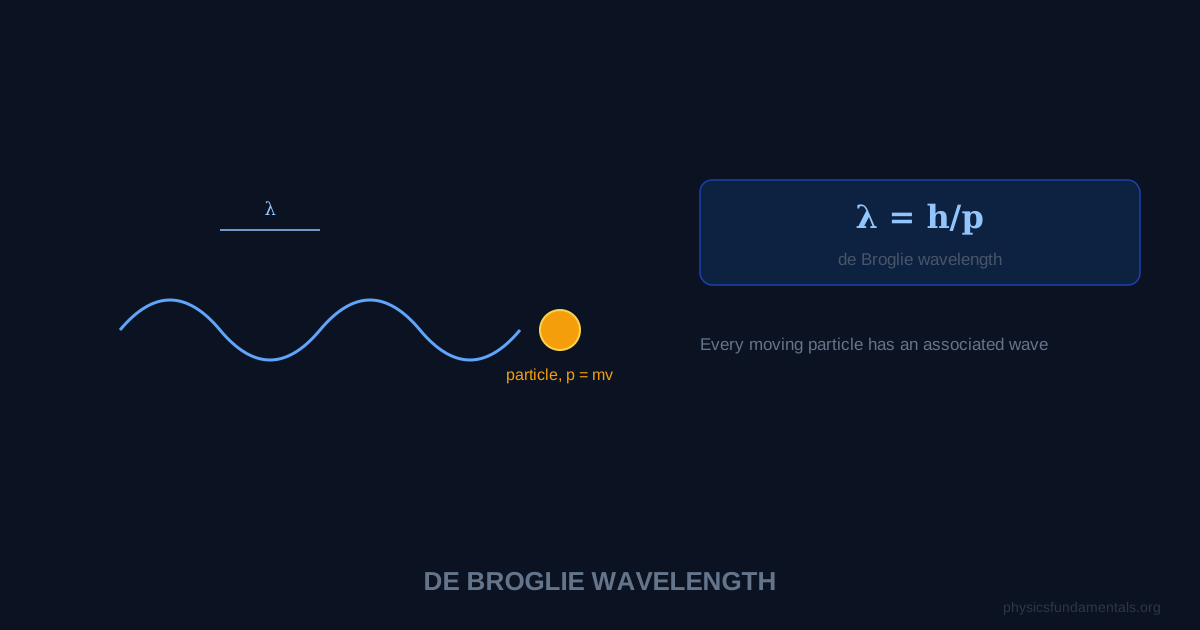
The de Broglie wavelength of a particle is λ = h/p = h/mv, where h is Planck's constant (6.626 × 10⁻³⁴ J·s), p is momentum, m is mass, and v is speed. Every moving particle — electron, proton, even a football — has an associated wavelength. For macroscopic objects, the wavelength is absurdly small and undetectable. For electrons and other subatomic particles, the wavelength is comparable to atomic spacings, which is why electrons diffract and interfere just like light waves.
Louis de Broglie proposed this hypothesis in his 1924 PhD thesis. It was confirmed three years later when Davisson and Germer demonstrated electron diffraction from a crystal of nickel — electrons producing the same diffraction patterns as X-rays. This was one of the most dramatic experimental confirmations in the history of physics, and it earned de Broglie the 1929 Nobel Prize.
- The de Broglie formula λ = h/p — where it comes from and what it means
- Why macroscopic objects have wavelengths too small to detect
- 4 worked examples: electron wavelengths, diffraction conditions
- Electron microscopes — practical application of de Broglie waves
- Connection to the Bohr atom and standing wave orbits
The De Broglie Wavelength Formula
Where:
- λ = de Broglie wavelength (m)
- h = Planck's constant = 6.626 × 10⁻³⁴ J·s
- p = momentum = mv (kg·m/s)
- m = mass (kg)
- v = speed (m/s)
Derivation
De Broglie combined Einstein's photon energy E = hf and special relativity's E = pc (for massless photons) to get p = h/λ, then hypothesised this applied to all particles: λ = h/p. The hypothesis was bold because it extended a photon property to matter with mass.
For an electron accelerated through voltage V from rest, it gains kinetic energy eV = ½mv², so v = √(2eV/m) and:
4 Worked Examples
Example 1 — Electron wavelength
Problem: An electron (m = 9.11 × 10⁻³¹ kg) moves at 1% of the speed of light (v = 3 × 10⁶ m/s). Find its de Broglie wavelength.
Solution:
p = mv = 9.11 × 10⁻³¹ × 3 × 10⁶ = 2.733 × 10⁻²⁴ kg·m/s
λ = h/p = 6.626 × 10⁻³⁴ / 2.733 × 10⁻²⁴ = 2.42 × 10⁻¹⁰ m = 0.242 nm
This is comparable to atomic spacings (~0.1–0.5 nm), which is why electrons diffract from crystal lattices.
Example 2 — Accelerated electron
Problem: An electron is accelerated through 100 V. Find its de Broglie wavelength. (e = 1.6 × 10⁻¹⁹ C)
Solution:
λ = h/√(2meV) = 6.626 × 10⁻³⁴ / √(2 × 9.11 × 10⁻³¹ × 1.6 × 10⁻¹⁹ × 100)
= 6.626 × 10⁻³⁴ / √(2.915 × 10⁻²⁶) = 6.626 × 10⁻³⁴ / 1.707 × 10⁻¹³
λ = 1.23 × 10⁻¹⁰ m = 0.123 nm
Example 3 — Football wavelength
Problem: A football (m = 0.43 kg) moves at 20 m/s. Find its de Broglie wavelength.
Solution:
λ = h/mv = 6.626 × 10⁻³⁴ / (0.43 × 20) = 6.626 × 10⁻³⁴ / 8.6 = 7.7 × 10⁻³⁵ m
This is 10²⁰ times smaller than a proton. Utterly undetectable — which is why footballs don't diffract around goalposts.
Example 4 — Diffraction condition
Problem: Electrons are to be diffracted by a crystal with lattice spacing 0.20 nm. What voltage should accelerate the electrons to give a wavelength of 0.20 nm?
Solution:
From λ = h/√(2meV): V = h²/(2meλ²)
V = (6.626 × 10⁻³⁴)² / (2 × 9.11 × 10⁻³¹ × 1.6 × 10⁻¹⁹ × (0.20 × 10⁻⁹)²)
V = 4.39 × 10⁻⁶⁷ / (1.165 × 10⁻⁵⁸) = 37.7 V ≈ 38 V
Electron Microscopes
Optical microscopes are limited by the wavelength of visible light (~400–700 nm) — they cannot resolve features smaller than roughly half a wavelength. Electron microscopes use electrons accelerated to keV energies, giving wavelengths of ~0.001 nm — thousands of times shorter than light. This allows resolution down to individual atoms. The electron microscope is one of the most direct practical applications of wave-particle duality and the de Broglie hypothesis.
De Broglie Waves and the Bohr Atom
De Broglie's hypothesis explains why the Bohr atom has quantised orbits. For a stable electron orbit, the electron's de Broglie wave must form a standing wave around the nucleus — the circumference must be an integer number of wavelengths: 2πr = nλ = nh/mv. This gives exactly the quantisation condition Bohr postulated: mvr = nh/2π = nħ. De Broglie's wave picture thus provides the physical reason behind Bohr's ad hoc quantisation rule.
Wave Functions and Probability — Extending de Broglie
De Broglie's hypothesis was the seed from which Schrödinger grew wave mechanics. The de Broglie wave isn't a mechanical wave in a medium — it's a probability amplitude wave. The square of the wave function |ψ|² gives the probability density of finding the particle at that position. This probabilistic interpretation (due to Max Born, 1926) resolved the paradox of what exactly was "waving."
For a free particle with definite momentum p = mv, the de Broglie wave is a perfect sine wave of wavelength λ = h/p extending over all space — which means the particle's position is completely uncertain, consistent with the Heisenberg uncertainty principle (Δx × Δp ≥ ħ/2). A particle with a well-defined wavelength has completely undefined position.
Neutron Diffraction
Neutrons, like electrons, have associated de Broglie wavelengths. Thermal neutrons at room temperature (kinetic energy ~0.025 eV) have wavelengths around 0.1–0.3 nm — comparable to atomic spacings. Neutron diffraction therefore reveals crystal structures, just as X-ray diffraction does. But neutrons interact with nuclei, not electrons, so they provide complementary information to X-rays: they're sensitive to light elements (especially hydrogen, which barely scatters X-rays) and can distinguish isotopes. Neutron diffraction is crucial for studying biological molecules, hydrogen-bonded systems, and magnetic structures in materials.
The Double-Slit Experiment with Single Particles
Perhaps the most striking demonstration of wave-particle duality is the double-slit experiment performed one particle at a time. Electrons (or photons, atoms, even molecules) are sent toward a double slit one by one. Each particle hits the detector as a point — particle-like. But where each successive particle lands appears random. After thousands of particles, the accumulated pattern on the detector is an interference fringe — the pattern of a wave that passed through both slits simultaneously.
Each electron apparently "goes through both slits" and interferes with itself. Attempting to detect which slit each electron goes through — by placing a detector at the slits — destroys the interference pattern. The wave-particle duality is not a statement about our ignorance of which path was taken; it's a fundamental feature of quantum reality. Richard Feynman described this as "the only mystery" in quantum mechanics — everything else can be derived from it.
De Broglie Wavelength of Large Molecules
In 1999, Anton Zeilinger's group demonstrated quantum interference using buckminsterfullerene (C₆₀) molecules — spheres of 60 carbon atoms with mass 1.2 × 10⁻²⁴ kg. At thermal speeds ~200 m/s:
λ = h/mv = 6.626 × 10⁻³⁴/(1.2 × 10⁻²⁴ × 200) = 6.626 × 10⁻³⁴/2.4 × 10⁻²² = 2.76 × 10⁻¹² m = 2.76 pm
This wavelength is still comparable to atomic spacings. The interference pattern was observed using a grating with 50 nm slits — the experiment worked. By 2019, the same group had demonstrated interference with molecules of over 2000 atoms. Quantum wave behaviour, and de Broglie's formula, appears to hold for increasingly large objects — the limit is not known, but is certainly somewhere between molecules and everyday objects.
Worked Example 5 — Particle in a box
Problem: An electron is confined to a one-dimensional box of length 0.5 nm (roughly the size of an atom). Using the de Broglie standing wave condition, find the allowed energies for the first three states.
Solution:
Standing wave condition: L = nλ/2 → λ_n = 2L/n
de Broglie: p_n = h/λ_n = nh/(2L)
KE_n = p_n²/(2m) = n²h²/(8mL²)
For L = 0.5 nm = 5 × 10⁻¹⁰ m, m = 9.11 × 10⁻³¹ kg:
E₁ = h²/(8mL²) = (6.626 × 10⁻³⁴)²/(8 × 9.11 × 10⁻³¹ × (5 × 10⁻¹⁰)²)
= 4.39 × 10⁻⁶⁷/(8 × 9.11 × 10⁻³¹ × 2.5 × 10⁻¹⁹) = 4.39 × 10⁻⁶⁷/1.822 × 10⁻⁴⁸
= 2.41 × 10⁻¹⁹ J = 1.51 eV
E₂ = 4E₁ = 6.02 eV
E₃ = 9E₁ = 13.55 eV
These energies are of the order of atomic energy levels — exactly right for an electron confined to atomic-scale dimensions. The quantisation of energy in atoms arises from exactly this standing wave condition.
Heisenberg Uncertainty from de Broglie Waves
The Heisenberg uncertainty principle emerges naturally from de Broglie's wavelength concept. A perfect sine wave has a definite wavelength (definite momentum λ = h/p) but is spread over all space — position is completely uncertain. To localise a particle to a small region Δx, you need a superposition of waves with a range of wavelengths Δλ, which gives a range of momenta Δp = hΔ(1/λ). The mathematics of Fourier analysis shows that Δx × Δp ≥ ħ/2 — the Heisenberg uncertainty principle. It's not a limitation of our measuring instruments; it's an inherent consequence of representing a localised particle as a wave packet built from waves of different momenta. De Broglie's hypothesis thus contains the seeds of the uncertainty principle within it.
Exam Summary
The de Broglie wavelength λ = h/mv (or h/p) is the key formula. For an electron accelerated through voltage V: λ = h/√(2meV). The wavelength decreases with increasing momentum — heavier, faster particles have shorter wavelengths and less obvious wave behaviour. The formula applies to all particles: electrons, protons, neutrons, atoms, and even molecules, though for macroscopic objects the wavelength is unmeasurably small. Electron diffraction (confirmed 1927) and neutron diffraction are the key experimental confirmations of de Broglie's hypothesis at A-Level and beyond.
Connection to Quantum Mechanics
De Broglie's 1924 hypothesis was so radical that his PhD examiners weren't sure whether to accept it — they reportedly sent his thesis to Einstein, who confirmed it was "not a joke." Three years later, the experimental confirmation won de Broglie the 1929 Nobel Prize and established that wave mechanics wasn't a mathematical curiosity but a physical reality. Schrödinger's equation (1926), which governs the evolution of de Broglie waves, became the foundation of all of modern quantum mechanics. Every result of quantum chemistry, condensed matter physics, and quantum optics rests on the insight that matter has wavelike properties — an insight that began with de Broglie counting visible wavelengths on a blackboard in 1924.
Practical Uses of Electron Waves
Beyond the electron microscope, de Broglie electron waves are exploited in: electron diffraction analysis (LEED — low-energy electron diffraction) to determine surface crystal structures with sub-nanometre precision; electron lithography for writing nanoscale features in chip manufacturing (electron wavelengths of 0.01 nm allow features far smaller than optical lithography's ~100 nm limit); and electron holography, which records the full wave (amplitude and phase) of an electron beam scattered by a sample, allowing three-dimensional reconstruction of electromagnetic fields around nanostructures. All of these technologies rely on the fundamental correctness of λ = h/mv, confirmed daily in thousands of laboratories worldwide.
The Davisson-Germer experiment of 1927 remains the gold-standard confirmation: electrons of known kinetic energy (hence known momentum p = √(2meV)) were scattered from nickel crystal planes with spacing d = 0.215 nm, producing diffraction peaks at angles given by Bragg's law nλ = 2d sinθ. The measured angles matched λ = h/p exactly — a perfect vindication of de Broglie's hypothesis and the foundation of wave mechanics.
Summary and Exam Tips
The de Broglie wavelength λ = h/p = h/mv is the single most important formula in this topic. For accelerated electrons, λ = h/√(2meV) is derived by equating kinetic energy to work done by the electric field. Remember: wavelength decreases as momentum increases, so higher accelerating voltage → shorter wavelength → better resolution for electron microscopes. The key examples to know: a 100 V electron has λ ≈ 0.12 nm (comparable to atomic spacing, diffracts from crystals); a typical electron microscope operates at 100–300 kV giving λ ≈ 0.004 nm (allows atomic resolution). For protons at the same energy, mass is 1836× larger, so wavelength is 1/√1836 ≈ 1/43 of the electron's wavelength. De Broglie's formula applies universally — the only practical limitation is whether the wavelength is large enough relative to available apertures or gratings to produce measurable wave effects.
Three key relationships to keep straight: (1) λ = h/p = h/mv — wavelength from momentum; (2) for accelerated electron: p = √(2meV), so λ = h/√(2meV); (3) for relativistic particles (v approaching c, not in A-Level but in undergraduate): use relativistic momentum p = γmv. In A-Level, always use the non-relativistic form — it's accurate enough for the accelerating voltages involved in typical problems (up to a few keV for electrons; relativistic effects only become significant above ~50 keV).
In summary: Louis de Broglie's proposal that λ = h/p applies to all matter transformed physics from a set of empirical rules into a coherent wave-based description of nature. The confirmation — electron diffraction matching the predicted wavelengths exactly — was the experimental foundation of quantum mechanics. Every subsequent development in quantum theory, from Schrödinger's equation to quantum computing, builds on this single insight: matter, like light, exhibits both wave and particle properties depending on how it is observed.
Try it yourself: check your own numbers with the de Broglie Wavelength Calculator, which shows the formula, the worked substitution and the answer step by step.
Frequently Asked Questions
What is the de Broglie wavelength?
What does the de Broglie wavelength depend on?
Why don't large objects show wave behaviour?
How was de Broglie's hypothesis confirmed?
What is the de Broglie wavelength of a proton compared to an electron at the same speed?
Share this article
Written by
Physics Fundamentals Editorial Team
Written and reviewed by our team of physics educators. Content is aligned with A-Level, GCSE, AP Physics, and undergraduate curricula.
About Physics Fundamentals →