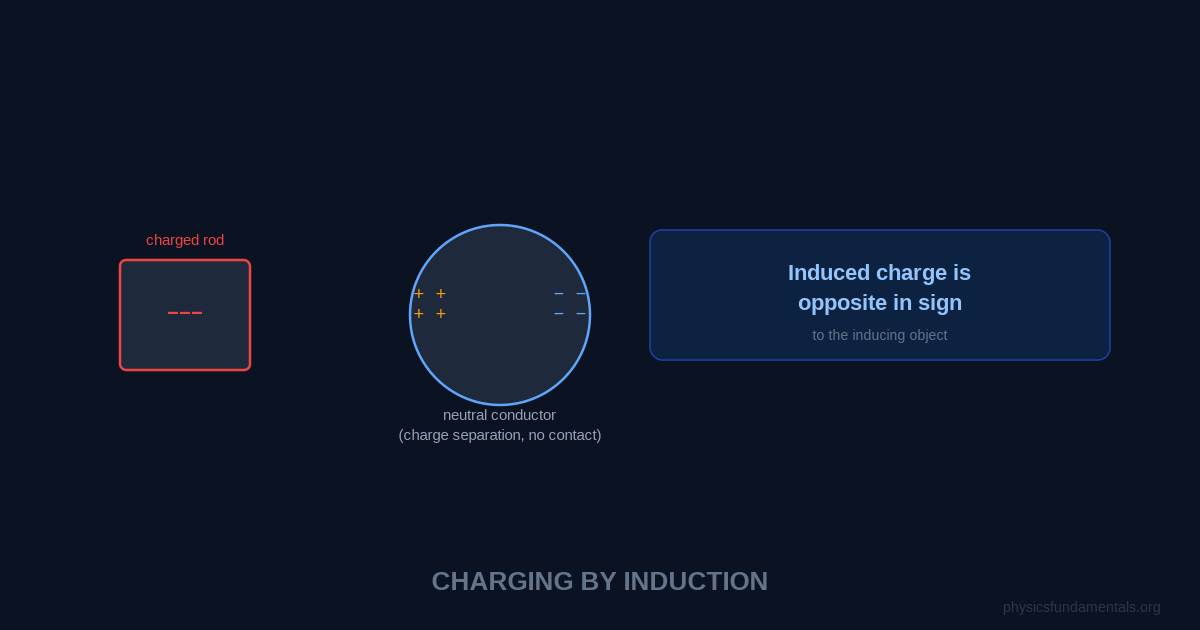
Charging by induction is a way to give a neutral conductor a net electric charge without ever touching it to a charged object. Bringing a charged rod close to a neutral conductor causes its free charges to redistribute — electrons shift toward or away from the rod depending on its sign. Briefly connecting the conductor to the ground while the rod is still nearby lets a net charge flow in or out; disconnecting the ground and then removing the rod leaves the conductor permanently charged, with a sign opposite to the rod that induced it.
This is one of three ways to charge an object (alongside friction and conduction), and it's the only one of the three that works without any direct contact at all — which is exactly why it shows up in lightning rods, photocopiers, and classic electrostatics demonstrations with pith balls and metal spheres. For the force between charged objects once they're charged, see our guide to electric charge and Coulomb's law.
- The three charging methods compared — friction, conduction, and induction
- The step-by-step process for charging a single conductor by induction
- Why the induced charge always ends up opposite in sign to the inducing object
- 2 worked examples: a single grounded sphere, and the classic two-sphere separation method
The Three Charging Methods
| Method | Contact? | Resulting charge |
|---|---|---|
| Friction | Rubbing two surfaces together | Both objects charged, opposite signs |
| Conduction | Direct touch | Both objects end up the same sign |
| Induction | No contact — just proximity | Conductor ends up the opposite sign to the inducing object |
Induction is the odd one out in two ways: it needs no physical contact, and the result is opposite in sign rather than matching. Both of those follow directly from how it actually works.
How Charging by Induction Works, Step by Step
Here's the process for charging a single, isolated conducting sphere using a negatively charged rod:
- Bring the charged rod close to the neutral sphere, without touching it. The rod's negative charge repels the sphere's free electrons, pushing them to the far side. The near side, now electron-deficient, becomes positively charged. The sphere is still overall neutral — this is charge separation (polarization), not a net charge yet.
- Ground the sphere — connect it to the Earth with a wire, while the rod is still held nearby. The Earth acts as a huge reservoir of charge. Because the rod is still repelling electrons, those excess electrons on the far side flow down the ground wire and away into the Earth.
- Disconnect the ground, while the rod is still in place. The sphere is now electron-deficient overall — it has a net positive charge, with no way for those electrons to flow back.
- Remove the rod. With nothing left to attract the remaining electrons toward one side, the sphere's net positive charge spreads out evenly over its whole surface.
The sphere ends up charged opposite in sign to the rod that induced it — here, a negative rod leaves the sphere positively charged. This always holds: the inducing object repels (for a same-sign rod) or attracts (for an opposite-sign rod) the mobile charges, and whichever charge sign is pushed away through the ground wire is the sign the conductor permanently loses — leaving it with the opposite net charge.
Worked Example 1: Grounding With a Positive Rod
A positively charged rod is held near a neutral, grounded metal sphere. What is the sign of the sphere's final charge once the ground is disconnected and the rod is removed?
The positive rod attracts the sphere's free electrons toward the near side. With the sphere grounded, this attraction pulls additional electrons up from the Earth into the sphere (the positive rod is effectively pulling electrons in through the ground wire). Disconnecting the ground traps those extra electrons. Removing the rod lets them spread out evenly.
Result: the sphere ends up with a net negative charge — opposite to the positive rod, consistent with the key rule above.
Worked Example 2: The Two-Sphere Separation Method
Two identical neutral metal spheres, A and B, are touching each other on insulating stands (so together they form one connected neutral conductor). A negatively charged rod is brought close to sphere A only. While the rod is still in place, the spheres are pulled apart, and then the rod is removed. What is the final charge on each sphere?
The rod's negative charge repels free electrons in the connected A–B system away from A, toward B — exactly like step 1 above, except here the "escape route" for electrons is sphere B instead of a ground wire. Separating the spheres while the rod is still present locks each sphere's charge in place before anything can flow back.
Result: Sphere A (nearer the rod) ends up positively charged; Sphere B (farther from the rod) ends up negatively charged. This method needs no ground wire at all — the second sphere plays that role instead, and critically, the spheres must be separated before the rod is taken away, or the charges would simply recombine.
Real-World Applications
Lightning rods: a negatively charged storm cloud overhead induces a positive charge at the tip of a grounded lightning rod — exactly the single-sphere process above, happening continuously. This encourages a controlled, safe discharge path rather than a strike through a building's structure.
Electrophorus: a classic charge-multiplying device (a charged insulating plate plus a metal disc with an insulating handle) that uses induction repeatedly to generate charge without ever needing to re-charge the original plate by friction each time.
Photocopiers and laser printers: use electrostatic induction and charge transfer to attract toner particles to precisely the right areas of a charged drum, which then transfers the image to paper.
Electrostatic precipitators: used in industrial smokestacks, these charge airborne particles (often by direct ionization rather than induction specifically) so they're attracted to and collected on oppositely-charged plates, removing pollutants from exhaust gases.
Common Mistakes
Thinking the conductor ends up the same sign as the inducing object. That's what happens with conduction (direct contact), not induction. Induction always leaves the conductor with the opposite sign.
Removing the rod before disconnecting the ground (or before separating two spheres). If the rod is removed first, the induced charge separation simply collapses back to neutral — grounding must be disconnected (or the spheres separated) while the inducing object is still in place, then the object removed last.
Assuming the inducing object loses or gains charge. The rod's own charge is unchanged throughout the entire process — it never touches anything, so it's doing the inducing without participating in any charge transfer itself.
Frequently Asked Questions
What is charging by induction?
How does charging by induction differ from charging by conduction?
What is the step-by-step process of charging an object by induction?
Why must the charged object stay in place until after the ground is disconnected?
Does charging by induction change the charge on the inducing object?
What is charging by conduction?
What is charging by friction?
Share this article
Written by
Physics Fundamentals Editorial Team
Written and reviewed by our team of physics educators. Content is aligned with A-Level, GCSE, AP Physics, and undergraduate curricula.
About Physics Fundamentals →