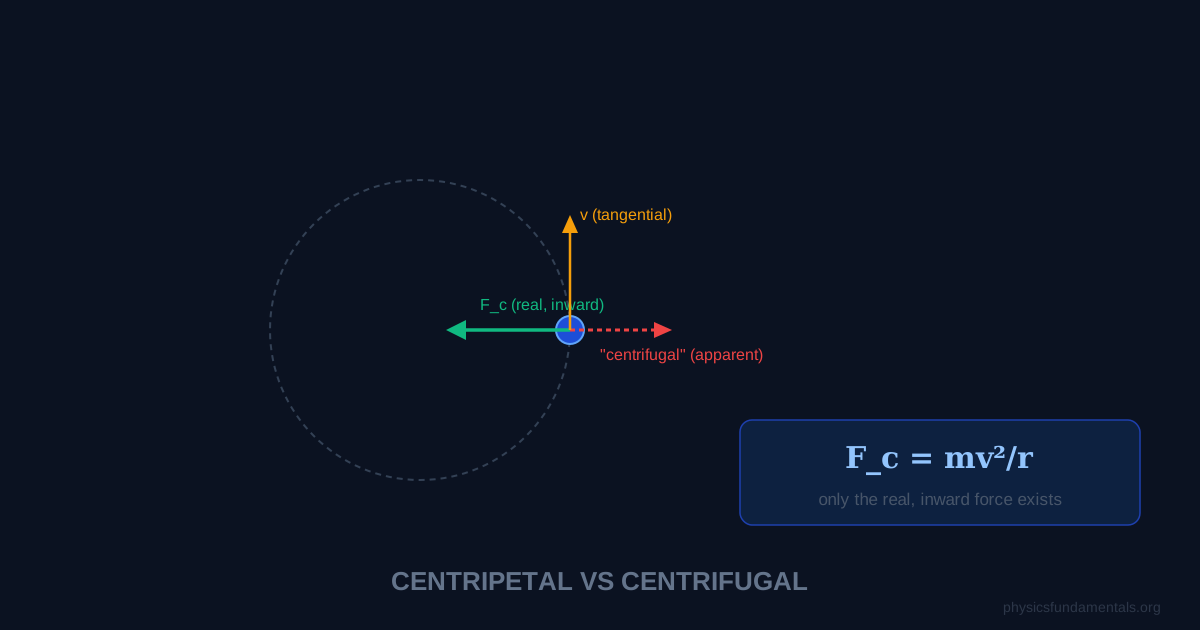
Centripetal force is the real inward force that keeps an object moving in a circle: F = mv²/r. Without it, the object would fly off in a straight line (Newton's first law). "Centripetal" means "centre-seeking" — the force always points toward the centre of the circular path. In contrast, the "centrifugal force" that throws you outward in a turning car is a fictitious force — it only appears to act when you're in a rotating (non-inertial) reference frame. From an outside observer's perspective, you're simply experiencing a lack of sufficient centripetal force.
This distinction matters more than it might seem. Every circular motion problem in physics requires identifying what real force is providing the centripetal force: tension in a string, normal force on a curved road, gravity for a satellite, friction on a car's tyres. "Centripetal force" is not a new force — it's always one of the existing forces you already know, acting in the inward direction.
Centripetal vs Centrifugal Force — Side by Side
| Property | Centripetal Force | Centrifugal Force |
|---|---|---|
| Real or fictitious? | Real — a genuine physical force | Fictitious — only appears in rotating frames |
| Direction | Inward, toward the centre | Outward, away from the centre |
| Reference frame | Any frame, including inertial (non-rotating) | Only exists in a rotating (non-inertial) frame |
| Formula | F = mv²/r, directed inward | F = mv²/r, directed outward (frame-dependent) |
| What provides it | Tension, gravity, friction, or normal force | Nothing — it's not a force exerted by any object |
| Newton's third law pair? | Yes — has a real reaction force | No — it has no reaction force |
| Example | String tension pulling a swung ball inward | Feeling "pushed" outward on a car's turn |
The key takeaway from the table above: centripetal force is what a physicist analysing the situation from outside (an inertial frame) sees acting on the object. Centrifugal force is what you feel from inside the rotating system — useful for quick calculations in that frame, but not a force any object is actually exerting.
- Centripetal force: F = mv²/r — derivation and what provides it
- Centripetal acceleration: a = v²/r directed inward
- Why centrifugal force is fictitious — the correct analysis
- 4 worked examples: car on a bend, satellite orbit, conical pendulum, banked track
- Common real forces that act as centripetal force
Centripetal Acceleration and Force
An object moving in a circle at constant speed is accelerating — because the direction of velocity is continuously changing. This acceleration always points toward the centre of the circle:
Where v is the speed (m/s), r is the radius (m), and ω = v/r is the angular velocity (rad/s).
By Newton's second law, this acceleration requires a net inward force:
Where m is the mass (kg). This is the centripetal force — always directed toward the centre, perpendicular to the velocity at every instant.
What Provides the Centripetal Force?
Centripetal force is not a new type of force — it's always provided by one or more existing forces acting inward:
| Situation | Centripetal force provided by |
|---|---|
| Ball on a string, horizontal circle | Tension T in the string |
| Car going around a flat bend | Friction between tyres and road |
| Satellite in orbit | Gravitational force from Earth |
| Car on a banked road | Component of normal force toward centre |
| Electron orbiting nucleus (Bohr) | Electrostatic (Coulomb) force |
| Roller coaster at the top of a loop | Weight + normal force (both inward) |
The Centrifugal Force — Fictitious
From inside a rotating reference frame (like a car going around a bend), it feels as if you're being pushed outward. This apparent outward "force" is the centrifugal force. However, it's not a real force — there is no outward push in an inertial frame.
What's actually happening: your body tends to move in a straight line (Newton's first law). The car turns inward. Your body appears to move outward relative to the car — but from an inertial observer's perspective, you're simply moving straight while the car curves beneath you. The car door pushes you inward (providing centripetal force); you push back on the door (Newton's third law). No centrifugal force needed to explain this.
Centrifugal force is a useful calculating tool in rotating reference frames, but always remember it's fictitious — it has no reaction force and does not appear in inertial frames.
4 Worked Examples
Example 1 — Car on a flat bend
Problem: A 1200 kg car travels around a flat circular bend of radius 80 m at 15 m/s. Find the friction force required and the maximum speed if the coefficient of friction μ = 0.6. (g = 9.81 m/s²)
Solution:
Centripetal force required: F_c = mv²/r = 1200 × 15² / 80 = 1200 × 225/80 = 3375 N
Maximum friction available: F_max = μmg = 0.6 × 1200 × 9.81 = 7063 N
Max speed: mv²_max/r = μmg → v_max = √(μgr) = √(0.6 × 9.81 × 80) = √470.9 = 21.7 m/s
Example 2 — Satellite orbit
Problem: A 500 kg satellite orbits Earth at radius 7.0 × 10⁶ m. Find the orbital speed and period. (G = 6.674 × 10⁻¹¹, M_E = 5.97 × 10²⁴ kg)
Solution:
Gravity provides centripetal force: GMm/r² = mv²/r
v = √(GM/r) = √(6.674 × 10⁻¹¹ × 5.97 × 10²⁴ / 7.0 × 10⁶)
= √(5.694 × 10⁷) = 7546 m/s ≈ 7.5 km/s
T = 2πr/v = 2π × 7.0 × 10⁶ / 7546 = 5828 s ≈ 97 minutes
Example 3 — Ball on a string, vertical circle (top)
Problem: A 0.5 kg ball on a 0.8 m string swings in a vertical circle. Find the minimum speed at the top for the string to remain taut.
Solution:
At the top, both weight and tension point inward (downward):
mg + T = mv²/r. For minimum speed, T = 0:
mg = mv²_min/r → v_min = √(gr) = √(9.81 × 0.8) = √7.848 = 2.80 m/s
Example 4 — Conical pendulum
Problem: A conical pendulum has string length 0.6 m and the string makes 30° with the vertical. Find the period of revolution.
Solution:
Radius of circle: r = L sinθ = 0.6 × sin30° = 0.3 m
Vertical equilibrium: T cosθ = mg → T = mg/cos30°
Horizontal (centripetal): T sinθ = mv²/r → mg sinθ/cos30° = mv²/r
v² = gr sinθ/cos30° = gr tanθ = 9.81 × 0.3 × tan30° = 9.81 × 0.3 × 0.577 = 1.699
v = 1.304 m/s; T = 2πr/v = 2π × 0.3/1.304 = 1.44 s
Angular Velocity and the Period of Circular Motion
For uniform circular motion, the angular velocity ω (rad/s) relates to the period T (s) and frequency f (Hz):
The centripetal acceleration and force can be written in terms of ω:
This form is often more convenient when the period rather than the speed is given. The ISS completes one orbit in T = 92.5 minutes = 5550 s, so ω = 2π/5550 = 1.132 × 10⁻³ rad/s. At r = 6.77 × 10⁶ m: a_c = ω²r = (1.132 × 10⁻³)² × 6.77 × 10⁶ = 8.67 m/s² — matching g at that altitude, which is exactly what we'd expect for an orbiting object.
Banking of Roads — The Ideal Banking Angle
On a banked road, the inward component of the normal force (rather than friction) provides centripetal force. At the ideal banking angle θ, no friction is needed:
Dividing: tan θ = v²/(rg)
Worked example: A motorway slip road has radius 80 m and is designed for 25 m/s. What banking angle is ideal?
tan θ = 25²/(80 × 9.81) = 625/784.8 = 0.796 → θ = arctan(0.796) = 38.5°
At this angle, a car travelling at exactly 25 m/s needs zero friction force. At lower speeds, friction acts up the slope (stopping the car sliding down); at higher speeds, friction acts down the slope (stopping the car sliding up or off the banking). The design speed for a banked curve determines the angle; the friction coefficient determines the safe speed range around that design speed.
Circular Motion in a Vertical Plane
When an object moves in a vertical circle, gravity acts throughout, so the centripetal force equation changes with position:
At the top of the loop: both weight and tension (or normal force) act downward (toward centre):
mg + N = mv²/r → N = mv²/r − mg
Minimum speed (N = 0): v_min = √(gr)
At the bottom of the loop: tension acts upward, weight downward:
N − mg = mv²/r → N = mv²/r + mg
The normal force at the bottom always exceeds mg — you feel heavier at the bottom of a loop.
Using energy conservation between top and bottom:
½mv²_bottom = ½mv²_top + mg(2r) → v²_bottom = v²_top + 4gr
At the minimum condition (v_top = √(gr)): v²_bottom = gr + 4gr = 5gr → v_bottom = √(5gr)
The Rotor Ride — Normal Force as Centripetal
A fairground rotor ride consists of a spinning vertical cylinder. Riders stand against the inner wall; as the cylinder spins faster, the normal force from the wall (pointing inward, toward the axis) provides centripetal force. Once spinning fast enough, the floor drops and riders are held up by friction between their backs and the wall.
For a rider of mass m in a cylinder of radius r spinning at angular velocity ω:
Normal force: N = mω²r (centripetal)
Friction force required: f ≥ mg
Maximum static friction: f_max = μN = μmω²r
Condition to hold rider: μmω²r ≥ mg → ω ≥ √(g/μr)
For μ = 0.4 and r = 3 m: ω_min = √(9.81/(0.4 × 3)) = √8.175 = 2.86 rad/s → about 27 rpm — the floor can safely drop.
Worked Example 5 — Minimum speed at the top of a hill
Problem: A car travels over a hill of radius of curvature 40 m. Find the maximum speed at which the car maintains contact with the road at the top. (g = 9.81 m/s²)
Solution:
At the top, the centripetal force is provided by weight minus normal force (both weight and centripetal acceleration point downward, normal force points up):
mg − N = mv²/r
Contact is lost when N = 0: mg = mv²/r → v_max = √(gr) = √(9.81 × 40) = √392.4 = 19.8 m/s ≈ 71 km/h
Exceed this speed and the car becomes airborne over the crest.
Satellites, Orbits, and Weightlessness
Every satellite in a circular orbit is in continuous free fall toward Earth — but moving so fast horizontally that Earth's surface curves away as fast as it falls. The centripetal acceleration equals g at that altitude: GM/r² = v²/r → v = √(GM/r). Everything inside the satellite — astronauts, equipment, liquids — falls at exactly the same rate, so there is no contact force between them and the satellite walls. This is weightlessness: not the absence of gravity, but the absence of any surface pushing back. An astronaut inside a freely falling lift (before it hits the ground) experiences exactly the same weightlessness as one in orbit. The ISS orbit at 400 km altitude has g ≈ 8.7 m/s² — so there's 89% of Earth surface gravity present, yet astronauts are "weightless" because they and the station fall together.
Common Mistakes in Centripetal Force Problems
Mistake 1 — Adding a "centrifugal force" to the free body diagram. In an inertial frame (outside the rotating system), there is no outward centrifugal force — don't draw it on a FBD. The only forces are real forces: gravity, normal force, tension, friction. The net of these must equal mv²/r directed inward.
Mistake 2 — Confusing centripetal force with a new force type. "Centripetal force" is not a type of force — it's a label for whichever real force (or resultant) acts inward to maintain circular motion. In different situations it's provided by: gravity (orbits), tension (string), friction (car on flat bend), normal force component (banked road, loop-the-loop bottom), or the resultant of several forces.
Mistake 3 — Using speed instead of ω for period problems. When you know the period T, use a_c = ω²r = (2π/T)²r. Avoid first calculating v = 2πr/T and then using a = v²/r — it's two steps where one suffices.
Centripetal Acceleration in Everyday Life
Every time you go around a roundabout, the friction between your tyres and the road surface acts inward — that's the centripetal force keeping you on a circular path. If you go too fast, the required centripetal force exceeds the maximum friction (μmg) and the car skids outward — not because an outward force pushed it, but because the inward force was insufficient to maintain the curve. When an aircraft banks to turn, the inward component of lift provides centripetal force; the vertical component of lift must still equal weight (hence g-forces on the pilot increase as the bank angle steepens). At 60° bank, the vertical component of lift equals weight only if total lift is 2mg — so the pilot experiences 2g. At 75° bank: 1/cos(75°) = 3.86g. Fighter pilots in tight turns can experience 7–9g briefly before losing consciousness from blood pooling in the legs.
Centripetal force problems are solved by the same systematic approach as all Newton's second law problems: draw a free body diagram with all real forces, resolve forces into components (one component must point toward the circle's centre), set the inward net force equal to mv²/r (or mω²r), and solve. The circular motion condition simply tells you what the inward net force must equal — it doesn't add a new force to your diagram.
In summary: there is one real centripetal force directed inward, provided by existing forces in the problem. There is no outward centrifugal force in an inertial frame. In a rotating frame, centrifugal force appears as a useful mathematical fiction to account for the frame's non-inertial nature, but always remember it has no reaction force and disappears the moment you analyse the problem from an inertial perspective.
Real-Life Examples of Centripetal and Centrifugal Force
Seeing both forces side by side in everyday situations makes the distinction concrete. In every example below, the centripetal force is the real, physical push or pull actually acting on the object; the centrifugal "force" is only what it feels like from inside the turning frame.
| Situation | Centripetal force example (real) | Centrifugal force example (felt) |
|---|---|---|
| Car turning a corner | Friction between tyres and road pulls the car inward | Passengers feel pushed outward against the door |
| Swinging a ball on a string | String tension pulls the ball toward your hand | The ball seems to "pull outward" on the string |
| Washing machine spin cycle | The drum wall pushes water and clothes inward | Water appears to fly outward through the drum holes |
| Orbiting satellite | Gravity pulls the satellite toward Earth's centre | Astronauts inside feel weightless, not "flung out" |
| Rollercoaster loop | Track pushes the cart (and normal force on riders) inward | Riders feel pinned outward against their seat at the top |
| Spinning fairground ride | The wall of the ride pushes riders inward | Riders feel flattened outward against the wall |
Notice the pattern: whenever you can point to a real object exerting a real push or pull (tension, gravity, friction, a wall, a track), that's the centripetal force doing its job. Whenever the description is a sensation — "feels pushed," "seems flung," "appears to fly" — that's the centrifugal effect, a byproduct of analysing motion from inside the rotating frame rather than a force any object is exerting.
Frequently Asked Questions
What are examples of centripetal and centrifugal force?
What is centripetal force?
Is centrifugal force real?
Why don't you fall out of a loop-the-loop at the top?
What provides centripetal force for a satellite?
What is the difference between centripetal acceleration and angular acceleration?
Centripetal vs centrifugal force — what's the actual difference?
Share this article
Written by
Physics Fundamentals Editorial Team
Written and reviewed by our team of physics educators. Content is aligned with A-Level, GCSE, AP Physics, and undergraduate curricula.
About Physics Fundamentals →