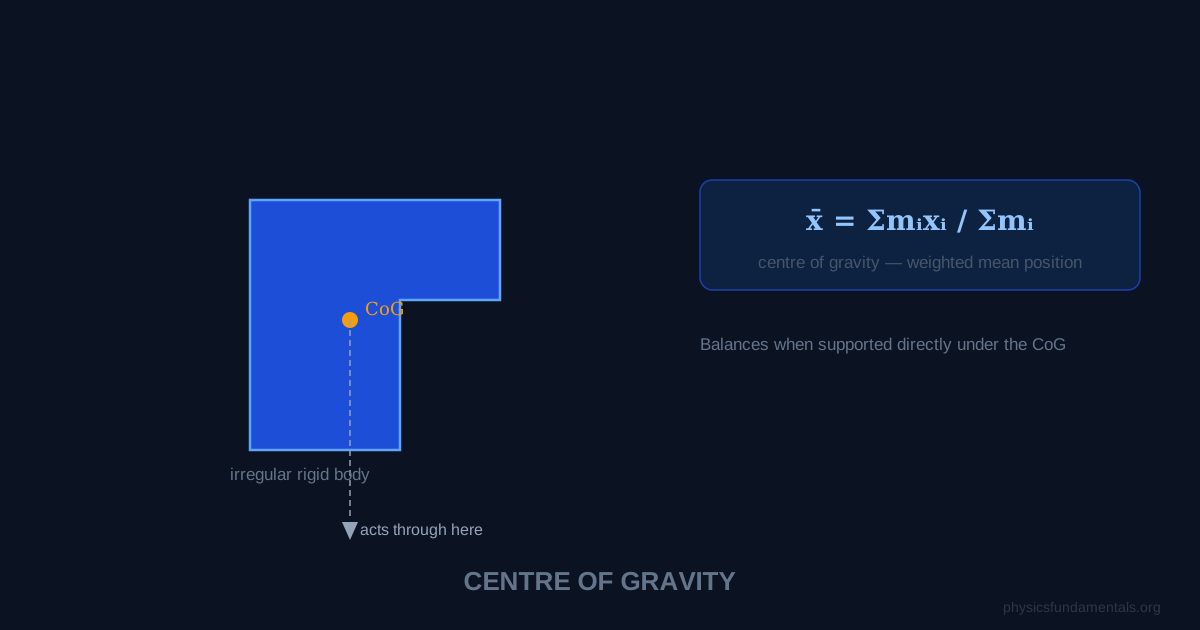
The centre of gravity (CoG) of an object is the single point through which the entire gravitational force can be considered to act. For objects in a uniform gravitational field (which includes virtually all objects near Earth's surface), the centre of gravity coincides with the centre of mass. An object balanced at its centre of gravity will remain in equilibrium — tip it slightly and it either returns to balance (stable), stays tilted (neutral), or continues to fall (unstable), depending on where the centre of gravity lies relative to the pivot.
Centre of gravity (also spelled "center of gravity") determines whether objects tip over, how vehicles corner safely, how ships stay upright, and why tall furniture needs wall anchors. Understanding it requires knowing not just where the CoG is, but what happens to it when an object tilts — and whether the resulting torque restores or topples the object.
- Centre of gravity definition and how it differs from centre of mass
- Finding CoG experimentally: suspension method
- Stable, unstable, and neutral equilibrium — the three types
- The toppling condition: when does an object fall?
- 4 worked examples including CoG of composite objects
Centre of Gravity vs Centre of Mass
Centre of mass (CoM): the weighted average position of all mass in an object. Defined purely by the mass distribution, independent of any field.
Centre of gravity (CoG): the point through which the resultant gravitational force acts on the object. Depends on both mass distribution and the local gravitational field.
In a uniform gravitational field (constant g at all points — which is an excellent approximation for any object much smaller than Earth), the CoG and CoM are at exactly the same point. For almost all A-Level and introductory physics, you can treat them as identical.
They differ only for very large objects where g varies significantly from one part of the object to another — for example, an enormous space structure extending thousands of kilometres toward Earth. For the Moon in Earth's gravity, the centre of gravity is very slightly closer to Earth than the centre of mass, which contributes to tidal locking.
Finding the Centre of Gravity Experimentally
Suspension method for a flat lamina (2D irregular shape):
- Hang the object from one edge and let it swing freely to equilibrium.
- Use a plumb line to draw a vertical line through the suspension point — the CoG must be on this line (otherwise the object would not hang in equilibrium).
- Repeat from a different suspension point, drawing a second vertical line.
- The CoG is at the intersection of the two lines.
For regular shapes, use symmetry: the CoG lies on every axis of symmetry. A uniform rod has CoG at its midpoint; a uniform rectangle has CoG at the centre; a uniform circle has CoG at its geometric centre.
Calculating Centre of Mass/Gravity
For a system of discrete masses m₁, m₂, m₃... at positions x₁, x₂, x₃...:
Apply the same formula in the y direction for 2D problems.
Types of Equilibrium
Stable equilibrium: When displaced, the object returns to its original position. The CoG rises when the object tilts, creating a restoring torque. Example: a ball in a bowl, a wide flat-bottomed object.
Unstable equilibrium: When displaced, the object continues to fall further from equilibrium. The CoG falls when the object tilts, creating a toppling torque. Example: a ball balanced on top of another ball, a pencil balanced on its tip.
Neutral equilibrium: When displaced, the object stays in its new position. The CoG neither rises nor falls when the object moves. Example: a ball on a flat surface, a cylinder lying on its side.
The Toppling Condition
An object on a flat surface will topple when the vertical line through its centre of gravity falls outside its base of support. As long as the vertical through CoG falls within the base, there is a restoring torque preventing toppling.
This explains: why racing cars have wide wheelbases and low profiles, why tall vehicles (lorries, buses) are more prone to toppling on bends, why the Leaning Tower of Pisa doesn't fall (its CoG's vertical still falls within the base), and why you lean forward when carrying a heavy rucksack (to keep your combined CoG above your feet).
The critical tipping angle θ for a rectangular block of height h and base width w:
Wide, short objects (large w/h) need a greater tilt to topple — more stable. Tall, narrow objects (small w/h) topple at small angles — less stable.
4 Worked Examples
Example 1 — CoG of two masses on a rod
Problem: A uniform rod of length 1.2 m and mass 2 kg has a 5 kg mass at one end (x = 0) and a 3 kg mass at the other end (x = 1.2 m). Find the centre of gravity. (Treat rod as uniform.)
Solution:
Rod's CoM is at x = 0.6 m. Total system:
x̄ = (5×0 + 2×0.6 + 3×1.2) / (5 + 2 + 3) = (0 + 1.2 + 3.6)/10 = 4.8/10 = 0.48 m from the 5 kg end
Example 2 — L-shaped lamina
Problem: An L-shaped uniform lamina consists of two rectangles: Rectangle A (4 cm × 2 cm) with CoM at (2, 1), mass proportional to area (8 units). Rectangle B (2 cm × 3 cm) with CoM at (1, 3.5), mass proportional to area (6 units). Find the CoM of the L-shape.
Solution:
x̄ = (8×2 + 6×1)/(8+6) = (16+6)/14 = 22/14 = 1.57 cm
ȳ = (8×1 + 6×3.5)/(14) = (8+21)/14 = 29/14 = 2.07 cm
Example 3 — Toppling angle
Problem: A uniform rectangular block is 0.3 m wide and 0.8 m tall. At what angle of tilt does it topple?
Solution:
tan(θ_tip) = (w/2) / (h/2) = w/h = 0.3/0.8 = 0.375
θ_tip = arctan(0.375) = 20.6°
The block topples when tilted more than 20.6° from vertical.
Example 4 — Stability on a slope
Problem: A uniform cube of side 0.4 m sits on a slope. What is the maximum slope angle before it topples (assuming no sliding)?
Solution:
CoG is at height h/2 = 0.2 m and offset 0 from centre. The cube topples when the vertical through CoG passes outside the downhill edge — when the slope angle equals the critical angle.
tan(θ_critical) = (half base)/(half height) = 0.2/0.2 = 1
θ_critical = arctan(1) = 45°
A cube topples at 45° — beyond that, it tips over rather than sliding.
Finding Centre of Gravity by Calculation — Extended Examples
For composite objects made of regular shapes, use the formula x̄ = Σ(mᵢxᵢ)/Σmᵢ for each component. A uniform material means mass is proportional to area (2D) or volume (3D), so mass ratios equal area or volume ratios.
Worked example — T-shaped lamina: A uniform T-shape consists of a horizontal bar (12 cm × 2 cm, CoM at y = 11 cm from bottom) on top of a vertical stem (3 cm × 10 cm, CoM at y = 5 cm from bottom). Both are the same thickness and material.
Mass of horizontal bar (proportional to area) = 12 × 2 = 24 units. CoM at y = 11 cm.
Mass of vertical stem = 3 × 10 = 30 units. CoM at y = 5 cm.
ȳ = (24 × 11 + 30 × 5)/(24 + 30) = (264 + 150)/54 = 414/54 = 7.67 cm from base
Horizontally (by symmetry if the T is symmetric): x̄ is on the axis of symmetry.
Centre of Gravity and Couples
When an object tilts, gravity still acts at the centre of gravity but the normal reaction from the ground acts at the pivot point (the tipping edge). These two forces — weight downward through CoG and normal reaction upward at the pivot — form a couple if the CoG's vertical doesn't pass through the pivot.
- Restoring couple: if the CoG vertical falls between the pivot and the object's centre, the couple tends to return the object upright. Object is in stable equilibrium.
- Toppling couple: if the CoG vertical falls outside the base (beyond the pivot point), the couple tends to rotate the object further. Object topples.
The critical condition — at the tipping point — is when the CoG vertical passes exactly through the pivot edge. The object is in unstable equilibrium and any small perturbation will cause it to topple.
Centre of Mass vs Centre of Gravity in Non-Uniform Fields
The distinction between CoM and CoG only matters when the gravitational field varies across the object. Near Earth's surface, g decreases by approximately 0.003 m/s² per kilometre of altitude — so a 1 km tall structure has a CoG very slightly lower than its CoM (the bottom, where g is slightly stronger, pulls proportionally more than the top). For a 1 km tower, the offset is about 0.1 mm — utterly negligible in engineering terms.
The distinction becomes significant for satellites and moons in orbit. The Moon's CoG is about 1–2 km closer to Earth than its CoM because Earth's gravity is stronger on the near side. This offset contributes to the tidal torque that keeps the Moon in tidal lock — always showing the same face to Earth.
Applications in Vehicle Design
Sports cars have engines mounted low and behind the front axle, seats reclined to lower the driver's CoG, and no spare tyre (eliminating weight high in the boot). Every design decision aims to lower the CoG, reducing the risk of rollovers and improving high-speed cornering stability by reducing load transfer between inside and outside tyres.
Double-decker buses carry passengers at two levels, raising the average CoG significantly. They compensate with a very wide wheelbase and heavy ballast low in the chassis. They must also reduce speed on bends — a double-decker is rated for much lower cornering speeds than a single-decker of the same length.
Shipping containers on cargo ships must be loaded carefully to avoid raising the CoG too high. Inspectors calculate the metacentric height before loading. A fully loaded ship that is top-heavy — containers stacked six high on the top deck — has a dangerously low metacentric height. Several container ship capsizings have resulted from improper loading that raised the CoG above the metacentre.
Worked Example 5 — Tilting cylinder
Problem: A uniform solid cylinder has radius 6 cm and height 20 cm. It is placed on a horizontal surface and tilted. At what angle does it topple?
Solution:
CoG is at the geometric centre: height h/2 = 10 cm above base, horizontally at the axis.
When tilted, the pivot is the lower rim edge. The CoG must stay above the base for stability.
The CoG is 10 cm high and the radius is 6 cm from centre. The critical angle is when CoG vertical passes through the rim edge:
tan(θ_tip) = r/(h/2) = 6/10 = 0.6
θ_tip = arctan(0.6) = 31.0°
The cylinder topples at 31° — noticeably less stable than a cube (which topples at 45°), because it's taller relative to its width.
Balancing and Equilibrium in Structures
Engineers designing structures always ensure that the combined CoG of the structure and its load remains within the support base under all operating conditions — including dynamic loads from wind, earthquakes, and moving equipment. The Burj Khalifa (828 m tall) is designed with a Y-shaped cross-section that keeps the CoG low relative to the width at every level, and the setbacks as height increases ensure the CoG of each section remains directly above the foundation footprint. The Eiffel Tower's lattice structure keeps most of its mass low — despite being 330 m tall, over 70% of its weight is below 50 m height, giving it a CoG at roughly 50 m and exceptional stability. Its base is 125 m × 125 m — making the stability ratio extremely favourable even in strong winds.
Exam Tips for Centre of Gravity Problems
The most common exam question types: (1) find the CoG of a composite shape by decomposition into rectangles/triangles with known centroids; (2) determine whether a tilted object will topple by checking if the vertical through CoG falls inside or outside the base; (3) find the balancing point of a non-uniform rod with added masses. For type (1), always sketch the shape, label component masses and their CoM positions, then apply x̄ = Σmx/Σm and ȳ = Σmy/Σm separately. For type (2), find the CoG height and horizontal offset from the tipping edge, then use tan(θ) = half-base/CoG height. For type (3), set the net torque about any convenient point to zero and solve for the unknown. Choosing the pivot at an unknown force eliminates that force from the equation.
When an object is removed from a larger shape (e.g. a circular hole punched from a rectangular plate), treat the removed piece as a negative mass. The CoG of the remaining shape: x̄ = (m_total × x_total − m_hole × x_hole)/(m_total − m_hole). This technique — subtraction of a shape — avoids integrating over the irregular boundary and is much faster in exam conditions. Always double-check by intuition: the CoG should shift away from where material was removed.
Frequently Asked Questions
What is the centre of gravity?
How do you find the centre of gravity of an irregular shape?
What is the difference between stable, unstable, and neutral equilibrium?
When does an object topple?
Why do racing cars have low centres of gravity?
Share this article
Written by
Physics Fundamentals Editorial Team
Written and reviewed by our team of physics educators. Content is aligned with A-Level, GCSE, AP Physics, and undergraduate curricula.
About Physics Fundamentals →