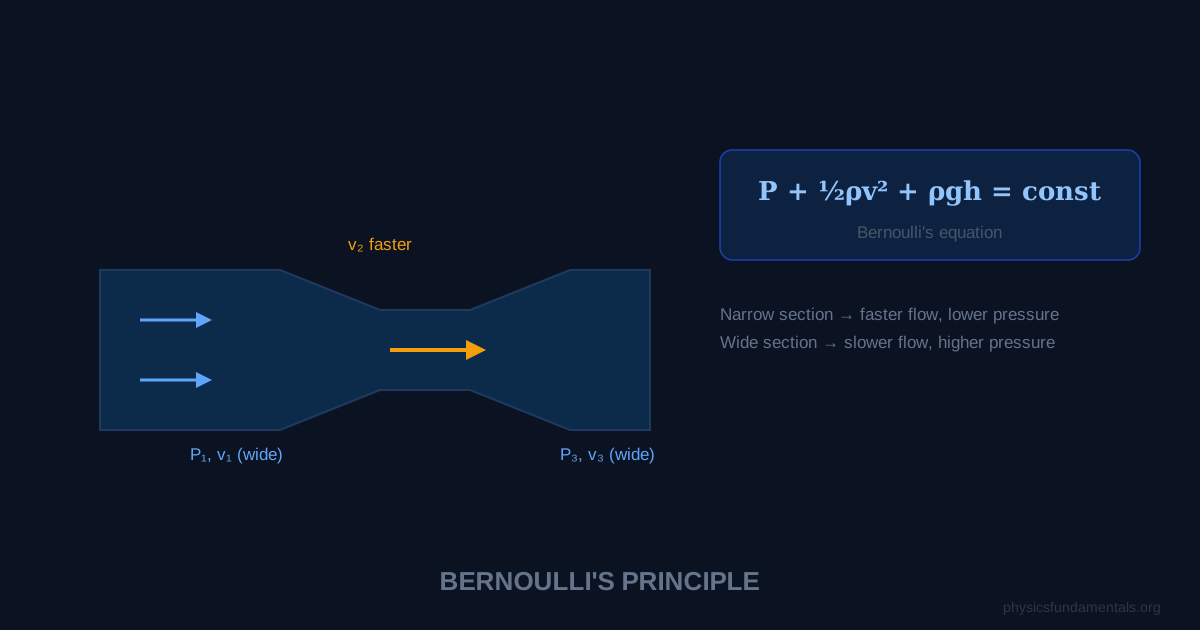
Bernoulli's principle states that for a steady, incompressible, non-viscous fluid flow, the sum of pressure, kinetic energy per unit volume, and gravitational potential energy per unit volume is constant along a streamline: P + ½ρv² + ρgh = constant. Where fluid flows faster, pressure is lower — and vice versa. This inverse relationship between speed and pressure is the basis of aerofoil lift, the Venturi meter, carburettors, and many other fluid devices.
Named after Daniel Bernoulli who published it in 1738, the principle is a direct application of energy conservation to fluids. It's often stated simply as "faster flow means lower pressure" — which is correct but can be misapplied. The principle applies along a single streamline, in steady, incompressible, non-viscous flow — conditions that real fluids approximate but don't perfectly meet.
- Bernoulli's equation: P + ½ρv² + ρgh = constant — all three terms explained
- Derivation from conservation of energy for a fluid element
- The Venturi effect and continuity equation: A₁v₁ = A₂v₂
- 4 worked examples including Venturi meters and aerofoils
- Why wings generate lift — and the common misconception about it
Bernoulli's Equation
Where:
- P = static pressure at the point (Pa)
- ½ρv² = dynamic pressure — kinetic energy per unit volume (Pa); ρ is fluid density (kg/m³), v is flow speed (m/s)
- ρgh = hydrostatic pressure — potential energy per unit volume (Pa); h is height above datum
The equation applies between any two points on the same streamline in steady, incompressible, inviscid (no viscosity) flow:
The Continuity Equation
Bernoulli's equation is almost always used with the continuity equation. For an incompressible fluid in a pipe of varying cross-section:
The volume flow rate is constant — fluid that enters a narrow section must speed up. This is why water in a hosepipe squirts faster when you partially block the end: smaller area → higher velocity (continuity) → lower pressure (Bernoulli).
Derivation from Energy Conservation
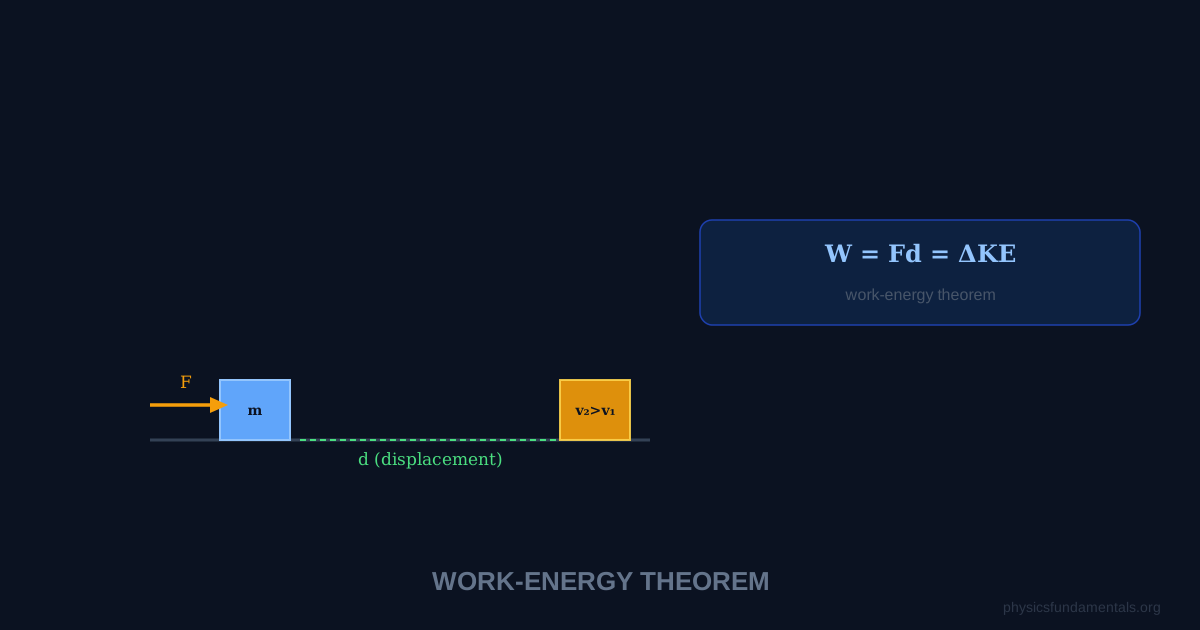
Consider a fluid element of volume ΔV, density ρ, mass Δm = ρΔV moving along a streamline. The work-energy theorem applied to the fluid element as it moves from point 1 to point 2:
Work done by pressure forces + work done by gravity = change in kinetic energy
(P₁ − P₂)ΔV + ρΔVg(h₁ − h₂) = ½ρΔV(v₂² − v₁²)
Rearranging: P₁ + ½ρv₁² + ρgh₁ = P₂ + ½ρv₂² + ρgh₂
This is exactly Bernoulli's equation — it's conservation of energy per unit volume for fluid flow.
4 Worked Examples
Example 1 — Venturi meter
Problem: Water (ρ = 1000 kg/m³) flows through a pipe. The wide section has diameter 6 cm (A₁ = 28.27 cm²) and pressure 120 kPa. The narrow section has diameter 3 cm (A₂ = 7.07 cm²) and the flow speed in the wide section is 2 m/s. Find the pressure in the narrow section. (Horizontal flow: ignore ρgh term.)
Solution:
Continuity: v₂ = A₁v₁/A₂ = (28.27/7.07) × 2 = 4 × 2 = 8 m/s
Bernoulli: P₁ + ½ρv₁² = P₂ + ½ρv₂²
P₂ = P₁ + ½ρ(v₁² − v₂²) = 120,000 + ½ × 1000 × (4 − 64)
P₂ = 120,000 + 500 × (−60) = 120,000 − 30,000 = 90,000 Pa = 90 kPa
Example 2 — Speed from pressure difference
Problem: In a horizontal pipe, the pressure difference between the wide and narrow sections is 25 kPa. The speed in the wide section is 1 m/s and the narrow section has half the area. Find the speed in the narrow section. (ρ = 1000 kg/m³)
Solution:
v₂ = 2 × v₁ = 2 m/s (from continuity, A₂ = A₁/2 → v₂ = 2v₁)
Check: ½ρ(v₂² − v₁²) = ½ × 1000 × (4 − 1) = 1500 Pa — not 25 kPa, so let's solve properly.
P₁ − P₂ = ½ρ(v₂² − v₁²) = ½ × 1000 × (v₂² − v₁²) = 25,000
v₂² − v₁² = 50; with continuity A₁v₁ = A₂v₂ and A₂ = A₁/2: v₂ = 2v₁
(2v₁)² − v₁² = 50 → 3v₁² = 50 → v₁ = 4.08 m/s, v₂ = 8.16 m/s
Example 3 — Water jet speed (Torricelli's theorem)
Problem: Water in a large tank is 3 m above a small hole in the tank's side. Find the speed at which water exits the hole. (Take the tank surface as point 1: v₁ ≈ 0, P₁ = P₂ = atmospheric.)
Solution:
Bernoulli (same pressure at surface and exit, v₁ ≈ 0):
ρgh₁ = ½ρv₂²
v₂ = √(2gh) = √(2 × 9.81 × 3) = √58.86 = 7.67 m/s
This is Torricelli's theorem — identical in form to free fall from height h.
Example 4 — Aerofoil lift pressure difference
Problem: Air (ρ = 1.2 kg/m³) flows over the top of a wing at 80 m/s and under the bottom at 60 m/s. Find the pressure difference and the lift on a 20 m² wing.
Solution:
ΔP = ½ρ(v_top² − v_bottom²) — note: higher speed on top means lower pressure on top
ΔP = ½ × 1.2 × (80² − 60²) = 0.6 × (6400 − 3600) = 0.6 × 2800 = 1680 Pa
Lift = ΔP × A = 1680 × 20 = 33,600 N
Why Wings Generate Lift — and the Misconception
The common explanation — "air over the top of a wing has further to travel and must speed up to meet air from below at the trailing edge" — is wrong. Air parcels separated at the leading edge don't need to meet again at the trailing edge. The actual explanation is that the wing's shape and angle of attack deflect airflow downward (Newton's third law: the wing pushes air down, air pushes wing up), and the pressure distribution predicted by Bernoulli is consistent with this.
Bernoulli gives the correct pressure difference and lift force — the physics is right. The "equal transit time" explanation of why air speeds up is wrong, but the conclusion (faster air on top, lower pressure, net upward force) is correct.
Torricelli's Theorem — Efflux Speed from a Tank
Torricelli's theorem is a direct consequence of Bernoulli's equation applied to a large open tank with a small hole in its side. Taking point 1 at the water surface (large area, so v₁ ≈ 0, pressure P_atm) and point 2 at the exit hole (also P_atm):
This is identical to the speed of an object falling freely from height h — a remarkable coincidence that shows energy conservation governing both. A tank 4 m deep with a hole at the bottom produces an exit jet at √(2 × 9.81 × 4) = 8.86 m/s. Torricelli published this result in 1643, more than 40 years before Newton's laws and nearly a century before Bernoulli's general equation.
Pitot Tubes and Airspeed Measurement
Aircraft measure airspeed using a Pitot tube — a forward-facing tube that brings the incoming air to rest, creating a stagnation point. Bernoulli's equation between the free-stream (speed v, pressure P) and the stagnation point (speed 0, pressure P₀):
The pressure difference P₀ − P (stagnation pressure minus static pressure) is measured by a differential pressure sensor. For a commercial airliner at cruising altitude, where ρ_air ≈ 0.4 kg/m³ and v ≈ 250 m/s: P₀ − P = ½ × 0.4 × 250² = 12,500 Pa — about 12% of atmospheric pressure, easily measurable. All commercial aircraft carry at least two Pitot-static systems for redundancy.
Bernoulli's Equation and the Continuity Equation Together
In pipe flow problems, you almost always need both equations simultaneously. The continuity equation A₁v₁ = A₂v₂ tells you how speed changes; Bernoulli tells you how pressure changes in response. A worked sequence:
Problem: Water (ρ = 1000 kg/m³) flows through a horizontal pipe that narrows from diameter 8 cm to 4 cm. The inlet pressure is 200 kPa and inlet flow speed is 1.5 m/s. Find the outlet pressure.
Solution:
A₁ = π(0.04)² = 5.027 × 10⁻³ m²; A₂ = π(0.02)² = 1.257 × 10⁻³ m²
Continuity: v₂ = A₁v₁/A₂ = (5.027/1.257) × 1.5 = 4 × 1.5 = 6.0 m/s
Bernoulli: P₂ = P₁ + ½ρ(v₁² − v₂²) = 200,000 + ½ × 1000 × (1.5² − 6²)
P₂ = 200,000 + 500 × (2.25 − 36) = 200,000 − 16,875 = 183,125 Pa ≈ 183 kPa
Limitations of Bernoulli's Equation
Bernoulli's equation is powerful but has four key assumptions that must hold for it to give accurate results:
- Steady flow: conditions at every point are constant in time. Turbulent flow, oscillating flow, or accelerating flow invalidates the equation.
- Incompressible fluid: density is constant. Valid for liquids and slow-moving gases (Mach number below ~0.3). Supersonic flow requires compressible flow equations.
- Inviscid (no viscosity): viscous losses are ignored. Valid for low-viscosity fluids (water, air) in short pipe sections, but fails for oil in long pipes where viscous losses (modelled by the Darcy-Weisbach equation) dominate.
- Along a streamline: the equation applies between two points on the same streamline. To compare points on different streamlines you need the full pressure field, which requires solving the Navier-Stokes equations.
Common Misconceptions About Lift
The "equal transit time" explanation of wing lift — that air over the longer upper surface must travel faster to "catch up" with air going under — is physically wrong. Air parcels separated at the leading edge don't meet again at the trailing edge; the upper surface parcel arrives first, not simultaneously. The real reason for faster flow over the top of a wing is the wing's geometry and angle of attack, which deflects streamlines upward before the wing and downward after — by Bernoulli, the accelerated flow on the curved upper surface produces lower pressure, and by Newton's third law, the wing pushes air downward so air pushes the wing upward. Both explanations give the same answer but only the latter is physically correct.
Worked Example 5 — Firefighting hose nozzle
Problem: A fire hose has diameter 7 cm and carries water at 3 m/s and 400 kPa gauge pressure. It narrows to a nozzle of diameter 2.5 cm. Find the exit speed and gauge pressure at the nozzle. (ρ = 1000 kg/m³)
Solution:
A₁ = π(0.035)² = 3.848 × 10⁻³ m²; A₂ = π(0.0125)² = 4.909 × 10⁻⁴ m²
v₂ = v₁ × A₁/A₂ = 3 × (3.848/0.4909) = 3 × 7.84 = 23.5 m/s
P₂ = 400,000 + ½ × 1000 × (9 − 552.25) = 400,000 − 271,625 = 128,375 Pa ≈ 128 kPa gauge
Exam Technique: Choosing the Right Two Points
The most common mistake in Bernoulli problems is choosing the wrong two points. Always ask: are both points on the same streamline? Do I know enough variables at each point? The standard strategy:
- Large reservoir / tank surface: velocity ≈ 0 (surface barely drops if the hole is small), pressure = atmospheric. Use as point 1.
- Pipe exit / free jet: pressure = atmospheric. Use as point 2 to find exit velocity.
- Pipe narrowing (Venturi): use continuity to find both velocities, then Bernoulli for the pressure difference.
- Stagnation point (Pitot tube): velocity = 0, pressure = stagnation pressure P₀.
The ρgh term is often negligible for horizontal pipes or when height changes are small. Drop it only when you can confirm Δh × ρg is negligible compared to ½ρΔv² or ΔP. For water flowing at several m/s, a 1 cm height change gives ρgΔh = 1000 × 9.81 × 0.01 = 98 Pa — often negligible against dynamic pressure differences of thousands of pascals.
Applications in Nature and Engineering
Prairie dog burrows have openings at different heights. Wind flowing over the higher mound travels faster, creating lower pressure there. The pressure difference drives ventilation airflow through the burrow without any fan — the animals exploit Bernoulli's principle instinctively.
Carburettors in petrol engines use a Venturi throat: air accelerates through a narrow section, creating low pressure that draws fuel from a jet. The fuel-air mixture then flows into the cylinders. Modern fuel-injection systems have largely replaced carburettors, but the underlying Bernoulli physics remains relevant in turbochargers and superchargers.
Atomisers and spray bottles work on the same Venturi principle. Squeezing the handle forces air over a tube dipping into the liquid; the fast-moving air creates low pressure that draws liquid up the tube and disperses it as a mist. Perfume atomisers, paint spray guns, and many medical nebulisers all use this effect.
The Magnus effect — the curved trajectory of a spinning ball — also arises from Bernoulli's principle. A spinning ball drags a layer of air around with it, making airflow faster on one side (where spin and forward motion align) and slower on the other. The pressure difference deflects the ball's path, producing the curve a skilled cricketer, footballer, or baseball pitcher deliberately induces.
Bernoulli and the Continuity Equation — Summary
Every Bernoulli calculation in a pipe involves both equations working together. Continuity constrains the speeds; Bernoulli links speeds to pressures. Neither is sufficient alone. Always write both equations before substituting numbers, and always check that your pressure answer makes physical sense — narrower section means higher speed and lower pressure.
When solving exam problems, always state which two points you are applying Bernoulli between, write out the full equation with all six terms before cancelling any, and justify each cancellation (e.g. "pressure at open surfaces = atmospheric, so P₁ = P₂" or "large reservoir so v₁ ≈ 0"). Examiner mark schemes award method marks for showing these steps even if the arithmetic is wrong.
Frequently Asked Questions
What is Bernoulli's principle?
What is the continuity equation?
Why does faster flow mean lower pressure?
When does Bernoulli's equation NOT apply?
What is the Venturi effect?
Share this article
Written by
Physics Fundamentals Editorial Team
Written and reviewed by our team of physics educators. Content is aligned with A-Level, GCSE, AP Physics, and undergraduate curricula.
About Physics Fundamentals →